
1868 – 1918·Feast July 17
St. Nicholas II of Russia and Family
Royal Passion-Bearers of the Russian Orthodox Church
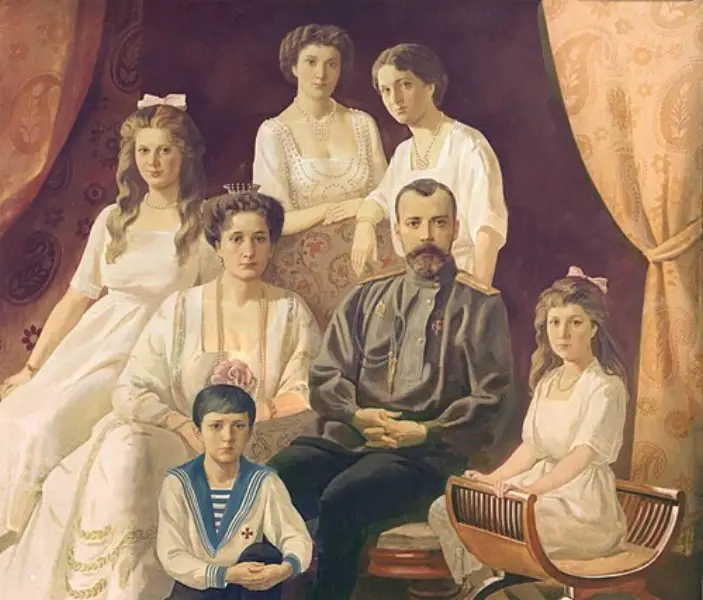
Overview
The glorification of the Romanovs — canonization, as it is named in Orthodox usage — raised to the altars the final imperial household of Russia: Tsar Nicholas II with Tsarina Alexandra and their son and daughters: Olga, Tatiana, Maria, Anastasia, and Alexei. On 17 July 1918 the Bolsheviks put the whole family to death at the Ipatiev House in Yekaterinburg; the house was later demolished, and the Church on Blood now stands on the site with its altar placed directly over the place of execution. The Russian Orthodox Church Outside of Russia acted first, canonizing the tsar's younger brother Grand Duke Michael Alexandrovich and his secretary Nicholas Johnson — both killed at Perm on 13 June 1918 — on 1 November 1981. On 15 August 2000 the Moscow Patriarchate canonized Nicholas II and his immediate family, citing their humbleness, patience, and meekness during imprisonment and execution. In 2016 the family's physician Eugene Botkin was added as a righteous passion bearer. Both canonizations provoked controversy: critics judged Nicholas a weak ruler whose failures brought the revolution, others objected that the family had not died for the faith, and ritual-murder narratives circulated that mainstream historians reject. Believers nonetheless attribute healings and conversions to prayers to the family.
The Complete Life
Passion-Bearers, Not Martyrs
At the heart of the Romanov glorification lies a careful theological distinction. The family were officially designated passion-bearers by the August 2000 Council — Christians who accepted suffering and death in a Christ-like spirit without having been killed specifically for the faith — yet Church publications, icons, and popular devotion have persistently called them martyrs all the same. The distinction mattered greatly to the canonizations' opponents. Some rejected the classification of the family as new martyrs precisely because, in their view, the Romanovs were not put to death on account of their religious faith. A priest of the Russian Orthodox Church Abroad answered this objection by recalling that martyrdom in Russian church tradition is not weighed against whatever merits or faults the martyr may happen to have had; what counts is the reason for which the person was put to death. Whether the category fits was thus bound up with how the killing itself was interpreted. Behind the argument over words stood the family's own conduct in captivity: it was for their humbleness, patience, and meekness under imprisonment and execution, rather than for any public confession of faith, that the Moscow Patriarchate said it elevated them. Since the late twentieth century believers have attributed healings from illness and conversions to the Orthodox Church to prayers addressed to Maria and Alexei and to the rest of the family, giving the devotion a living, devotional substance that the debates over categories never quite touched.
§ Controversy
The Ipatiev House
The final chapter of the family's life unfolded in captivity in the Urals. Nicholas, Alexandra, their five children, and their small household were held by the Bolsheviks at the Ipatiev House in Yekaterinburg, a city that had become a centre of Red power during the civil war. There, on the night of 17 July 1918, the family was murdered. The tsar's younger brother, Grand Duke Michael Alexandrovich, had already been killed at Perm on 13 June 1918 together with his secretary, Nicholas Johnson. The site of the Yekaterinburg killing became a place of memory almost against the will of the state that carried it out: the Ipatiev House was eventually demolished, and in its place rose the Church on Blood, whose altar stands over the exact spot of the execution. Nearby, at the Romanov Monastery by Ganina Yama — where the family's remains were found — stands the Church of St. Nicholas. The architecture of commemoration thus encircled the event itself, marking in stone and gold the place where the last emperor of Russia, his empress, and their children met their end, and preparing, long before any council met, the ground on which their eventual glorification would be built.
§ Canonization
Two Acts of Glorification
The elevation of the Romanovs to sainthood came in stages, from two branches of a divided church. The Russian Orthodox Church Outside of Russia, the émigré body formed after the revolution, acted first: on 1 November 1981 it canonized Grand Duke Michael Alexandrovich and his secretary Nicholas Johnson, the two men murdered at Perm in June 1918. The Moscow Patriarchate, working within the Soviet Union and then post-Soviet Russia, took a longer path. On 15 August 2000 it proclaimed Nicholas II and those nearest him — Alexandra together with the five children — to be saints, citing their humbleness, patience, and meekness during imprisonment and execution at Bolshevik hands. The family were designated passion-bearers, the category the Russian tradition reserves for those who suffer evil without being killed for the faith as such. A further act followed on 3 February 2016, when the Bishops' Council of the Russian Orthodox Church numbered among the saints the family's own doctor, Eugene Botkin, as a righteous passion bearer, honouring the layman who had stayed with his patients to the end. Together these acts gathered into the calendar the last emperor, his household, and those closest to them in death, completing at the level of formal veneration what pilgrimage to the execution site had already begun.
§ Canonization
A Contested Devotion
Both canonizations drew opposition from within the churches that performed them. Critics in 1981 pointed to Nicholas II's perceived weaknesses as a ruler and argued that his decisions had led to the Bolshevik Revolution and to immense damage to Russia and its people. Religious leaders in both churches objected that he had been a poor emperor whose incompetence brought suffering on his people, making him at least partly responsible for his own death and that of his wife and children; his kindness as a private man, a faithful husband, and an affectionate father could not, in their judgment, outweigh the record of his governance. Others objected to the classification of the family as new martyrs on the ground that they were not killed for their faith. A darker controversy attended the rhetoric that surrounded the émigré canonization: some observed that the Russian Orthodox Church Abroad appeared to blame Jewish revolutionaries for the deaths and to equate a political assassination with ritual murder, a reading encouraged by the fact that Yakov Yurovsky, the executioner, was Jewish. In 2017 Russia's Federal Investigative Committee, prompted by the Church, opened an investigation into ritual-killing claims that mainstream historians associate with antisemitism. Devotional extremes followed as well: some members of the Church Abroad question the authenticity of the family's remains, while the fringe movement of Tsar-worshippers venerates Nicholas as the Tsar-Redeemer and calls on Russians to atone for the murders.
§ Controversy
Timeline
- 18 May 1868
Nicholas II is born at the Alexander Palace, Tsarskoye Selo.
§ Introduction
- 6 Jun 1872
Alexandra Feodorovna is born at the New Palace in Darmstadt, Hesse.
§ Introduction
- 13 Jun 1918
Grand Duke Michael Alexandrovich, the tsar's younger brother, and his secretary Nicholas Johnson are murdered at Perm.
§ Canonization
- 17 Jul 1918
The Bolsheviks shoot Nicholas II, Alexandra and their five children in the Ipatiev House at Yekaterinburg.
§ Introduction
- 1 Nov 1981
The Russian Orthodox Church Outside Russia canonizes Grand Duke Michael and Nicholas Johnson.
§ Canonization
- 15 Aug 2000
The Russian Orthodox Church announces the canonization of Nicholas II and his family for their humbleness, patience and meekness under captivity.
§ Canonization
- 3 Feb 2016
The Bishops' Council of the Russian Orthodox Church canonizes the tsar's physician Eugene Botkin as a righteous passion bearer.
§ Canonization
- 2017
Prompted by the Church, Russia's Federal Investigative Committee opens an inquiry into claims the deaths were ritual killings.
§ Controversy
In Their Own Words
humbleness, patience and meekness
The Record
- Canonization
- Canonized on 1 November 1981 by the Russian Orthodox Church Outside of Russia and on 15 August 2000 by the Moscow Patriarchate
Prayer
Bibliography
Show 7 sources
- "Nicholas II And Family Canonized For 'Passion'". The New York Times, 15 August 2000.
- "On This Day in 1918 the Romanov Family Was Killed". The Moscow Times, 17 July 2019.
- Massie, Robert K. The Romanovs: The Final Chapter. Random House, 1995, pp. 134-135.
- King, Greg, and Wilson, Penny. The Fate of the Romanovs. John Wiley and Sons.
- Serfes, Nektarios (2000). "Miracle of the Child Martyr Grand Duchess Maria". The Royal Martyrs of Russia.
- "Определение Освященного Архиерейского Собора Русской Православной Церкви об общецерковном прославлении ряда местночтимых святых". Патриархия.ru.
- Yegorov, Oleg (2018). "Who among the Romanovs survived the Red Terror a century ago?". Russia Beyond, 1 August 2018.
Profile text adapted from the Wikipedia article, licensed CC BY-SA 4.0.
Pray with this saint every day
Save St. Nicholas II of Russia and Family to your favorites, read the full profile, and get feast-day reminders in the Saints app.
Get the Saints AppFree on the App Store for iPhone and iPad