
fifth century – 490·Feast October 15
St. Canus Natus
Fifth-century hermit and Bishop of Marseille
Overview
Canus Natus was a fifth-century saint of Provence whose Latin name, meaning 'he was born old', preserves the tradition that he came into the world already white-haired, a feature his contemporaries read as a sign of wisdom. Drawn to solitude, he lived as a hermit at Sauzet, a place the Provençal scholar Christophe de Villeneuve-Bargemon later described as a wilderness of willows. A miracle recorded by Henri François Xavier de Belsunce de Castelmoron, an eighteenth-century bishop and historian of Marseille, relates that a dead reed the hermit used as a walking cane was restored to green life; this sign is said to have moved him to take on the governance of the church of Marseille during the closing decades of the fifth century. As a bishop he set himself firmly against paganism and heresy. On retiring from office he withdrew again to Sauzet, where he died on 15 October 490. The hamlet that formed around his grave took his name and grew into the present village of Saint-Cannat, and the Église Saint-Cannat in Marseille, erected between 1526 and 1619, stands in his honour.
The Complete Life
A Child Born Old
Only a handful of details survive about the origins of Canus Natus, and nearly all of them gather around one arresting image. He was born in the fifth century, in the Gallo-Roman south of what is now France, and the tradition transmitted by the local sources insists that his hair was white from the moment of his birth. In the outlook of late antiquity this was not a medical curiosity to be explained but a sign to be interpreted: white hair belonged to the old, and the old were presumed wise, so an infant who bore it was thought to have been marked out by heaven. The tradition is carried by several independent local authorities, including the antiquarian Christophe de Villeneuve-Bargemon and the historian-bishop Belsunce de Castelmoron, whose works on Provence and on the church of Marseille preserved the memory of the saint for later generations. The point is sealed in his very name. The Latin phrase 'canus natus' means 'he was born old', and the words clung to him so firmly that they became the name by which Provençal devotion remembers him. Even the arms of the village that grew up around his resting place, Saint-Cannat, were long associated with his memory. What the sources do not give is a family, a teacher, or a childhood; the legend begins, as it were, in medias res, with a child already old and a life already pointed toward God.
§ Early life
Hermiage at Sauzet and the See of Marseille
The first movement of his adult life was away from the world. Canus Natus became a hermit at a place called Sauzet, which Christophe de Villeneuve-Bargemon, writing in the early nineteenth century, characterised as a 'desert' clothed with willow trees — the conventional vocabulary of early monastic literature for any wild and solitary spot. There, in poverty and prayer, the hermit of Sauzet lived out a vocation of penance. The sources then attach a miracle to his name. According to Henri François Xavier de Belsunce de Castelmoron, whose history of the church of Marseille appeared in 1747, the reed that the hermit used as a walking cane — a dry, dead stalk — was brought back to life and stood green again. The wonder was read as a divine confirmation, and on its account Canus Natus took up the office of bishop at Marseille during the latter part of the century. The pattern is a familiar one in the lives of the Gallo-Roman saints: the solitary is called out of his retreat, sometimes reluctantly, to govern and defend the church. His episcopate was marked by firm resistance. He set his face against the surviving paganism of the countryside and against the heresies that troubled the church of his day, discharging, so the local tradition holds, the duties of a shepherd with the austerity he had learned in the willows of Sauzet.
§ Religious vocation
Saint-Cannat and the Memory of the Hermit
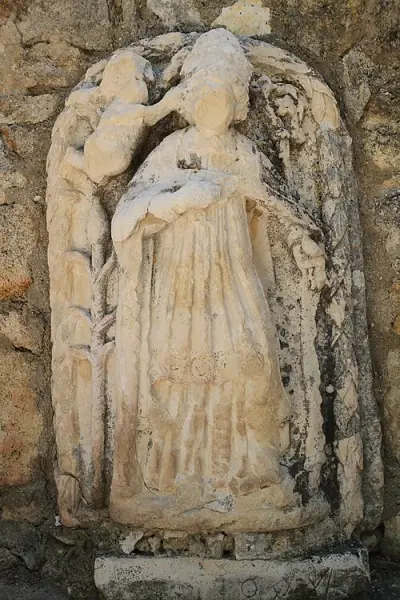
When his time as bishop was done, Canus Natus did what so many of the early saints of Gaul did: he returned to the solitude he had left. He came back to Sauzet and settled there again, and it was at Sauzet that he died on 15 October 490. His body was buried at the place of his retreat, and the grave became a point of gathering. In time a hamlet formed around it, and the hamlet took the name of the man buried there, becoming in the modern era the village of Saint-Cannat in the Bouches-du-Rhône. A statue of the saint still stands there as an object of pilgrimage. His memory reached beyond the village as well. In Marseille itself, the city he had governed as bishop, the Église Saint-Cannat was raised in his honour between 1526 and 1619, a church that carries his name into the present day. The outline of his life that survives is thin — a birth, a hermitage, a miracle with a reed, an episcopate, a death — yet it proved durable enough to shape the geography of Provence, leaving the saint's name fixed both to a village inland and to a church in the great port city on the Mediterranean.
§ Death and legacy
Timeline
- 15 Oct 490
Dies at Sauzet, where he had retired, and is buried there; the hamlet that grew around his grave is now Saint-Cannat.
§ Death and legacy
- 1526
The Église Saint-Cannat in Marseille, named in his honour, begins construction and is not finished until 1619.
§ Death and legacy
In Their Own Words
desert
The Record
- Symbols
- White hair from birth·A dead reed restored to green, used as a cane
- Canonization
- Pre-congregation; venerated from antiquity in Provence, with no formal canonization recorded in the sources
Prayer
Bibliography
Show 5 sources
- Christophe de Villeneuve-Bargemon, Statistique du département des Bouches-du-Rhône, Ricard, 1824, p. 951
- Henri François Xavier de Belsunce de Castelmoron, L'antiquité de l'Église de Marseille, et la succession de ses évêques, Ve. J.P. Brebion, 1747, pp. 201-206
- Variétés religieuses; ou, choix de poésies provençales, avec notes, Aix-en-Provence: Makaire, 1860, pp. 165-180
- Saint-Cannat Official website: Origins of the Bishops of Marseille (archived 2014-08-19)
- Aix-en-Provence Information Office (archived 2015-04-05)
Profile text adapted from the Wikipedia article, licensed CC BY-SA 4.0.
Pray with this saint every day
Save St. Canus Natus to your favorites, read the full profile, and get feast-day reminders in the Saints app.
Get the Saints AppFree on the App Store for iPhone and iPad