
c. 1042 – 1086·Feast July 10
St. Canute IV of Denmark
King of Denmark, martyr, and patron of Denmark
Overview
Canute IV, called Canute the Holy or Saint Canute, was King of Denmark from 1080 until his death in 1086. Born around 1042 into the numerous progeny of Sweyn II Estridsson, he first appears in the record as a raider on his father's 1069 expedition against England and again as a leader of the attack of 1075. When his brother Harald III was elected king, Canute went into exile in Sweden, returning to succeed Harald on 17 April 1080. He married Adela, daughter of Count Robert I of Flanders, by whom he had a son, Charles, and twin daughters. An ambitious and devout ruler, Canute strengthened the Danish monarchy and championed the Church: he enforced the collection of tithes, demanded strict observance of church holidays, and gave lavishly to the churches of Dalby, Odense, Roskilde, and Viborg, and above all to Lund, to which he granted vast lands in 1085 while founding its cathedral school. Claiming the English crown as grandnephew of Canute the Great, he assembled a great fleet in 1085 that never sailed; the ensuing discontent fed a peasant revolt, and on 10 July 1086 rebels slew Canute before the altar of St. Alban's Priory in Odense. Canonized in 1101 by Pope Paschal II, he was the first Danish king to become a saint and is the patron of Denmark.
The Complete Life
A Prince of the House of Estridsson
Canute entered the world around 1042, one among Sweyn II Estridsson's many sons, and — like most of that brood — not a queen's child but an unknown mistress's. The Estridsen dynasty to which he belonged had only recently supplanted the line that had ruled Denmark and England together, and its princes were bred to war and sea-power as a matter of course. The written record first notices him aboard his father's 1069 expedition against England — the classic demonstration of Danish sea power in the generation after the Norman Conquest. Six years on, the Anglo-Saxon Chronicle lists him among the commanders of a second English expedition in 1075; homeward bound, the Danish fleet called at Flanders, a county whose enmity toward William I made it Denmark's natural friend. Beyond the western seas, the skald Kálfr Mánason credits him with successful campaigns to Sember and Ester. The pattern of these years — England, Flanders, the Baltic — foreshadows the geography of his reign. He was, besides, a claimant in waiting: grandnephew of Canute the Great, whose North Sea realm of England, Denmark, and Norway endured to 1035 — he grew up in a house that never forgot that realm and viewed its English crown as stolen goods. When Sweyn died and Canute's brother Harald III was elected king, Canute went into exile in Sweden, possibly involved in active opposition to Harald, until Harald's death on 17 April 1080 opened his way home.
§ Life
King and Churchman
Canute took the throne on 17 April 1080 and soon showed himself at once intensely ambitious and intensely devout. His accession brought a marriage to Adela, daughter of Count Robert I of Flanders, tying Denmark to the power that had long sheltered its fleets; of the union came a son, Charles, born in 1084 and destined to rule Flanders a generation later, and twin daughters arriving shortly before their father's death. The programme within Denmark was an alliance of throne and altar. Canute raised the church's authority in the kingdom and insisted that church holidays be kept with austerity; he showered gifts on the churches of Dalby, Odense, Roskilde, and Viborg, and on Lund above all; and, the Church's constant champion, he worked to make the tithe actually paid. The calculation was as shrewd as it was pious: a church thus enriched became a mighty ally, and that ally in turn undergirded the king's own standing. The crown of the policy arrived in May 1085 with a donation letter to the unfinished Lund Cathedral, bestowing extensive estates in Scania, Zealand, and Amager — property gathered largely through payments from outlaws purchasing pardon — together with the founding of the cathedral school at Lund. Its clergy gained wide powers to tax and to fine the peasantry of those lands, though the king kept for himself the right of pardon, the fining of those who ignored his leding summons, and transport for his retinue.
§ King of Denmark
The Invasion That Never Sailed
Ambition carried Canute beyond his own kingdom's shores. Grandnephew of Canute the Great, whose North Sea realm had embraced England, Denmark, and Norway down to 1035, he held the English crown to be his by right and looked on William the Conqueror as a thief who had taken it. Accordingly, in 1085, backed by his father-in-law Count Robert and by Olaf III of Norway, he drew up plans for invasion and summoned the host in leding to the Limfjord. The armament never put to sea. Holding Canute back was Henry IV, the Holy Roman Emperor, and the danger he posed at Schleswig: Denmark and Flanders stood on bad terms with Henry, whose enemy Hermann of Salm had taken shelter in Denmark, and an imperial attack seemed to the king a live possibility. Meanwhile the men of the fleet — peasant warriors who needed to bring in the harvest — grew restless in the waiting and chose Canute's brother Olaf, the future Olaf I of Denmark, to plead their case. The move kindled the king's suspicion; Olaf was seized and shipped off to Flanders. In the end the leding melted away and the peasants went home to their fields — but the humiliation prepared the rising that would cost Canute his life. In the judgment of the historian Niels Lund, the enterprise that never sailed marked the Viking Age's end.
§ Planned attempt on England
The Piety of a Stern King
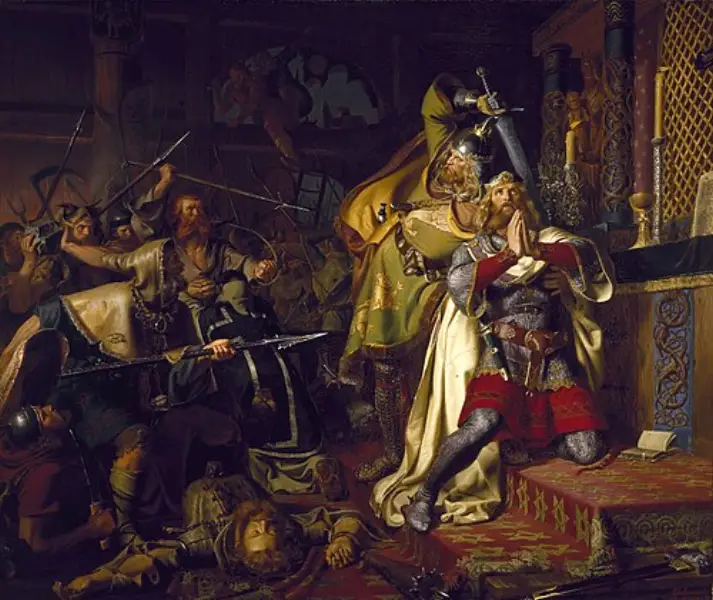
The devotion of Canute was the devotion of a king who understood the Church as the one institution capable of ordering his realm. The king's personal religion shows itself in small, stubborn particulars: church holidays kept strictly by royal command and not merely by exhortation; the tithe collected as a duty, not an optional kindness; endowment after endowment flowing to Dalby, Odense, Roskilde, and Viborg, and to Lund before all, the see he was building into the ecclesiastical capital of the realm. His legislation wore the same double face of piety and protection: by statute he shielded freed thralls, foreign clergy, and foreign traders alike, stretching a Christian king's peace over those with the least standing to invoke it. Yet the same energy that built up the Church pressed hard on the people. By edict he drew to the crown the ownership of land held in common, the claim to wrecked ships' cargo, and the inheritance of foreigners and of the kinless when they died — pretensions no Danish king had voiced before, and ones that bred deep resentment. When the end came, it found him at prayer: he had taken refuge with his men inside the wooden St. Alban's Priory at Odense, and he died before its altar, facing his killers — as a later forensic examination would suggest — without a struggle. The piety of Canute was not gentle, but it was entire.
§ King of Denmark
Death Before the Altar
The country rose before the fleet of 1085 could gather again. In the opening weeks of 1086 rebellion broke out among the peasantry of Vendsyssel, the district where the king then was. Canute fled — first to Schleswig, then across to Odense, seeking safety first in distance and then in sanctuary. There, on 10 July 1086, the king and his following shut themselves inside the wooden priory of St. Alban at Odense. The insurgents broke into the church and cut him down, together with his brother Benedict and seventeen companions, in front of the altar. Ælnoth of Canterbury, the chronicler, says the fatal stroke was a lance driven into the flank. Modern forensic eyes have corrected the ancient account: a CT examination in 2008 established that the king was right-handed and slight of frame, and that the blow which killed him entered by way of the abdomen and reached the sacrum — not the flank at all. The scan likewise found no sign that he defended himself against several attackers, evidence that can be read as supporting the account in which he awaited death without resistance. His brother Olaf — the unwilling emissary of the impatient fleet, and only recently the king's prisoner — followed him on the throne as Olaf I of Denmark, under a reign whose harvest failures would be remembered as a verdict on the killing.
§ Death
The First Danish Saint
A king slain at an altar, and a king who had spent his strength on the Church's behalf, passed at once into the category of the holy. Under Olaf, his brother and successor, harvests failed in Denmark, and the failure was understood as heaven's answer to the sacrilege of killing a king within a church. Miracles were soon reported at the grave, and efforts to have him canonized were under way already in Olaf's own reign. Rome gave the answer: on 19 April 1101, moved by envoys sent by Eric I of Denmark, Pope Paschal II confirmed the cult that had formed around Canute, and the king was declared a saint — the first Dane ever so honoured. The Catholic Church keeps his feast on 10 July, the day of his death in the Odense priory. In 1300 his bones, and those of Benedict his brother, were placed in Saint Canute's Cathedral at Odense, the great church raised in his name, where his remains are exhibited to this day. Devotion travelled fast and far. Pilgrims made their way to the Odense tomb, where many were said to have been healed of their diseases; Ælnoth of Canterbury, an English monk, composed his life and carried his fame to England; the Benedictine house at Odense served as the cult's centre, and in Denmark its popularity crested in the 1120s and 1130s. In Sweden and Finland his memory mingled with St. Knut's Day, which was in fact kept for his nephew Canute Lavard.
§ Canonization
Tyrant, Just King, and National Saint
Judgments on Canute's reign have shifted from age to age: to some he was a violent sovereign who ground down his own subjects; to others a hard but even-handed ruler, devoted to the Roman Catholic Church and prepared to defend justice without sparing himself. Popular he never quite was, as saints go, in Denmark — yet his sainthood clothed the Danish monarchy in an aura of divine legitimacy it had never owned before. Why the rising that killed him broke out remains unknown; guesses have pointed to the fines levied on peasants who failed the leding of 1085, as the Chronicon Roskildense would have it, or to the rigour of his tithe policy. His monuments are striking. The donation letter of 1085 for Lund Cathedral stands as the oldest comprehensive text Denmark possesses, opening a broad view of post-Viking society, and it may have aimed — as Sweyn II had wished — at creating a Danish archdiocese at Lund, accomplished in 1104. At Næstved Church a beautiful statue of the saint survives, with a screen showing scenes of his life that dates from the fifteenth century. His blood ran on into European history: Charles, his son, ruled Flanders from 1119 to 1127 as Charles the Good and, like his father before him, was cut down in a church by rebels at Bruges, afterwards receiving beatification. His name has even reached modern Spain, where the feast of San Canuto has been taken up in jest by advocates of cannabis legalisation, the Spanish word for a marijuana cigarette happening to match the saint's.
§ Legacy
Timeline
- 1042
Born around this year, one of the many sons of Sweyn II Estridsson by an unknown mistress.
§ Life
- 1069
First noted in the record as a member of Sweyn's raid on England.
§ Life
- 1075
Led another raid against England; the returning fleet stopped in the County of Flanders, a natural Danish ally against William I.
§ Life
- 17 Apr 1080
On the death of his brother Harald III he succeeds to the throne of Denmark and marries Adela, daughter of Count Robert I of Flanders.
§ Life
- 1084
His son Charles, the later Count of Flanders, was born; twin daughters followed shortly before his death.
§ Life
- May 1085
Writes a donation letter granting Lund Cathedral extensive estates in Scania, Zealand and Amager, and at the same time founds Lund Cathedral School.
§ King of Denmark
- 1085
Plans an invasion of England with Robert of Flanders and Olaf III of Norway and calls his fleet to the Limfjord; it never sets sail.
§ Planned attempt on England
- 1086
A peasant revolt breaks out in Vendsyssel while he is staying there; he flees first to Schleswig and then to Odense.
§ Death
- 10 Jul 1086
Rebels storm St. Alban's Priory in Odense and kill Canute, his brother Benedict and seventeen followers before the altar.
§ Death
- 19 Apr 1101
Pope Paschal II, persuaded by envoys of Eric I, confirms the cult of Canute and canonizes him, the first Dane so honoured.
§ Canonization
- 1104
The Danish Archdiocese of Lund, which Canute's donation may have aimed to establish, is finally achieved.
§ Legacy
- 1119
His son Charles becomes Count of Flanders, ruling as Charles the Good until 1127.
§ Legacy
- 1300
His bones, with those of his brother Benedict, are interred in Saint Canute's Cathedral at Odense, where they remain on display.
§ Canonization
- 2008
A CT scan shows Canute was right-handed and slender, and points to death from a weapon thrust entering the abdomen and reaching the sacrum.
§ Legacy
The Record
- Major works
- Donation letter to Lund Cathedral (1085)·Lund Cathedral School (foundation)
- Patron of
- Denmark
- Canonization
- Canonized on 19 April 1101 by Pope Paschal II, the first Dane to be canonized
Prayer
Bibliography
Show 8 sources
- Stefan Pajung, "Knud den Hellige ca. 1042-1086", danmarkshistorien.dk, Aarhus University, 22 January 2010.
- Bricka, Carl Frederik, Dansk Biografisk Lexikon, vol. IX [Jyde - Køtschau], 1895, pp. 260-263.
- "Knud 4. den Hellige". Gyldendals Åbne Encyklopædi.
- Farmer, David Hugh (1997). The Oxford Dictionary of Saints, 4th ed. Oxford University Press, p. 87.
- "Knud den Helliges gavebrev 1085", danmarkshistorien.dk, Aarhus University, 6 June 2010.
- "CT-scanning af Knud den Hellige afslører nyt om kongemord", Ingeniøren, 8 March 2008.
- Line, Philip (2007). Kingship and State Formation in Sweden: 1130-1290. Brill, pp. 499-500.
- Rincón, Reyes (20 January 2003). "En honor a San Canuto". El País.
Profile text adapted from the Wikipedia article, licensed CC BY-SA 4.0.
Pray with this saint every day
Save St. Canute IV of Denmark to your favorites, read the full profile, and get feast-day reminders in the Saints app.
Get the Saints AppFree on the App Store for iPhone and iPad