
1096 – 1131·Feast January 7
St. Canute Lavard
Duke of Schleswig and Danish martyr prince
Overview
Canute Lavard, Danish Knud Lavard, was a Danish prince of the house of Estridsen, born at Roskilde on 12 March 1096, the only legitimate son of King Eric I of Denmark and Boedil Thurgotsdatter. Bypassed in the royal election of 1104 because he was a minor, he grew up close to the noble Hvide family, later among his keenest supporters. In 1115 his uncle King Niels made him jarl of Southern Jutland to end the attacks of the Slavic Obotrites, and over the next fifteen years he pacified the border so successfully that he was titled Duke of Holstein, became a vassal of the Holy Roman Empire, and changed his title to Duke of Schleswig — the first Danish royal to embrace the knightly ideals of medieval Germany. The emperor Lothair III acknowledged his lordship over the western Wends. Such popularity, and such foreign ties, alarmed the Danish magnates and his cousin Magnus the Strong, who trapped him in Haraldsted Forest near Ringsted and murdered him on 7 January 1131. The murder set off a civil war that only ended in 1157, when Canute's posthumous son Valdemar I prevailed. Raised to the altars by Pope Alexander III in 1169 and solemnly glorified in 1170 at Valdemar's request, he stands as an ancestor of the Valdemarian line of kings.
The Complete Life
The Only Legitimate Son
Canute Lavard was born at Roskilde on 12 March 1096, the only legitimate son of King Eric I of Denmark, who died in 1103, and of Boedil Thurgotsdatter. His position in the royal house was therefore strong in principle and weak in fact: legitimacy set him apart from his father's many half-royal kin, yet his youth set him aside in practice. When the succession came in 1104, he was bypassed in the election as a minor, and the throne of Denmark passed into other hands for the whole of his life. The boy was raised alongside the Hvide, the great magnate house of Zealand, whose members would later rank among his most eager supporters; the bond formed in those years of exclusion would matter enormously at the end of his life and after it. He also grew up in a Denmark changing beneath its old forms: the kingdom was Christian, tied by trade and war to both the German empire and the Slavic lands to the south, and its princes were beginning to adopt the titles and manners of continental feudalism. In this double world — the old Danish election-kingship and the new German-influenced lordship — Canute Lavard's whole career would be spent, and the tension between the two would eventually cost him his life.
§ Biography
Jarl and Duke on the Southern Border
In 1115, when the prince was nineteen, his uncle King Niels of Denmark handed him the government of Southern Jutland with the title jarl of the duchy at Schleswig. The charge carried a plain military object: to stop the raids by which the Slavic Obotrites harried the Danish south. For some fifteen years afterwards he discharged that trust so effectively that peace took hold along the frontier, and honours followed: the title Duke of Holstein, vassalage under the Holy Roman Empire, and finally the style Duke of Schleswig, which he adopted in place of the older Danish word. In that change of title he seems to have been the first royal Dane drawn to the knightly ideals and habits then flourishing in Germany. From Emperor Lothair III he received recognition as ruler of the western Wends, carrying his authority over Slavic territory as well. Henceforth he was a border lord owing duty to two overlords at once, Danish and German — the first prince of the frontier so placed, and the origin of the double position that Southern Jutland would occupy ever after. Charismatic and successful, he became a plausible successor to his uncle in Danish eyes. Yet the same ascent bred powerful enemies among the realm's princes and magnates, men who doubted where his loyalty lay, who dreaded his intimacy with the emperor, and who saw in this frontier warrior a threat to the arrangements of the old Denmark.
§ Biography
Murder in Haraldsted Forest
What destroyed Canute Lavard was the alarm he had come to inspire. King Niels and Niels' son Magnus the Strong both appear to have been disturbed by the emperor's recognition of their kinsman's standing among the western Wends — a dignity that could seem to point toward the Danish crown itself. On 7 January 1131, in the forest of Haraldsted near Ringsted in Zealand, Canute was ambushed and killed by Magnus, his cousin, for whom he was a rival claimant to the throne. The sources divide on responsibility: some lay the deed on Magnus alone, others hint at Niels behind it. Nothing, in any event, was gained but ruin. Out of the killing came a civil war that flared and subsided for a generation, closing only in 1157 with the victory of Valdemar I — the son born to Canute in the very year of his murder. The body of the slain prince was first laid in Ringsted Abbey, among the earliest Benedictine communities of Denmark; in 1157 it was translated to a new chapel at St. Bendt's Church in Ringsted. The Obotrite lands he had held were divided between the chiefs Pribislav and Niklot, and the frontier world he had governed passed to other hands while Denmark paid, for twenty-six years, for the crime committed in a winter wood.
§ Biography
Glorification at Ringsted
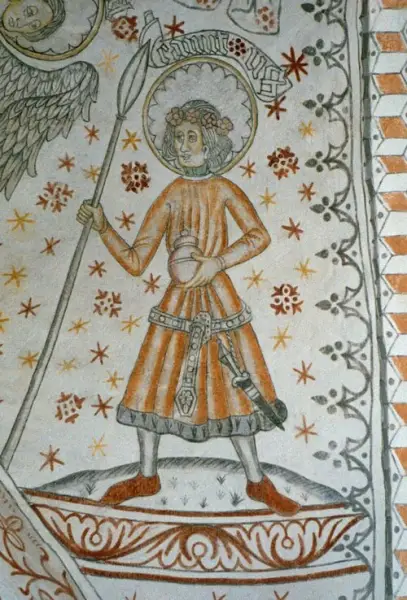
The road from Haraldsted forest to the altars of the Church ran through the fortunes of the murdered man's son. The fate of Canute and the later victory of Valdemar I formed the background to the canonisation of 1170, sought by the king himself: to Danish eyes of the time, the triumph of the slain prince's line over his enemies read as heaven's own verdict on the murder, and the new dynasty gave that verdict liturgical form. Pope Alexander III had already canonized him in 1169. Knutsdagen, his feast, was at first kept on the anniversary of his death, 7 January; when Sweden, Finland, and parts of Norway moved the close of Christmas a week later in the late seventeenth century, the observance travelled with it and is now held on 13 January in those lands. The place of his passion became holy ground as well: in the Middle Ages a chapel, Knud Lavards Kapel, rose on the spot where he fell, though it vanished after the Reformation. Its ruins came to light again in 1883, and in 1902 a memorial crucifix four metres high was set up near the site of his death, so that the scene of treachery remains marked for pilgrims and passers-by. A fresco of the saint likewise survives at Vigersted Church near Ringsted.
§ Biography
Ancestor of the Valdemarian Kings
Canute Lavard's most consequential legacy was dynastic. He was the father of King Valdemar I of Denmark, Valdemar the Great, and the grandfather of King Valdemar II, Valdemar the Victorious; he was thus an ancestor of the Valdemarian kings and of their subsequent royal line, the line under which medieval Denmark reached its greatest power. The Hvide family with which he had grown up stood behind that triumph, and the civil war his murder ignited was settled only when his son took the throne his father had never worn. His memory also travelled beyond Denmark. The Canute Guild in Tallinn, Estonia, was named in commemoration of him, and the guild in turn gave its name to the Canute Street and the Canute Garden of the town, so that a Danish prince killed in a Zealand forest is remembered in the street plan of the Baltic. In Sweden and Finland his cult entangled itself with that of his uncle Canute IV: St. Knut's Day in those countries, though popularly attached to the martyred king, was historically kept in memory of Canute Lavard's death. At Ringsted the chapel raised where he fell, its ruins found again in 1883 and marked since 1902 by a great crucifix, keeps the ancient geography of his passion, and his feast on 7 January opens each year in the church's calendar.
§ Biography
Timeline
- 12 Mar 1096
Born at Roskilde, the only legitimate son of King Eric I of Denmark and Boedil Thurgotsdatter.
§ Biography
- 1103
His father Eric I dies, leaving the young prince under the shadow of a contested succession.
§ Biography
- 1104
Passed over in the royal election on account of his youth, he grows up among the Hvide, a noble family later among his staunchest supporters.
§ Biography
- 1115
His uncle King Niels places him over the Duchy of Schleswig as jarl of Southern Jutland to end the attacks of the Slavic Obotrites.
§ Biography
- 7 Jan 1131
Trapped in Haraldsted Forest near Ringsted in Zealand and murdered by his cousin Magnus the Strong, who saw him as a rival for the throne.
§ Biography
- 1131
His posthumous son Valdemar, the future Valdemar I of Denmark, is born.
§ Issue
- 1157
His remains are translated from Ringsted Abbey to a new chapel at St. Bendt's Church; the civil war his death sparked ends with Valdemar's triumph.
§ Biography
- 1169
Canonized by Pope Alexander III.
§ Biography
- 1170
His canonization is celebrated at the request of King Valdemar; his feast is first kept on the anniversary of his death, 7 January.
§ Biography
- 1883
The ruins of the medieval chapel erected on the site of his death are rediscovered.
§ Biography
- 1902
A four-metre memorial crucifix is raised near the site where Canute Lavard died.
§ Biography
The Record
- Patron of
- Zealand, Denmark
- Symbols
- Knight with a wreath, lance, and ciborium
- Canonization
- Canonized in 1169 by Pope Alexander III; glorified in 1170 at the request of King Valdemar I
Prayer
Bibliography
Show 7 sources
- "Knud Lavard". Danmarks Konger (archived 14 January 2018).
- Bricka, Carl Frederik. "Magnus (Nielsen), 1106-1134". Dansk biografisk Lexikon.
- "Valdemarstiden 1157-1241". Aarhus University (archived 14 March 2012).
- "Knud Lavard, ca. 1096-1131". Aarhus University (archived 6 September 2018).
- Schurr, Susanne (1992). "Knud Lavard, Jarl in Schleswig". In Bautz, Traugott (ed.), Biographisch-Bibliographisches Kirchenlexikon, vol. 4. Herzberg: Bautz, cols. 183-186.
- Attwater, Donald and John, Catherine Rachel (1993). The Penguin Dictionary of Saints, 3rd ed. New York: Penguin Books.
- Mortensen, Lars Boje (2006). The Making of Christian Myths in the Periphery of Latin Christendom (Ca. 1000-1300). Museum Tusculanum Press.
Profile text adapted from the Wikipedia article, licensed CC BY-SA 4.0.
Pray with this saint every day
Save St. Canute Lavard to your favorites, read the full profile, and get feast-day reminders in the Saints app.
Get the Saints AppFree on the App Store for iPhone and iPad