
died 303·Feast October 20
St. Caprasius of Agen
Martyr of Agen in Roman Aquitaine
Overview
Caprasius of Agen, known in French as Saint Caprais, is honoured as a martyr of the early fourth century at Agen in south-western France, and his feast falls on 20 October. The historical ground beneath his cult is thin: relics linked with him came to light at Agen during the fifth century, and local legends of the fourteenth century went further and called him the first bishop of the city, a claim resting, as Alban Butler observed, on nothing firmer than a sixth-century church raised under his invocation. The legend of his martyrdom places him under the persecutions directed by the prefect Dacian. Fleeing the storm, Caprasius took refuge on Mont-Saint-Vincent near Agen, and from that height he watched the execution of the virgin Faith. He was himself condemned to death, and as he went to his death he was accompanied by Alberta, the sister of Faith and in certain versions the martyr's own mother, and by the pair Primus and Felician, brothers in the flesh; the four lost their heads together. In the ninth century his cult was fused with those of Faith and Alberta, and also with Primus and Felician, who came to be called his brothers; the spread of Faith's cult from Conques carried his name along the pilgrim roads to Compostela.
The Complete Life
The Hill and the Sword
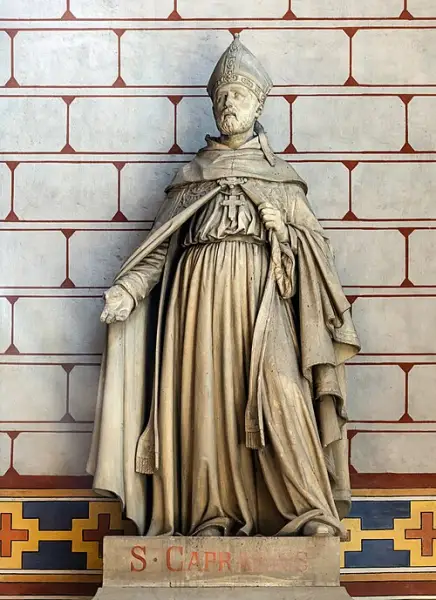
The legend of Caprasius is inseparable from the legend of Faith, and it unfolds in a single landscape around Agen. When the prefect Dacian unleashed his persecutions on the Christians of Aquitaine, Caprasius fled to Mont-Saint-Vincent, a hill close to the town, and from that vantage he became a witness rather than a victim: he looked down and saw the execution of Faith, the young virgin whose death at Agen became one of the most celebrated martyrdoms of Gaul. The sight did for him what sermons rarely do. He was discovered, or gave himself up, and was condemned to die. The route to his execution became a procession: Alberta, the sister of the slain Faith, joined him on the way, and she is identified in some versions of the story as Caprasius' own mother; with her came two brothers, Primus and Felician, whose names would afterwards be knotted to his for good. The four of them were beheaded together, a single stroke of Roman justice making one feast of several lives. The spare narrative has the shape that martyr-acts of southern Gaul so often take: flight, the sight of another's witness, a sudden conversion of fear into declaration, and the sword. The date assigned is 303, the year of the great persecution, and the place is Agen, whose cathedral still carries his name and whose statue of him, carved by Louis Rochet in 1844, keeps the image of the man who watched a virgin die and followed her.
§ Legend
A Cult Carried Along the Pilgrim Roads
What can be said historically about Caprasius is modest, and the tradition itself has been frank about it. Relics associated with him were found at Agen in the fifth century, and by the following century a church stood under his invocation; Alban Butler, writing with the scepticism of the eighteenth century, allowed that this dedication is the only evidence for his existence. The fourteenth-century local legends that promote him to first bishop of Agen belong to the appetite of medieval towns for apostolic foundations. Yet the cult prospered by attachment. In the ninth century it was formally fused with those of Faith and Alberta, the sister who died with him, and with Primus and Felician, now called his brothers, a welding of separate Aquitanian traditions into a single story. In 866 the relics of Faith were carried to Conques, whose abbey church stood on one of the roads to Compostela, and the prestige of her shrine drew the associated saints along the pilgrim ways. Two Spanish churches preserve his name: San Caprasio at Santa Cruz de la Serós in Jacetania, a First Romanesque building raised at the beginning of the eleventh century on the Way of St. James, and another San Caprasio at Suellacabras in the province of Soria in Castile and León. Venerated in the Roman Catholic and Eastern Orthodox churches, he keeps his feast on 20 October.
§ Dedications
Timeline
- 303
During the persecutions of the prefect Dacian, Caprasius is condemned and beheaded at Agen alongside Alberta, Primus and Felician.
§ Legend
- 400
Relics associated with Caprasius are discovered at Agen in south-west France during the fifth century.
§ Introduction
- 500
A church is dedicated to him in the sixth century, the only evidence for his existence that Alban Butler would accept.
§ Introduction
- 800
During the ninth century his cult is fused with those of Saint Faith and Alberta of Agen, and with Primus and Felician, called his brothers.
§ Introduction
- 866
The remains of Saint Faith are transferred to Conques on the pilgrimage route to Compostela, spreading the associated cult along the Way of St. James.
§ Introduction
- 1000
The First Romanesque church of San Caprasio is built at Santa Cruz de la Serós, a stop on the Way of St. James.
§ Introduction
- 1300
Local legends of the fourteenth century make Caprasius the first bishop of Agen.
§ Introduction
The Record
- Patron of
- Agen
- Canonization
- Pre-congregation; relics associated with him were discovered at Agen in the fifth century
Prayer
Bibliography
Show 4 sources
- Alban Butler, David Hugh Farmer, Paul Burns, Butler's Lives of the Saints (Liturgical Press, 2000), 139.
- Saint Faith of Aquitaine. Archived May 17, 2008, at the Wayback Machine.
- St Faith. Archived June 12, 2008, at the Wayback Machine.
- St. Caprasius - Saints & Angels - Catholic Online.
Profile text adapted from the Wikipedia article, licensed CC BY-SA 4.0.
Pray with this saint every day
Save St. Caprasius of Agen to your favorites, read the full profile, and get feast-day reminders in the Saints app.
Get the Saints AppFree on the App Store for iPhone and iPad