
died 430·Feast June 1
St. Caprasius of Lérins
Hermit and Co-Founder of Lérins Abbey
Overview
Caprasius, who died in 430, was a hermit of Provence who turned his back on a rich and distinguished Gallic family to live in solitude on the Îles de Lérins, the small Mediterranean islands off the southern coast of Gaul. Two young aspirants, Honoratus and his brother Venantius, sought him out and attached themselves to his eremitical life. The three resolved to travel together to the holy places of Palestine and to the lavras of Syria and Egypt, but the journey halted at Methoni in Messenia, where Venantius died. Caprasius and Honoratus then made their way back to Gaul, dwelt for a time among the hills near Fréjus, and afterwards returned to Lérins, resolved to model their existence on that of the Desert Fathers. Disciples gathered around them, and from their company, formed under the influence of the monastic rule of Pachomius the Great, Lérins Abbey eventually arose. One scholar has suggested that Caprasius, whether because of his age or because he lacked the personal magnetism of Honoratus, may never have been the community's formal superior. His feast is kept on June 1, and his relics rest at Aulla in Tuscany.
The Complete Life
A Gallic Inheritance Renounced
Caprasius entered the world sometime in the fourth century, in a Gaul still largely pagan at the edges yet already thick with Christian communities along the Mediterranean coast. The sources agree that his family was wealthy and prominent, a household that could have opened doors to a career in administration, in the army, or in provincial society. That inheritance is precisely what the record remembers him for refusing. At a moment no chronicle dates, he walked away from position and property and made for the Îles de Lérins, the cluster of small islands lying off the southern Gallic shore, where he settled into the life of a solitary. The choice placed him within a current of his age: educated Gallo-Romans were discovering the desert ideal through accounts of the monks of Egypt and Syria, and some sought to reproduce that austerity closer to home. On Lérins, Caprasius lived stripped of the comforts his birth had promised, praying and fasting in a landscape of stone, scrub and sea. His example proved magnetic. Honoratus, a young man of similar background, came to the island with his brother Venantius, asking to be trained in the same discipline. The older hermit received them, and the three formed a small band of aspirants whose friendship would shape the monastic history of Provence. Nothing in the surviving notices suggests Caprasius ever regretted the exchange of an estate for a cell; the tradition remembered him instead as the patient senior man of the island, the one who had chosen the hard path first.
§ Caprasius of Lérins
The Hermit of the Islands
The vocation of Caprasius was eremitical before it was anything else. He went to Lérins not to found an institution but to be alone with God, and his earliest years there were those of a solitary. Yet solitude of the Christian kind draws others, and it drew two youths, Honoratus and his brother Venantius, who wished to become hermits as well. Together the three conceived a plan of pilgrimage: they would visit the holy places of Palestine and then press on to the lavras of Syria and Egypt, to see with their own eyes the monasteries of the desert whose fame filled the Christian world. The expedition was a test of vocation undertaken in the most literal way, by walking toward the sources of the tradition. It ended in loss. At Methoni in Messenia, on the western coast of Greece, Venantius died, and the two survivors cut short their voyage and returned. The failure of that journey became the hinge of Caprasius's calling. He and Honoratus came back to Gaul, lived for a season among the hills near Fréjus, and then went again to Lérins, this time not merely to be solitaries but to build a common life in imitation of the Desert Fathers. Under the influence of the rule of Pachomius the Great, what had been a scattering of hermits became a brotherhood. A later scholar has observed that Caprasius may never have held the formal leadership of that community, perhaps because he was already old, or because he lacked the charisma that drew men so readily to Honoratus. His vocation, in that reading, was to be the first, not the foremost.
§ Caprasius of Lérins
Founding a Community on the Desert Model
The mission of Caprasius was the transplanting of desert monasticism onto Gallic soil. When he and Honoratus returned to Lérins after their interrupted pilgrimage, they carried with them a concrete vision: a life modeled on the Desert Fathers, ordered by the rule of Pachomius the Great, lived in community on an island that was itself a kind of desert. Others came, and kept coming, until the site of the hermits' settlement had grown into Lérins Abbey, one of the most influential monastic foundations of the early medieval West. The abbey became a nursery of bishops and writers, and its ascetic culture shaped the Church of southern Gaul for centuries. Within that enterprise, the role of Caprasius appears to have been quiet and preparatory. The tradition names him as the senior hermit whom Honoratus joined, the man whose settled presence on the island made the foundation possible; yet a scholar consulted in the modern notices judges that he may not have been the community's official leader, whether on account of his advancing years or because the gifts of government and attraction belonged to his younger companion. If so, his mission was of the kind the Church has always needed and rarely celebrated: to hold a place in prayer until others arrive to build upon it. The pilgrimage to the East, the death of Venantius, the retreat at Fréjus and the return to the island together form a mission narrative in which every setback was converted into structure. From a hermit's cell, a great abbey; from a broken journey, a rule-shaped brotherhood.
§ Caprasius of Lérins
A Saint of Two Countries
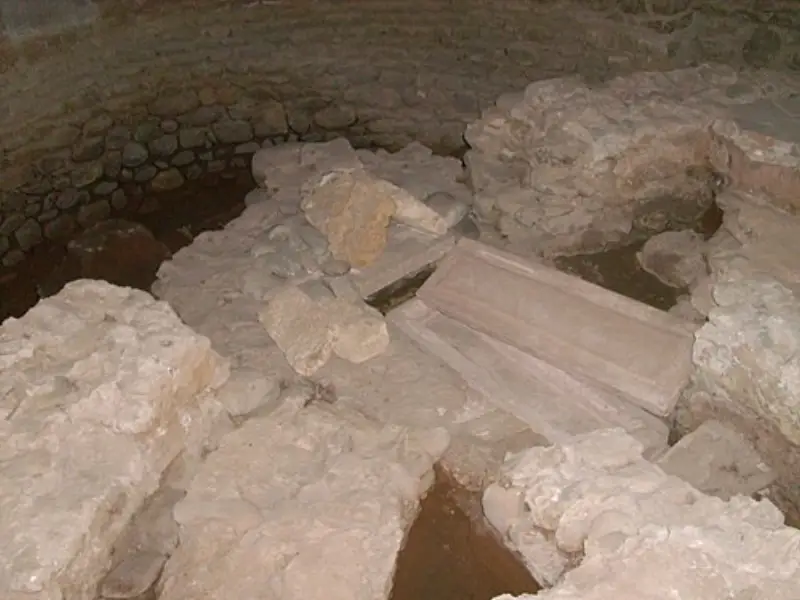
Caprasius died in 430, and the principal witness to his life came from a distinguished hand: Hilarius of Arles, who had himself been a monk at Lérins before ruling the see of Arles, composed a laudatio in his honour after his death. That funeral praise is the main source for everything later ages know of the hermit, and its authorship binds Caprasius to the first generation of Lérins' influence upon the Gallic episcopate. His cult spread with the abbey's fame and, remarkably, found a second home far from Provence. His relics are preserved in the Abbey of San Caprasio at Aulla in north Tuscany. That Benedictine monastery began as a hostel on the Via Francigena, the great pilgrimage road to Rome, and was originally dedicated to Santa Maria; in 1077 it was rededicated to San Caprasio, who thus stood forth as the town's patron and one of heaven's advocates for pilgrims, a fitting charge for a saint whose one great journey had itself ended unfinished. He is honored in both the Roman Catholic and the Eastern Orthodox Church, with his feast on June 1. One caution belongs in any account of his legacy: he must not be confused with Caprasius of Agen, a fourth-century French martyr of the same name, whose story is entirely distinct. The hermit of Lérins left no writings and no rule under his own name; what he left was an island, a community, and the memory of a man who preferred the margin of the sea to the center of the world.
§ Veneration
Timeline
- 430
Dies at Lérins in Provence after living there as a hermit
§ Introduction
- 1077
The Aulla abbey, once titled Santa Maria, is dedicated to San Caprasio as the town's patron
§ Veneration
The Record
- Patron of
- Patron of the town of Aulla, Tuscany·Patron saint of pilgrims
- Symbols
- Habit of a hermit of Lérins
- Canonization
- Pre-congregation; honored from antiquity in Provence and later in Tuscany
Prayer
Bibliography
Show 5 sources
- Great Synaxaristes: (in Greek) Ὁ Ὅσιος Καρπάσιος τῶν Λερίνων. 1 Ιουνίου. ΜΕΓΑΣ ΣΥΝΑΞΑΡΙΣΤΗΣ.
- "Caprasius Presbyter at Lerins", A Dictionary of Early Christian Biography (Henry Wace, ed.)
- Odden, Per Einar. "Den hellige Caprasius av Lérins (d. 430)", Den katolske kirke, June 8, 1998
- Arduino, Fabio. "San Caprasio Lérins", Santi e Beati, April 23, 2006
- St. Caprasius - Saints & Angels - Catholic Online
Profile text adapted from the Wikipedia article, licensed CC BY-SA 4.0.
Pray with this saint every day
Save St. Caprasius of Lérins to your favorites, read the full profile, and get feast-day reminders in the Saints app.
Get the Saints AppFree on the App Store for iPhone and iPad