
5th or 6th century – 6th century·Feast May 16
St. Carannog
Welsh Abbot, Confessor and Monastic Founder
Overview
Carannog, known in Old Welsh as Carantog, in Breton as Karanteg, in Latin as Carantocus and in Irish as Cairnech, was a sixth-century Welsh saint, abbot and confessor. The medieval Vitae place him among the royalty of Ceredigion, descended either directly from Cunedda Wledig or as a grandson through Queen Meleri and King Ceredig. Refusing the throne that awaited him, he fled to Llangrannog and then crossed the sea to Ireland, where he stood beside Saint Patrick at the head of Ireland's first Christians in the contest with the druids and won the affectionate name Carus Cernachus, Dear Carannog. Returning to Britain, he founded religious communities in the South West and traveled on to Brittany. His memory is kept across the Celtic world, at Llangrannog in Ceredigion, at Crantock in Cornwall, at Carhampton in Somerset, at Carantec in Brittany and at sites in Ireland, each keeping his feast on May 16 or 17. His Vita contains one of the earliest appearances of King Arthur in writing, telling how Carannog tamed a dragon and received the land of Carrum from the king.
The Complete Life
A Prince of Ceredigion
The details of Carannog's life descend chiefly through two twelfth-century hagiographies, the Vita Prima Sancti Carantoci and the Vita Secunda Sancti Carantoci, supplemented by a fifteenth-century Vita preserved in the Léon Breviary, by the Vitae of saints associated with him, and by the broader stream of Welsh tradition. All of these sources seat him among the rulers of Ceredigion, though they differ on his exact place in the line: he is given either as a direct son of Cunedda Wledig or as a grandson through Queen Meleri and King Ceredig. That royal blood is the hinge of his story. Like many saints of the Welsh genealogies, Carannog rejects his inheritance, and the rejection is dramatized in a peculiarly vivid way: rather than accept the crown, the young prince runs away. The Life says he escaped to Llangrannog, the coastal settlement in Ceredigion that still bears his name, in order to avoid being elected king. The scene compresses the whole ideal of early Celtic sanctity into a single act, the trading of a throne for a life given to God. His name itself travels across languages and seas, recorded as Carantog in Old Welsh, Karanteg in Breton, Carantocus in Latin and Cairnech in Irish, with Carantoc and Carantock as anglicized forms. The spread of the name is the first clue that the man behind it moved widely, and that his cult was carried by movement: across the Irish Sea, across the Severn, and across the Channel to Armorica.
§ Life and historicity
Flight from the Throne
Carannog's vocation began as an escape and matured into mission. Having fled the election that would have made him king, he did not settle into comfortable retirement at Llangrannog but crossed the sea to Ireland, which the Lives present as still wrestling between the new faith and the old. There he attached himself to the work of Saint Patrick, standing with the early Irish Christians in their contest with the druids. The Irish church remembered him warmly for it, giving him the affectionate byname Carus Cernachus, Dear Carannog or Dear Crannog, a detail that suggests his Irish sojourn left real affection behind. The fight with the druids, as the hagiographies frame it, was not merely argument but a collision of spiritual claims, and the young Welsh prince placed himself squarely on the Christian side of it. This period formed the ascetic and apostolic character that the rest of his life displayed. When he returned to Britain he was no longer a fugitive heir but a confessor and abbot, a man with authority born of renunciation. The pattern is the classic one of the Celtic saints: royalty refused, exile embraced, authority earned in a foreign mission field, and then a lifetime spent founding. His later movements, through the South West of Britain and on to Brittany, repeat the same logic on a wider map. Each refusal opened a further journey, and each journey left behind a community, a church, or a place-name that still carries his memory. The vocation of Carannog is therefore best read as a single long act of leaving, from the court of Ceredigion to the shores of the Celtic world.
§ Life and historicity
Foundations Across the Celtic World
The mission of Carannog unfolded as a chain of foundations stretching from his native Ceredigion to the far side of the Channel. He is credited as the founder of the Llan at Llangrannog in Wales, the llan being the characteristic Welsh monastic enclosure of settlement, church and burial ground; further houses are credited to him in Somerset, Cornwall, Brittany and Ireland. In Britain's South West, the Lives set his most famous foundation at Carrum, the modern Carhampton in Somerset, on land the Arthurian episode says was given to him by King Arthur himself. The distribution of his cult follows the map of his travels: he is venerated at sites in Cornwall, in Ireland, at Carhampton in Somerset, and at numerous places in Brittany such as Carantec, alongside the principal center at Llangrannog. The consistency of the calendar is striking evidence that one man stands behind the many dedications: in each of these places his feast is kept on 16 May, the traditional date of his death, or on 17 May, the traditional date of his burial. The agreement of dates across so wide a geography indicates, as scholars note, that the local traditions descend from the same historical figure rather than from a scatter of unrelated holy men who happened to share a name. His mission was thus of the kind that stitches regions together, a network of houses and dedications binding Wales, Ireland, Cornwall, Somerset and Brittany into a single spiritual family under one patron.
§ Venerations
The Saint Who Met Arthur
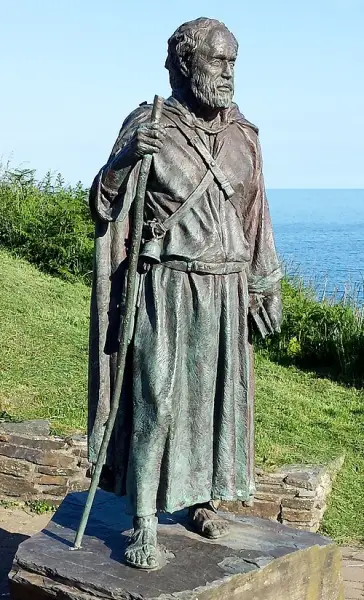
Carannog occupies a place of genuine importance in the history of Arthurian literature, for his Vitae stand among the earliest written sources for King Arthur, independent of Geoffrey of Monmouth's Historia Regum Britanniae. Indeed, his is one of only six Welsh saints' Vitae that can potentially serve as evidence for a historical Arthur outside Geoffrey's influence. In the episode the Lives preserve, Carannog is traveling from Ceredigion toward South West England when, attempting to cross the Severn, he loses his portable altar to the waves. Journeying on through Dumnonia, he is summoned to Din Draithou, the modern Dunster in Somerset, where he blesses Arthur and learns that the king has long been occupied with hunting a dragon that is devastating the land of Carrum. Arthur, unable even to find the creature, asks the saint to locate it and bring it in, offering in exchange help in finding the lost altar. Carannog summons the dragon by prayer; the creature dashes toward him with a great din, as a calf trots to its dam, and bends its head. He leads it to Arthur's fortress, and when Arthur tries to use the recovered altar as a table, it flings off everything placed upon it. Impressed, the king returns the altar and grants Carannog the whole land of Carrum, where the saint builds his monastery. Material relics also endure: the Carantacus Stone, a sixth-century gravestone inscribed CARANTACUS found in 1745 at St Michael's churchyard, Llandre-Egremont, now rests in St Tysilio's Church, though whether it marks the saint's grave or a namesake's remains uncertain. A statue of the saint stands at Llangrannog, and stained glass depicts him in the church that bears his name.
§ Carannog and Arthur
Timeline
- 1745
The Carantacus Stone, a sixth-century gravestone inscribed CARANTACUS, comes to light in St Michael's churchyard, Llandre-Egremont
§ Venerations
- 1889
The stone has by now been incorporated into the wall of the newly rebuilt St Michael's Church
§ Venerations
The Record
- Major works
- Llan (monastic foundation) at Llangrannog, Ceredigion·Monastic sites across Somerset, Cornwall, Brittany and Ireland·Monastery at Carrum (modern Carhampton, Somerset)
- Patron of
- Llangrannog, Ceredigion·Carantec, Brittany·Crantock, Cornwall
- Symbols
- Portable altar·Tamed dragon
- Canonization
- Pre-congregation; venerated from the early medieval period in the Catholic and Eastern Orthodox Churches
Prayer
Bibliography
Show 8 sources
- Tatlock, J. S. P. "The Dates of the Arthurian Saints' Legends", Speculum 14.3 (July 1939: 345–365), pp. 349ff.
- Lloyd, John Edward. "Carannog". Dictionary of Welsh Biography.
- Castleden, Rodney (2003). King Arthur: The Truth Behind the Legend. Taylor & Francis. pp. 138–139. ISBN 1134373775.
- Rees, William Jenkins (1853). Life of Saint Carannog, translated in Lives of the Cambro British Saints, p. 396 ff.
- "Carantacus Stone, St Tysilio's Church, Llandissilio". Coflein. 29 April 2013.
- Shales, Jessica (2025). Arthurian Literature XL. Boydell & Brewer. pp. 22–23, 35–37. ISBN 9781843847403.
- Breeze, Andrew (2012). The Arthur of Medieval Latin Literature: The Development and Dissemination of the Arthurian Legend. Cardiff: University of Wales Press. p. 27. ISBN 9780708323861.
- Doble, Gilbert H. (1965). The Saints of Cornwall, Part Four. Truro: Dean and Chapter of Truro.
Profile text adapted from the Wikipedia article, licensed CC BY-SA 4.0.
Pray with this saint every day
Save St. Carannog to your favorites, read the full profile, and get feast-day reminders in the Saints app.
Get the Saints AppFree on the App Store for iPhone and iPad