
1848 – 1911·Feast December 6
St. Carmen Sallés y Barangueras
Founder of the Missionary Sisters of the Immaculate Conception
Overview
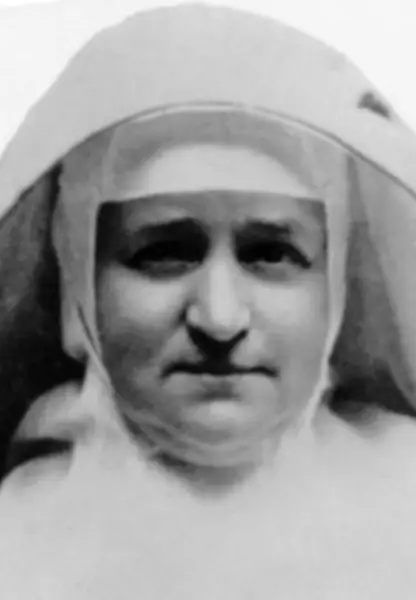
María del Carmen Sallés y Barangueras, in religion Carmen of Jesus, was a Spanish religious sister who entered the world at Vic in Barcelona province on 9 April 1848, second of the ten children of José Sallés y Vall with his wife Francisca Barangueras y del Planell. A pilgrimage to Montserrat in 1858 settled her resolve to give her life to God, a resolve strengthened by her First Communion. Breaking a betrothal into which she had been promised, she entered the Sister Adorers of the Blessed Sacrament and began her novitiate at Barcelona on 7 May 1869, then passed in 1871 to the Dominican congregation of the Annunciation of the Blessed Virgin, in which she made perpetual vows in August 1872. For two decades she worked among women attempting to leave prostitution and crime, and ran a small school for the children of working women. After prayer before the Virgin of Good Counsel in Madrid she left her congregation with three companions, and on 22 February 1892 founded the Missionary Sisters of the Immaculate Conception at Burgos, a congregation devoted to the education of girls as a safeguard against moral ruin. She died at Madrid on 25 July 1911 and was canonized on 21 October 2012.
The Complete Life
A Daughter of Vic
María del Carmen Sallés y Barangueras was born at Vic in the province of Barcelona on 9 April 1848, into a Spain of restored monarchy and deep Catholic practice. Second of ten children, her parents being José Sallés y Vall and his wife Francisca Barangueras y del Planell, she grew up in a household large enough to teach her early the arts of care, order and sacrifice. In time the family moved to Manresa, the Catalan town whose religious life would frame her youth. The decisive moment of her childhood came in 1858, when she traveled with her parents on pilgrimage to Montserrat, the mountain abbey that stands at the heart of Catalan devotion. Something in that journey fixed her course: she decided during the trip to devote her life entirely to God, and the decision was strengthened when she received her First Communion. The next years tested it. Like many daughters of her time and class, she had been committed to an arranged marriage, a future her family had arranged without reference to the vocation stirring in her. In 1864, at sixteen, she announced her intention to become a religious sister and set about persuading her parents to release her from the engagement. The struggle ended as she hoped: the betrothal was broken, the marriage abandoned, and the path to religious life opened. It is worth noticing how early the pattern of her later life appears here, the combination of tender obedience and iron resolve by which she would carry every project of her adulthood, from the rescue of women in difficulty to the founding of a congregation against considerable odds.
§ Life
Two Congregations and a Search
Carmen's entry into religious life came in stages, each one a genuine discernment. She first joined the Sister Adorers of the Blessed Sacrament, a congregation devoted to Eucharistic adoration and to the service of women in moral danger, and she began her novitiate with them at Barcelona on 7 May 1869. The breaking of her betrothal was the price of that entrance, and she paid it without hesitation. Two years later, in May 1871, she felt drawn elsewhere and entered the Dominican congregation of the Annunciation of the Blessed Virgin, an active teaching body; in August 1872 she pronounced perpetual vows among them. What followed was roughly two decades of apostolic labor. Her work centered on the rehabilitation of women caught in prostitution or entangled with the courts, women whom respectable society had written off, and on the equally practical question of what became of their children. She kept a modest little school in being so the children of working mothers need not roam the streets, an arrangement that reveals her instinct for prevention rather than mere rescue. Yet the fit between her charism and the Dominican institute was never perfect, and her ideas about educating girls to change society itself outran the structures available to her. The turning point came in the chapel of the Virgin of Good Counsel in the Collegiate Church of San Isidro in Madrid, where prayer settled her next course of action. She left the congregation with three other sisters who shared her vision, and the little group made its way to Burgos, arriving on 15 October 1892, to attempt something new.
§ Life
Education as Liberation
The work Carmen founded at Burgos on 22 February 1892, the Missionary Sisters of the Immaculate Conception, was the mature expression of everything she had learned in twenty years of apostolate. Its purpose was twofold. First, to influence the norms of society in a positive direction, attacking at the root the conditions that pushed women toward prostitution and other forms of moral degradation. Second, and more concretely, to educate girls, giving them the knowledge, skills and self-respect that would keep them from falling into those dangers in the first place. The congregation therefore took the school as its principal instrument, and it trained young women to be teachers, multiplying its reach through each graduate who stood before a classroom. Diocesan approval came with remarkable speed, on 7 December 1892, within the founding year, a sign of the confidence the bishop of Burgos placed in the new institute. The sisters' work spread steadily: the decree of praise was granted by Pope Pius X on 19 September 1908, and full papal approval followed from Pope Pius XII on 7 December 1954. The congregation crossed into the United States in 1962 and into China in 1981, and by 2006 counted 519 religious in 66 houses. The scale of the growth testifies to the soundness of the intuition: Carmen had seen that the rescue of individual women, necessary as it was, could never be more than a remedy, and that only education, offered to girls as a right and sustained by faith, could change the conditions that produced the need for rescue.
§ Life
The Dignity of Women
The spiritual center of Carmen Sallés's life was a conviction about the equal dignity of men and women before God. Her biographers record that she was remembered above all as a firm champion of equal standing for both sexes and an unbending defender of women's rights, and that she fixed this cause at the centre of her life from the very beginning of her entrance into religious life. This was not, for her, a political program appended to religion; it was a reading of the Gospel itself, worked out among women the rest of society had abandoned. Her years with the Sister Adorers, serving women attempting to leave prostitution, brought her face to face with what inequality meant in practice: women with no education, no protection under custom, and no way out except the one the sisters offered. Her response was Marian and Eucharistic at once. She placed her new congregation under the Immaculate Conception, the sign of a woman fully graced and fully free, and she traced her decision to found it to prayer before an image of the Virgin of Good Counsel in Madrid. The counsel she believed she received was concrete: leave what is safe and build for girls what was never built for their mothers. The spirituality that resulted was practical, cheerful and unafraid of structures, convinced that holiness could organize a school as readily as it could organize a prayer. Carmen of Jesus, the religious name she took, described a life directed entirely toward him precisely by being directed toward the least regarded of his disciples.
§ Life
Death in Madrid
The last years of Carmen Sallés's life were spent in the ordinary labor of governing and watching over the congregation she had called into being. She died at Madrid on 25 July 1911, at the age of sixty-three, in the Kingdom of Spain whose capital had once been the scene of her decisive prayer at the Collegiate Church of San Isidro. She had lived to see the decree of praise granted by Pope Pius X in 1908, three years before her death, but not the full papal approval of 1954, the arrival of her sisters in the United States in 1962, or their extension to China in 1981. By the census of 2006, the Missionary Sisters of the Immaculate Conception numbered 519 religious in 66 houses, a body of work that grew steadily from the small group that had arrived at Burgos in October 1892. Her death left the institute still young and still largely Iberian, its future secured by the soundness of its rule and the formation of its teachers rather than by the person of the foundress alone, which is the test of any genuine foundation. She was buried as religious sisters of her time were buried, and her memory among her daughters kept the traits her biographers emphasized: the advocacy for women, the insistence on education, and the counseled boldness that had twice led her out of secure situations, out of a betrothal and out of a congregation, into the larger work God was asking of her.
§ Life
From Venerable to Saint
The cause of Carmen Sallés moved through the modern stages of canonization with unusual neatness, each step documented by the Congregation, later Dicastery, of the Causes of Saints. On 17 December 1996 Pope John Paul II attested that her life had shown heroic virtue, whereupon she received the title of Venerable. The miracle examined for her beatification concerned a religious sister's sudden recovery from terminal tubercular spondylitis, a healing in which new vertebrae appeared where the ruined ones had been. The Congregation of the Causes of Saints validated the process on 13 January 1995; the Medical Council had met on 3 May 1992 to weigh the case, judging the recovery rapid, complete, without medium- or long-term after-effects, and beyond scientific explanation. On 18 December 1997 John Paul II recognized the healing as miraculous, and on 15 March 1998 he presided in person at her beatification in Saint Peter's Square. A second miracle was then investigated, the cure in 1999 at São Paulo of a Brazilian girl named Maria Isabel Gomes de Melo Gardelli, who suffered a severe case of acute cerebral ischemia that left her with grave facial deformities; a novena was said to Carmen Sallés for her cure, and within five days the child seemed delivered of the affliction. Benedict XVI gave approval to this second miracle on 19 December 2011 and raised her to the honors of the altar at Saint Peter's Square on 21 October 2012, in the same ceremony that raised Kateri Tekakwitha, Marianne Cope, Anna Schäffer and others to the altar. Her feast is kept on 6 December.
§ Beatification and canonisation
A Congregation Across Three Continents
The legacy of St. Carmen Sallés y Barangueras is carried above all by the congregation she founded. The Missionary Sisters of the Immaculate Conception, begun at Burgos in 1892 with a handful of women and a conviction about the education of girls, received diocesan approval within its first year, the decree of praise in 1908, and full papal approval in 1954. From Spain it spread outward: to the United States in 1962 and to China in 1981, and by 2006 it counted 519 religious in 66 houses. Each of those houses represents the foundress's founding insight in action, that the way to protect women is to teach them, and that a society can be changed by changing what it offers its daughters. Her canonization in 2012 placed her among the saints of modern Spain and gave the Church a figure who joined Marian devotion to a defense of women's rights unusual in explicitness for her century. The two miracles accepted in her cause, the healing of a sister's ruined spine and the cure of a Brazilian child from cerebral ischemia, were read by the Church as confirmation of that life. Devotionally she is remembered with the title Virgin, her religious name Carmen of Jesus, and her feast on 6 December. For the many institutions her daughters run, schools and centers for women and girls, she remains the model of a founder whose program was not a document but a person: the young woman, poor and at risk, in whom Carmen Sallés saw the face of Christ and the future of society.
§ Life
Timeline
- 9 Apr 1848
Born at Vic, Barcelona, second of the ten children of José Sallés y Vall and of his wife Francisca Barangueras y del Planell
§ Life
- 1858
On a pilgrimage to Montserrat with her parents, decides to devote her life to God; the resolve deepens after her First Communion
§ Life
- 1864
Declares that she wishes to enter religious life and wins her parents over to ending the arranged match to which she had been pledged
§ Life
- 7 May 1869
Joins the Sister Adorers of the Blessed Sacrament, breaking her betrothal, and begins her novitiate at Barcelona
§ Life
- May 1871
Passes to the Dominican congregation of the Annunciation of the Blessed Virgin
§ Life
- Aug 1872
Makes perpetual vows among the Dominican Sisters of the Annunciation
§ Life
- 22 Feb 1892
Having left her congregation with three companions, founds the Missionary Sisters of the Immaculate Conception at Burgos
§ Life
- 15 Oct 1892
Arrives at Burgos with her three companions after praying before the Virgin of Good Counsel in Madrid
§ Life
- 7 Dec 1892
The new congregation receives diocesan approval
§ Life
- 19 Sep 1908
Pope Pius X grants the congregation the decree of praise
§ Life
- 25 Jul 1911
Dies at Madrid aged sixty-three
§ Life
- 7 Dec 1954
Pope Pius XII grants the congregation full papal approval
§ Life
- 17 Dec 1996
Declared Venerable after Pope John Paul II confirms a life of heroic virtue
§ Beatification and canonisation
- 18 Dec 1997
John Paul II approves as miraculous the healing of a nun's tubercular spondylitis
§ Beatification and canonisation
- 15 Mar 1998
Beatified by Pope John Paul II at Saint Peter's Square
§ Beatification and canonisation
- 19 Dec 2011
Pope Benedict XVI approves the second miracle, a Brazilian girl's cure from cerebral ischemia
§ Beatification and canonisation
- 21 Oct 2012
Canonized by Pope Benedict XVI at Saint Peter's Square
§ Beatification and canonisation
The Record
- Major works
- Missionary Sisters of the Immaculate Conception (founded 1892)·School for the children of working women·Teacher training for young women through her institute
- Patron of
- Of women's equality and the rights of women, the cause she championed
- Symbols
- Religious habit of the Missionary Sisters of the Immaculate Conception
- Canonization
- Beatified by Pope John Paul II on 15 March 1998; canonized by Pope Benedict XVI on 21 October 2012, both in Saint Peter's Square
Prayer
Bibliography
Show 7 sources
- "Future Spanish saint's intercession cured 3-year-old". Catholic News Agency. 1 March 2012.
- "Homily of His Holiness Pope Benedict XVI". vatican.va.
- "Saint María del Carmen Sallés Barangueras". Saints SQPN. 25 July 2016.
- "Saint Maria Carmen Sallés y Barangueras". Santi e Beati.
- "Santa Carmen Sallés", Concepcionistas.
- "Maria del Monte Carmelo", Dicastero delle Cause dei Santi.
- "21 October 2012: Holy Mass and Canonization of the Blesseds James Berthieu, Pedro Calungsod, John Baptist Piamarta, Carmen Sallés y Barangueras, Marianne Cope, Kateri Tekakwitha, Anna Schäffer | BENEDICT XVI". www.vatican.va.
Profile text adapted from the Wikipedia article, licensed CC BY-SA 4.0.
Pray with this saint every day
Save St. Carmen Sallés y Barangueras to your favorites, read the full profile, and get feast-day reminders in the Saints app.
Get the Saints AppFree on the App Store for iPhone and iPad