
1st century·Feast May 26 (also January 4 with the Seventy Disciples)
St. Carpus of Beroea
Apostle of the Seventy and Bishop of Beroea
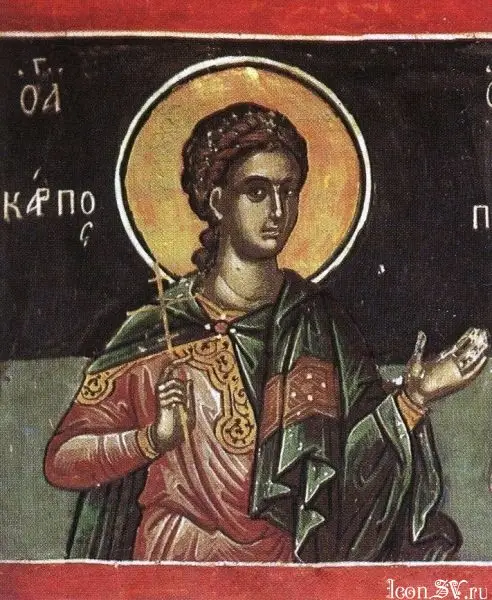
Overview
Carpus, in Greek Karpos, is numbered among the Seventy Disciples sent out by Christ and is remembered by the Church on 26 May in the company of St. Alphaeus, and again on 4 January with the whole company of the Seventy. His single appearance in the New Testament is a household detail: in the Second Epistle to Timothy, Paul asks that the phelonion he left at Troas with Carpus, together with the books, be brought when Timothy comes. Tradition remembers him as bishop of Beroea, the modern Verria, in Macedonia. The Eastern Orthodox Church honors him with a troparion that begs his intercession for the forgiveness of transgressions and a kontakion that hails him as a shining star whose memory the Church keeps in faith, illumined by the multitude of his miracles. Beyond these notices, the record is silent: a disciple named in Scripture, a host of the Apostle Paul, and a bishop of a Macedonian see.
The Complete Life
Named in Scripture
Carpus of Beroea, whose Greek name is Karpos, belongs to that circle of early disciples known as the Seventy, the larger company of followers sent out by Christ beyond the Twelve. Of his birth, family and calling the tradition preserves nothing at all; he enters history through a single sentence of St. Paul. In the Second Epistle to Timothy, writing from near the end of his life, the Apostle asks that the phelonion he had left behind at Troas with Carpus, along with the books, be brought to him when Timothy comes. The notice is domestic in scale, a cloak and some volumes deposited with a trusted friend, yet it has carried Carpus's name through two millennia. It tells us that he was a man Paul trusted with his possessions, that he lived at or near Troas on the northwestern coast of Asia Minor, and that he stood close enough to the Apostle to be remembered in a letter the whole Church would read. The Eastern tradition adds his office: he was bishop of Beroea, the modern Verria, in Macedonia, one of the cities where Scripture itself records that the Jews received the word readily, examining the texts daily. The connection between the Carpus of Troas and the see of Beroea is a matter of tradition rather than of the New Testament text, and the calendar of the Church honors him as both: the disciple who hosted Paul and the bishop who governed a Macedonian church. His commemoration falls on 26 May, kept alongside St. Alphaeus, and again on 4 January, when he stands with the whole body of the Seventy Disciples, whose collective feast gathers the unnamed laborers of the first generation.
§ Carpus of Beroea
A Shining Star in the Church's Calendar
The liturgical legacy of Carpus of Beroea is preserved in the hymnody of the Eastern Orthodox Church, which keeps his memory twice each year. On 26 May he is commemorated together with St. Alphaeus, and on 4 January he is gathered with the rest of the Seventy Disciples, the synaxis of that larger apostolic company. The troparion in his honor, sung in the third tone, addresses him as a holy apostle and asks him to entreat the merciful God to grant the forgiveness of transgressions to the souls of the faithful. The kontakion, in the fourth tone, is warmer still in its imagery: the Church, it declares, possesses him as a shining star and is illumined by the multitude of his miracles, and it prays that he will save those who honor his holy memory in faith. The language of miracle-working light places Carpus within the standard devotional portrait of the apostles of the first generation, those whose preaching was confirmed by signs. Beyond the hymns, his legacy rests on the two anchors already noted: the verse of Scripture that names him, and the episcopal see of Beroea, modern Verria in Greek Macedonia, which counts him among its early bishops. Western lists of the disciples honored as saints in the Catholic Church include him as well, so that both the great traditions of Christianity keep a place for the man about whom the New Testament says only that he had Paul's cloak and his books. Few saints rest on less evidence; fewer still have kept so secure a place in the calendar upon it.
§ Hymns
The Record
- Patron of
- Beroea (Verria), Macedonia
- Symbols
- Bishop's vestments, including the phelonion
- Canonization
- Pre-congregation; enumerated among the Seventy Disciples from apostolic times
Prayer
Bibliography
Show 1 sources
- This article is derived in whole or in part from Carpus of Beroea at OrthodoxWiki, which is dually licensed under CC-By-SA and GFDL.
Profile text adapted from the Wikipedia article, licensed CC BY-SA 4.0.
Pray with this saint every day
Save St. Carpus of Beroea to your favorites, read the full profile, and get feast-day reminders in the Saints app.
Get the Saints AppFree on the App Store for iPhone and iPad