
6th century·Feast March 5
St. Carthage the Elder
Bishop, Abbot and Disciple of Ciaran of Saighir
Overview
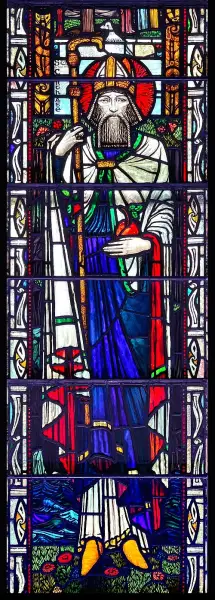
Saint Carthage the Elder, also called Carthach, was an Irish bishop and abbot of the sixth century whose feast is kept on 5 March. He is remembered chiefly as the disciple and successor of Ciaran of Saighir, called the Elder, and as the fosterer and tutor of the greater namesake who bore his name, Carthage of Lismore, the Mochuda of the calendars. He belonged to the Eóganacht Chaisil, the royal kindred of Munster, and was the son, or more probably the grandson, of Óengus mac Nad Froích, the king whom Saint Patrick is said to have baptized. Ciaran once sent him abroad on a pilgrimage of penance that lasted seven years and carried him to Gaul and to Rome. His penance complete, he was received back into the brotherhood of Saighir, and he afterwards founded the monastery of Druim Fertain in Carberry and another on the upper island of Lough Sheelin in County Meath. The Martyrology of Donegal records him as a bishop and alumnus of Ciaran of Saighir, naming his places as Druim-fertain, Inish Uachtair in Loch Sileann and Cill Charthaigh.
The Complete Life
A Kinsman of Kings
Carthage the Elder, known in the Irish sources as Carthach, was a bishop and abbot of the sixth century, a period when the Irish church was taking its characteristic monastic shape under founders whose genealogies mattered as much as their deeds. His own pedigree was of the best: he belonged to the Eóganacht Chaisil, the royal dynasty that ruled Munster from the rock of Cashel, and he was the son, or, as the sources more cautiously judge, the grandson of Óengus mac Nad Froích, the king of Munster whom Saint Patrick is recorded to have baptized. That descent places him among the first Christian generation of the royal line, a man whose family had passed from paganism to the faith within living memory. Such connections were the ordinary currency of early Irish sanctity; the great founders were commonly of royal or noble blood, and their kinship opened lands, protection and recruits to their foundations. The distinction implied by his epithet, the Elder, is chronological rather than a judgment of quality: it separates him from the later and more famous Carthage of Lismore, called Mochuda, whose memory eclipsed that of his teacher. It is a mark of the older man's importance that the greater saint was formed in his household. The sources give no date for his birth and no account of his childhood, and the year of his death is not certainly known, though one national biography heads its notice with a query against 580. What is certain is his standing: a bishop, an abbot, and a man remembered in the martyrologies on 5 March.
§ Carthage the Elder
Penitent of Saighir
The vocation of Carthage the Elder was formed and tested at Saighir, the monastery of Ciaran of Saighir, known as the Elder, in the territory of Ossory. He became Ciaran's disciple, and in time his successor, the heir of one of the earliest monastic churches in Ireland, traditionally counted the first foundation of the faith in the island's midlands. The most striking episode of his religious life is a disciplinary one. For some offense the record does not name, Ciaran sent him upon a penitential pilgrimage, a canonical punishment of the early Irish church in which the penitent traveled abroad, exile, prayer and wandering joined into a single instrument of correction. Carthage spent seven years in that discipline, journeying through Gaul and as far as Rome, a route that would have carried him through the monastic landscapes of Merovingian France and into the city of the apostles. The distance and the duration both testify to the seriousness with which the Irish church treated its canons, and to the completeness of Carthage's submission to them: a man of royal descent accepted correction and served it out. When the canonical penance had run its course, he was readmitted to the brotherhood of Saighir, given back to the community that had sent him away. The episode, preserved because it was edifying, discloses the character that his later foundations would require, a patience capable of enduring seven years of displacement, and a humility that returned to the place of his correction rather than resenting it.
§ Carthage the Elder
Two Monasteries and a Pupil
The working life of Carthage the Elder after his reinstatement at Saighir was that of a founder. He established the monastery of Druim Fertain in Carberry, a district whose name the martyrologists locate in Cairbre Ua Ciardha, and he founded a second house on the upper island of Lough Sheelin, in County Meath, the Inish Uachtair in Loch Sileann that the Irish calendars attach to him. Two foundations, set in the midlands and the north, mark the range of a monastic career that operated from the base of his succession at Saighir. The Irish sources add a third kind of monument, harder to see but more consequential: a pupil. Carthage was the tutor and fosterer of Carthage of Lismore, called Mochuda, the founder of the great monastery of Lismore and one of the outstanding Irish saints of the following generation. In the Irish system of fosterage, the fosterer stood in a relation at once parental and pedagogical, and the tradition's insistence on this role credits the elder Carthage with the formation of the younger man's mind and spirit. The Martyrology of Donegal, summarizing the tradition, names him a bishop and an alumnus of Ciaran of Saighir, and lists his places, Druim-fertain, Inish Uachtair in Loch Sileann, and Cill Charthaigh in Tir Boghaine in Cinel Conaill, the last being Kilcar. A townland called Monument in the barony of Clanmaurice still preserves the scant remains of an ancient church known as Cill Cartaig, Carthage's Church, a physical trace of the wide devotion his name once commanded.
§ Carthage the Elder
Remembered in the Martyrologies
The legacy of Carthage the Elder is modest in bulk but firm in outline. He survives in the Irish calendrical tradition, above all in the Martyrology of Donegal, compiled by James Michael O'Clery and published in 1864, whose notice for 5 March preserves in a few lines the whole ancient record: that he was a bishop, an alumnus of Ciaran of Saighir, that his places included Druim-fertain in Cairbre Ua Ciardha, Inish Uachtair in Loch Sileann and Cill Charthaigh in Tir Boghaine in Cinel Conaill, and that Aenghus, father to him, was himself son of Nadfraech, a king of Munster. The identification of Cill Charthaigh with Kilcar ties his memory to the landscape of Donegal, while the ruins called Cill Cartaig in the townland of Monument, in the barony of Clanmaurice, carry it into Kerry. The scholarly apparatus around him is of the nineteenth and early twentieth centuries: the editions of the Irish saints' lives by Charles Plummer, the cyclopedia of biblical and ecclesiastical literature, and the Dictionary of National Biography, whose query of 580 for his death remains the only approximated date. His most lasting monument, however, is indirect. As tutor and fosterer of Carthage of Lismore, he stands at the head of a spiritual lineage that led to one of Ireland's greatest monasteries; the teacher is remembered because the pupil surpassed him. That is a legacy most founders might envy, and it is the one the sources give him.
§ Carthage the Elder
In Their Own Words
Carthach, Bishop, alumnus of Ciaran of Saighir... One of his places was Druim-fertain, and in Cairbre Ua Ciardha is Druim-fertain; and to him belongs Inish Uachtair in Loch Sileann, and Cill Charthaigh in Tir Boghaine in Cinel Conaill. He was son of Aenghus, son of Nadfraech king of Munster, &c.
The Record
- Major works
- Monastery of Druim Fertain in Carberry·Monastery on the upper island of Lough Sheelin, County Meath
- Patron of
- Kilcar (Cill Charthaigh), County Donegal
- Symbols
- Bishop's staff of an Irish abbot
- Canonization
- Pre-congregation; recorded in the Irish martyrologies
Prayer
Bibliography
Show 3 sources
- Bethada Náem nÉrenn (Lives of Irish Saints). Charles Plummer (ed.), Richard Irvine Best (ed.), Second edition. Clarendon Press, Oxford (1922; repr. 1968).
- "Carthach", The Cyclopedia of Biblical, Theological, and Ecclesiastical Literature. (James Strong and John McClintock, eds.) Harper and Brothers, NY, 1880.
- "Carthach (d.580?)". Dictionary of National Biography. London: Smith, Elder & Co. 1885–1900.
Profile text adapted from the Wikipedia article, licensed CC BY-SA 4.0.
Pray with this saint every day
Save St. Carthage the Elder to your favorites, read the full profile, and get feast-day reminders in the Saints app.
Get the Saints AppFree on the App Store for iPhone and iPad