
950 – 1050·Feast April 9
St. Casilda of Toledo
Muslim Princess Whose Bread Became Roses for Captives
Overview
Casilda, who lived from about 950 to 1050, was a princess of the Muslim taifa of Toledo, remembered in Christian tradition as the daughter of the emir Yahya ibn Ismail al-Mamun. Although raised in Islam, she took pity on the Christians held in her father's prisons and carried them bread, hidden in a basket beneath her clothing. Stopped one day by the emir and his soldiers and told to show what she held, she found the loaves transformed into a bouquet of roses, the sign by which her legend is still recognised. In young womanhood she fell ill and would have nothing to do with the Arab physicians of her city; she journeyed instead into the Christian north of Iberia, seeking the spring honoured at the shrine of San Vicente by Buezo, a short way from Briviesca. There she recovered, received baptism at Burgos, and spent the rest of her long life in solitude and penance near the miraculous spring. She is said to have reached the age of one hundred. Her story shares the miracle of the roses with Elizabeth of Hungary and Elizabeth of Portugal, and since her legend was written down only some three centuries after her death, scholars suspect borrowing from one of them. Zurbarán, Juan Rizi and other painters kept her image alive.
The Complete Life
A Daughter of the Emir
Casilda was born about the year 950 into the ruling house of Muslim Toledo, the taifa that had inherited the city upon the fracturing of the Caliphate of Cordoba. The legend names her father as Yahya ibn Ismail al-Mamun, the emir who governed that realm, so that the girl grew up in a court of Arabic learning and wealth, in a city where mosques stood upon ground Christians had once held sacred. She was raised a Muslim, as her station required, and nothing in the tradition suggests any early Christian tutelage. What it does record is a disposition that her father's religion could not contain: an active compassion for the Christian prisoners of Toledo, captives of the frontier wars between the taifa states and the Christian north, who languished in the emir's jails without friend or advocate. History knows little more of her childhood than this, and the hagiography, composed centuries later, clothes her early years chiefly in the one trait it most wanted remembered, that she could not pass by suffering. That trait, working inside a Muslim palace and against a Muslim father's authority, is the seed from which everything else in her story grows, and it made her, in the eyes of later generations, a fitting patron precisely for those who cross from Islam into the Church.
§ Life
Bread Under the Dress
The centre of Casilda's legend is a work of practical mercy carried out in secret. Again and again she made her way to the prison where Christian captives were held, carrying bread concealed in a basket hidden beneath her clothing, and so kept alive men whom her father's regime had abandoned. The story reaches its crisis when the emir, with his soldiers about him, stops his daughter and demands that she show what she is carrying in her skirt. Tradition fixes the moment with economy: as she began to open it, what lay within was no longer bread but a bouquet of roses, flowers out of season and out of place, which she could display without shame. The tale belongs to one of the most widely travelled families of medieval miracle, the charity concealed and divinely disguised, and it attached itself also to Elizabeth of Hungary and to Elizabeth of Portugal, both of them royal women caught carrying food to the poor. Scholars note the complication plainly: Casilda is supposed to have lived long before either Elizabeth, yet her life was not put in writing until some three hundred years after her death, so that the narrative shape of her story almost certainly owes something to one of theirs. Whatever its genealogy, the legend preserves a real vocation, the feeding of captives at personal risk.
§ Life
The Journey to the Spring
The second half of Casilda's story turns from mercy to healing. While still a young woman she fell seriously ill, and the medical help available to her, the Arab doctors of Toledo, she refused. Instead she set out on the long road northward through Iberia, out of Muslim rule and into Christian country, bound for the spring venerated at the shrine of San Vicente by Buezo, hard by Briviesca in the land that would later be Old Castile. Pilgrimage to healing springs was one of the common devotions of the age, and the shrine's reputation evidently reached even the emir's household. The journey is the hinge of her life: she arrived a sick Muslim princess, and she left the waters cured. In thanksgiving she did not return to Toledo but went to Burgos, where she received baptism into the Christian faith and where she was ever afterwards venerated as one of the city's own. Her mission, in the sense her later worshippers understood it, was accomplished not by preaching but by conversion itself: a woman born to the ruling house of Islamic Spain who crossed the frontier of her own world, publicly, and stayed on the Christian side of it for the rest of a very long life.
§ Life
Solitude and Penance
After her baptism Casilda did not seek a court or a convent of rank but withdrew to a life of solitude and penance, settling not far from the miraculous spring that had cured her. The tradition draws her afterwards as a recluse, a woman of prayer and austerity who lived out her conversion in quiet, close to the shrine whose waters had opened her new life. Such anchorholds and hermit dwellings beside healing springs were familiar features of the eleventh-century religious landscape, and a convert of royal blood who chose that obscurity made her renunciation the more striking. The length of her life became part of her witness: she is said to have lived to be one hundred years old, so that the girl who had smuggled bread into her father's prison under Moorish rule died a Christian penitent in a land long since governed by Christian kings, having outlasted the whole political world of her childhood. Her spirituality, as the legend preserves it, has three faces: the works of mercy toward captives that began it, the pilgrimage of faith that crossed from one religion to another, and the long penitential quietude that ended it. Devotion later assigned her a particular care for those who follow her across that border, and for women who ask God for children, both of them read out of the substance of her story.
§ Life
A Hundred Years
Casilda's last years are the least documented and the most honoured part of her tradition. Living as a solitary near Buezo and Briviesca, she is said to have reached a full century of life, dying about the year 1050. If the chronology of the legend is taken at face value, she was born under the high Caliphate's successor state in Toledo and died within a generation of that city's capture by Alfonso VI in 1085, spanning in one lifetime the entire passage of central Iberia from Islam to Christendom. She died at Briviesca, which became the place particularly associated with her resting, while Burgos, the city of her baptism, kept and honoured her memory with equal devotion. No account of a deathbed saying or of last counsels survives; the tradition is content to let the fact of her great age stand as its own testimony, the hundred-year life of a woman who exchanged a palace for a hermitage and never went back. Her cult required no translation narrative and no formal canonization file: her beatification belongs to the era before the congregation, and both the Catholic Church and the Eastern Orthodox Church receive her among the saints, keeping her feast on the ninth of April.
§ Life
Roses in Painting
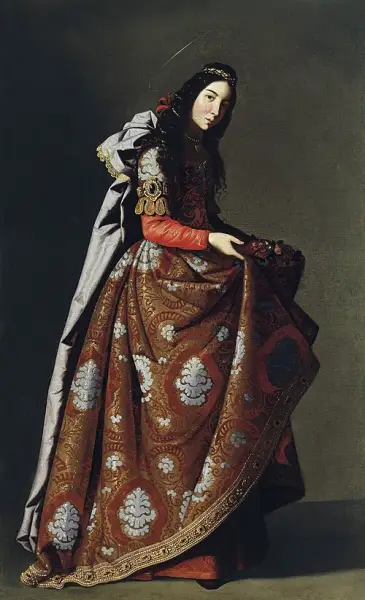
Casilda's afterlife in art is unusually rich for a saint of whom so little is certain. Francisco de Zurbarán painted his Santa Casilda between 1638 and 1642, taking as his model a lady of the Spanish court and clothing her in the fashions worn by courtiers of his own day, so that the Muslim princess appears as a grandee of seventeenth-century Spain, roses in her lap. Juan Rizi treated the same figure, and the episode itself was painted more than once: José Nogales of Seville made a Miracle of the Roses of it, and Zacarías González Velázquez another Miracle of St Casilda, while Burgos Cathedral preserves the scene of the saint apprehended with her basket in stained glass. This iconographic persistence explains much of her continuing fame, for each generation of painters re-told the story in its own dress. Devotionally she is invoked for Muslim converts to Christianity, a patronage of poignant permanence, and for infertile women, as well as for her native Toledo. Concha Espina devoted a full biography to her in 1940, and modern historians, notably Weinstein and Bell in their study of saints and society, have used her legend to show how miracle stories travelled between royal saints across centuries.
§ Gallery
Timeline
- 950
Born at Toledo, a Muslim princess named in the legend as daughter of the emir Yahya ibn Ismail al-Mamun.
§ Introduction
- 1050
Died at Briviesca, said to have lived to the age of one hundred.
§ Life
- 1638
Zurbarán painted his Santa Casilda between 1638 and 1642, using a lady of the Spanish court as his model.
§ Gallery
The Record
- Patron of
- Muslim converts to Christianity·Infertile women·Toledo, Spain
- Symbols
- Roses carried in her basket or dress
- Canonization
- Pre-congregation; beatified before the modern process, venerated in the Catholic and Orthodox churches
Prayer
Bibliography
Show 6 sources
- Concha Espina, Casilda de Toledo (Madrid: Biblioteca Nueva, 1940).
- "St. Casilda of Toledo, Spain", Antiochian Orthodox Christian Archdiocese of North America. Retrieved 6 May 2018.
- Weinstein, Donald; Rudolph M. Bell (1986). Saints and Society: The Two Worlds of Western Christendom, 1000–1700. Chicago: University of Chicago Press. p. 256. ISBN 978-0-226-89056-2.
- "St. Casilda", Franciscan Media. Retrieved 6 May 2018.
- Butler, Alban; Burns, Paul (1999). Butler's Lives of the Saints: April. A&C Black. p. 66. ISBN 978-0-86012-253-1.
- "Saint Casilda of Toledo – Saint of the Day – April 9", 9 April 2019.
Profile text adapted from the Wikipedia article, licensed CC BY-SA 4.0.
Pray with this saint every day
Save St. Casilda of Toledo to your favorites, read the full profile, and get feast-day reminders in the Saints app.
Get the Saints AppFree on the App Store for iPhone and iPad