
1458 – 1484·Feast March 4
St. Casimir
Prince of Poland and Lithuania, patron of youth
Overview
Casimir Jagiellon belonged by birth to the ruling house of both Poland and Lithuania: a prince of the Kingdom of Poland and the Grand Duchy, second-born son of King Casimir IV Jagiellon and of Queen Elisabeth Habsburg of Austria. Born at Wawel Castle in Kraków on 3 October 1458, he was tutored by the chronicler Jan Długosz and learned Lithuanian, Polish, German, and Latin. When his elder brother Vladislaus was elected King of Bohemia in 1471, Casimir became heir apparent to Poland and Lithuania. At thirteen he took part in the failed campaign to place him on the Hungarian throne, an expedition that collapsed in retreat and winter hardship. Contemporaries recorded his exceptional intellect, humility, and justice, and his generosity toward the sick and poor. He declined a marriage arranged with Kunigunde of Austria, preferring celibacy, and took over chancellery duties at Vilnius as his health failed. He developed tuberculosis, most likely, and died at Grodno on 4 March 1484 at the age of twenty-five. Buried in Vilnius Cathedral, he was venerated almost at once; his brother Sigismund I the Old initiated his canonization in 1514, and he was recognized as a saint in 1521 by Leo X or by the brief of Clement VIII in 1602. He is patron of Lithuania, Poland, and Lithuanian youth.
The Complete Life
A Child of the Jagiellon Court
Casimir was born at Wawel Castle in Kraków on 3 October 1458, a member of the Jagiellon dynasty that ruled both Poland and Lithuania. He was the third child and second son of King Casimir IV and Queen Elisabeth Habsburg of Austria, a devoted mother who took an active interest in her children's upbringing and often brought them along on the king's annual journeys to the Grand Duchy of Lithuania. The boy grew into a polyglot, commanding Lithuanian, Polish, German, and Latin. From his ninth year onward, he and his brother Vladislaus studied under the Polish priest Jan Długosz, a teacher strict and conservative by temperament, who trained them in Latin, German, legal study, history, rhetoric, and the classics, and who made ethics, morality, and religious devotion his constant emphasis, morality, and religious devotion, with corporal punishment approved by their father. Casimir's gifts showed themselves early in public speech: in 1469 he delivered an address greeting his father on returning to Poland, and in 1470 he welcomed Jakub Sienienski, Bishop of Kujawy, in like fashion. Długosz noted the prince's talent for oratory, one of the first signs of a mind that contemporaries would remember for its exceptional quality.
§ Early life and education
Heir to Two Thrones
Dynastic politics reshaped the young prince's future before he was out of his teens. His uncle Ladislaus the Posthumous, King of Hungary and Bohemia, had died without an heir, and Casimir's father advanced the family's claims to both crowns. When George of Poděbrady died in March 1471, Vladislaus was elected to the Bohemian throne in May, and Casimir thereby became heir apparent to Poland and Lithuania. King Casimir IV resolved to press further, installing his second son on the Hungarian throne against Matthias Corvinus. An army of twelve thousand men crossed the Hungarian border in October 1471, but the expected reinforcements never came, Corvinus won over the Hungarian nobles, and the expedition retreated through shortage, disease, and winter. The prince was sent to Jihlava for his safety in December, and after a truce in March 1472 he returned to Kraków to resume his studies. Długosz observed that he felt great sorrow and shame at the failure. Some researchers, noting his exposure to the cult of his uncle Władysław III, who fell at the Battle of Varna, have concluded that the Hungarian disaster turned Casimir decisively toward the religious life.
§ Hungarian campaign
Service in Church and State
Though marked for kingship, Casimir's public life took the shape of duty rather than ambition. The Italian humanist Filippo Buonaccorsi was engaged as his tutor in political matters, but the Renaissance polish left less mark on him than Długosz's severe schooling had. In 1474 the merchant and traveler Ambrogio Contarini met the prince and came away impressed by his wisdom. That same period of his education complete, at sixteen he spent most of his time at his father's side. In 1476 he accompanied the king to Royal Prussia, where the crown sought to settle its conflict with the Prince-Bishopric of Warmia. When the Seimas of the Grand Duchy of Lithuania demanded in 1478 that the king leave one of his sons in Vilnius as regent, Casimir IV refused, fearing separatist currents, though he moved to Vilnius after settling the Prussian affair and spent the years from 1479 to 1484 attending to Lithuanian affairs. Danger shadowed the succession: in 1481 a plot by Mikhailo Olelkovich and his relatives to murder the king and the prince at a wedding hunt was discovered, and Casimir departed for Poland to serve there as vice-regent, perhaps for his own safety, governing in a role that asked prudence rather than glory.
§ Later life and death
Piety of a Prince
The testimonies of his own day portray the prince as a young man of uncommon mind and learning, courteous and humble, always pursuing what was just and fair; those who knew him recalled his open-handed care for the sick and the poor. His inclination to the religious life deepened toward the end of his short life, and later sources preserved the shape of his devotion. Marcin Kromer related that he refused his physician's advice to have relations with women in the hope of curing his illness, preferring chastity even at the cost of his health. Other traditions hold that a particularly severe fast brought on his lung disease, and portray him before daybreak kneeling at the gates of a church until a priest should come to unlock them. His father sought to bind him in marriage to Kunigunde of Austria, daughter of Emperor Frederick III, but the prince is said to have declined the match, choosing celibacy and, as it seemed, sensing his approaching death. Zacharias Ferreri wrote that the prince had composed a hexameter prayer upon the incarnation of Christ, though that text has since perished, while a copy of the hymn Omni die dic Mariae was found in his coffin and became so identified with him that it is often called the Hymn of St. Casimir.
§ Pious life and attributed miracles
Illness and Death at Grodno
Casimir's health gave way as his responsibilities grew. According to Maciej Miechowita, he developed tuberculosis, and rumors of his piety and good deeds spread even as his strength declined. In May 1483 he rejoined his father at Vilnius. When Andrzej Oporowski, who held the offices of Bishop and Vice-Chancellor of the Crown, died, Casimir took over part of the chancellery's work, serving the state while his strength ebbed. In February 1484 the gravity of his condition interrupted the business of the realm: the Polish sejm assembled at Lublin was aborted so that King Casimir IV could hurry back to Lithuania to be with his son. The prince died at Grodno on 4 March 1484, twenty-five years old, an heir who never reigned. His remains were carried to Vilnius and interred in the cathedral, in the crypt beneath the Royal Chapel his father had built in the Gothic style in 1474. The tomb would soon become a place of pilgrimage, and the wonders reported there within a generation of his death gave rise to the cause that would place the young prince among the saints of the Catholic Church.
§ Later life and death
From Veneration to the Altars
Casimir's official cult spread quickly after his death. In 1501 Pope Alexander VI, citing his miracles and the splendor of his burial chapel, granted a special indulgence to pilgrims who prayed there from one vespers to another during certain festivals and contributed to the chapel's upkeep. In 1513 Andrzej Krzycki described the many wax votive offerings already crowding the grave. During the Fifth Council of the Lateran in 1514, the prince's brother, King Sigismund I the Old, petitioned for his canonization, and after repeated requests Pope Leo X appointed a three-bishop commission in November 1517, later sending his legate Zacharias Ferreri to investigate. Ferreri arrived in Vilnius in September 1520 and wrapped up his task within roughly two months. The report he produced, Casimir's first brief hagiography, was issued at Kraków in 1521 under the title Vita Beati Casimiri Confessoris. Canonization seemed certain, but Leo X died in December 1521, and no documentary proof of a bull survives, though crucial records were lost in the Sack of Rome of 1527. Casimir was entered in the first Roman Martyrology in 1583, and on 7 November 1602 Clement VIII's brief Quae ad sanctorum authorized his feast on 4 March in Poland and Lithuania, noting that Leo X had added him to the ranks of the saints; in the absence of any earlier document, the brief is often cited as his canonization.
§ Canonization and official veneration
Chapel, Painting, and a Living Cult
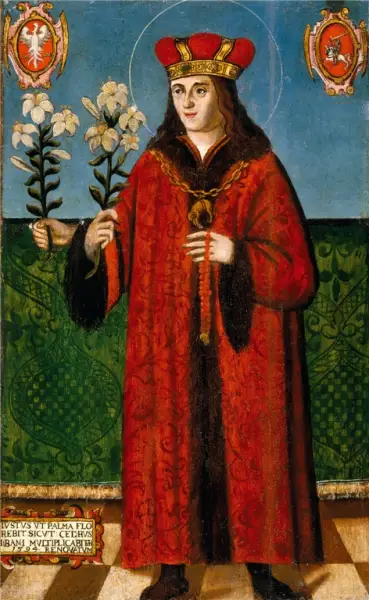
Veneration of Casimir flourished anew in the seventeenth century. Bishop Benedykt Woyna championed his cause, and the three-day festival of May 1604 welcomed the papal banner, saw the remains lifted from the crypt to the altar, and marked the laying of the cornerstone for the Church of St. Casimir; when the coffin was opened that August, a wonderful smell was said to fill the cathedral for three days. In 1607 and 1613 the bishop declared him patron of Lithuania, and in March 1636 Urban VIII granted the feast an octave in Vilnius and the Grand Duchy as his remains were moved to the newly completed Chapel of Saint Casimir. The saint's image follows a painting of about 1520 in Vilnius Cathedral, considered miraculous, which shows him with two right hands, a peculiarity explained by legend, by the painter's wish to picture his exceptional generosity, or by an old design bleeding through new paint. He appears as a young man in a long red robe lined with stoat fur, wearing or beside the grand ducal cap, holding a lily, the emblem of purity, and sometimes a cross, rosary, or book. His silver sarcophagus of 1747 rests in the chapel; his relics were hidden in wartime, exiled by Soviet authorities in 1952, and restored in 1989. In Vilnius his feast is kept each year with the Kaziuko mugė trade fair on the Sunday nearest 4 March, and more than fifty churches in Lithuania and Poland, together with dozens across the American diaspora, bear his name, as do the Sisters of Saint Casimir, founded by Maria Kaupas in 1908.
§ Dedications
Timeline
- 3 Oct 1458
Born at Wawel Castle in Kraków, third child and second son of King Casimir IV and Queen Elisabeth Habsburg of Austria.
§ Early life and education
- 1469
Delivered a speech greeting his father on the king's return to Poland, revealing his skill in oratory.
§ Early life and education
- May 1471
His elder brother Vladislaus was elected King of Bohemia, making Casimir the heir apparent to Poland and Lithuania.
§ Later life and death
- Oct 1471
Crossed the Hungarian border with a Polish army of 12,000 men in the failed campaign to install him as King of Hungary.
§ Hungarian campaign
- Mar 1472
After a truce lasting one year was struck at Buda, he went back to Kraków and took up his studies again under Długosz.
§ Hungarian campaign
- 1474
His father built the Gothic crypt under the Royal Chapel of Vilnius Cathedral where Casimir would later be buried.
§ Physical remains and relics
- 1476
Traveled with his father to Royal Prussia as the crown worked to settle its dispute with the Prince-Bishopric of Warmia.
§ Later life and death
- 1481
After a plot to murder the king and prince came to light, Casimir departed for Poland to serve there as vice-regent.
§ Later life and death
- May 1483
Joined his father in Vilnius and took over chancellery duties following the death of Bishop Andrzej Oporowski.
§ Later life and death
- Feb 1484
The sejm gathered at Lublin was cut short so that King Casimir IV could hurry home to Lithuania and the side of his dying son.
§ Later life and death
- 4 Mar 1484
Died at Grodno, most likely of tuberculosis, and his remains were interred in Vilnius Cathedral.
§ Later life and death
- 1501
Pope Alexander VI granted a special indulgence to those praying at Casimir's chapel during certain festivals.
§ Canonization and official veneration
- 1514
His brother King Sigismund I the Old petitioned the pope at the Fifth Council of the Lateran to canonize him.
§ Canonization and official veneration
- 1518
Was believed to have appeared before the Lithuanian army at the Siege of Polotsk, revealing a safe crossing of the Daugava River.
§ Pious life and attributed miracles
- 1521
Zacharias Ferreri's findings, the first short hagiography of Casimir, were published in Kraków as Vita Beati Casimiri Confessoris.
§ Canonization and official veneration
- 7 Nov 1602
Pope Clement VIII issued the brief Quae ad sanctorum, authorizing his feast on 4 March in Poland and Lithuania.
§ Canonization and official veneration
- 10 May 1604
A three-day festival welcomed the papal banner; his remains were lifted from the crypt up to the altar, and work began on the Church of St. Casimir.
§ Canonization and official veneration
- Mar 1636
Pope Urban VIII allowed his feast with an octave in the Diocese of Vilnius and the Grand Duchy of Lithuania, equivalent to proclaiming him patron of Lithuania; his remains were moved to the completed Chapel of Saint Casimir.
§ Physical remains and relics
- 1655
Before the Battle of Vilnius during the Deluge, his relics were removed and hidden, first at the Ruzhany Palace, until their return in 1663.
§ Physical remains and relics
- 1908
The women's congregation Sisters of Saint Casimir was established by Maria Kaupas and remains active in the United States.
§ Dedications
- 11 Jun 1948
Pius XII proclaimed Casimir special patron of Lithuanian youth at a time when many Lithuanians were displaced refugees of war.
§ Canonization and official veneration
- Oct 1952
Soviet authorities had his relics transferred without ceremony to the Church of St. Peter and St. Paul, and the cathedral reopened as an art gallery.
§ Physical remains and relics
- 1989
His relics returned to their place when Vilnius Cathedral was reconsecrated.
§ Physical remains and relics
The Record
- Major works
- Prayer in hexameter on Christ's incarnation (lost, attributed by Zacharias Ferreri)
- Patron of
- patron of Lithuania (1636)·patron of Poland·patron of Lithuanian youth (1948)
- Symbols
- lily·grand ducal cap
- Canonization
- Traditionally canonized in 1521 by Pope Leo X; formally recognized in the papal brief of Clement VIII on 7 November 1602
Prayer
Bibliography
Show 7 sources
- Jestice, Phyllis G. (2004). Holy People of the World: A Cross-cultural Encyclopedia. ABC-CLIO. ISBN 978-1-57607-355-1.
- Duczmal, Małgorzata (2012). Jogailaičiai. Translated by Birutė Mikalonienė and Vyturys Jarutis. Vilnius: Mokslo ir enciklopedijų leidybos centras. ISBN 978-5-420-01703-6.
- Burns, Paul (2007). Butler's Saint for the Day (revised ed.). Liturgical Press. ISBN 9780814618363.
- Čiurinskas, Mintautas (2003). Šv. Kazimiero gyvenimo ir kulto šaltiniai. Vilnius: Aidai. ISBN 9955-445-72-6.
- Maslauskaitė, Sigita (2006). "Šv. Kazimiero relikvijos ir relikvijoriai". In Račiūnaitė, Tojana (ed.). Šventųjų relikvijos Lietuvos kultūroje. Acta Academiae Artium Vilnensis, Vol. 41. Vilniaus dailės akademijos leidykla. ISBN 9955624612.
- Conway, G. E. (2003). "Omni die dic Mariae". New Catholic Encyclopedia, Vol. 10 (2nd ed.). Thomson/Gale. ISBN 9780787640040.
- Paltarokas, Kazimieras (2010). Karalaitis Šventasis Kazimieras. Danielius. ISBN 978-9955-476-84-9.
Profile text adapted from the Wikipedia article, licensed CC BY-SA 4.0.
Pray with this saint every day
Save St. Casimir to your favorites, read the full profile, and get feast-day reminders in the Saints app.
Get the Saints AppFree on the App Store for iPhone and iPad