
died 298·Feast December 3
St. Cassian of Tangier
Court Recorder Martyred for Protesting an Unjust Sentence
Overview
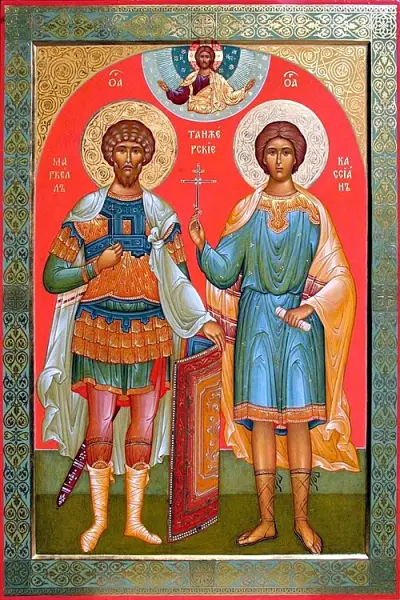
Cassian of Tangier, also called Cassian of Tingis, was a Christian of the third century who died a martyr at Tingis in the Roman province of Mauretania Tingitana, the modern Tangier in Morocco, on 3 December in the year 298, during the reign of Diocletian. His Passion has come down appended to that of Saint Marcellus the Centurion, and it is in Marcellus's trial that Cassian appears. He was serving as the court recorder, the shorthand clerk whose duty was to take down the proceedings, when Aurelius Agricola, the deputy prefect who conducted the trial in North Africa, passed sentence of death on the centurion. Cassian could not write out an unjust condemnation. He threw down his pen and declared openly that the sentence was unjust, was arrested on the spot, and was put to death a few days later. Because his protest was made with the pen of a stenographer, he has become the patron saint of modern stenographers. The hymn-writer Prudentius, born in 348, honours him by name in his Liber Peristephanon, telling how Tingis will bring her Cassian to the crowns of the martyrs. His feast is kept on 3 December.
The Complete Life
A Christian of Tingis
The record tells us almost nothing of Cassian before the morning that made him a martyr, and what it does tell is mostly place and office. He was a Christian living at Tingis, the Roman town at the Pillars of Hercules that gives its name to Tangier, in the province the empire called Mauretania Tingitana after it. He was born, so far as the tradition estimates, around the middle of the third century, which would make him a mature man of perhaps forty or fifty at his death, a Christian of the generation that had grown up between the persecutions, when the church of North Africa was numerous and deeply rooted. His name, Cassian, was common enough among Christians of the region, and in some catalogues his memory passed under other forms. He should not be confused either with John Cassian, the great monastic writer of Marseille, or with the schoolmaster martyr of Imola, who shares his name. What his office was, the Passion does make plain: he was a court recorder, a shorthand writer attached to the tribunal, one of the minor functionaries without whom no Roman court could proceed, whose skill with the pen was the technology of record-keeping in an empire that wrote down everything.
§ Introduction
The Pen Thrown Down
Cassian's vocation was consummated in a single public gesture made in the course of his ordinary work. The trial at which he was recording was that of Marcellus the Centurion, a soldier of the legion who had thrown down his military belt and declared that he would serve none but Christ, and the presiding judge was Aurelius Agricola, deputy prefect of the Roman province in North Africa. Sentence of death was passed on the soldier. At that point the clerk, whose whole task was to write what the court decreed, discovered a limit to his profession: there are things a Christian hand may not set down. He threw his pen to the ground and said aloud, before the tribunal, that the sentence was unjust. The act was doubly dangerous, a contempt of court and a confession of faith in the same motion, and it was treated as both: he was arrested immediately. A few days later he was executed, on the third of December, in the year 298, while Diocletian reigned. The smallness of the gesture, one pen, one sentence, thrown against one unjust verdict, is what has kept his memory fresh among those whose work is to record the words of others and who sometimes find that the words are unbearable.
§ Life
December in Tingis
The interval between Cassian's arrest and his death was only a few days, and the tradition has preserved no further examination, no dialogue with the judge, no testimony of torture, such as give other African martyrdoms their shape. What it has preserved is the date, the third of December, and the year, 298, which places his death in the opening years of the great persecution of Diocletian, the last and most systematic attempt of the Roman state to destroy the church, though in the far western province of Mauretania Tingitana its machinery arrived late and worked fitfully. That his Passion should have been transmitted attached to that of Marcellus, the centurion whose condemnation he protested, is fitting, for the two deaths belong to one another: the soldier died for renouncing his service, and the clerk died for renouncing his. How he was killed the account does not specify, and later iconography, which shows him with the palm and the pen, has been left to supply what the text withholds. His remains stayed at Tingis, and the town itself, pagan then and wholly transformed since, remains identified with him, so that the saint is called indifferently of Tangier or of Tangiers or of Tingis, by whichever name the city has borne.
§ Life
Patron of Stenographers
Cassian's afterlife rests on two foundations, one devotional and one literary. The devotional one is his patronage: he is the patron saint of modern stenographers, an office claimed for him with perfect logic from the part he played at Marcellus's trial, and every shorthand writer since who has sat at a proceeding and taken down what was said does so, in the church's imagination, under the protection of the clerk who could not. The literary foundation is older. Prudentius, the Spanish lawyer turned hymn-writer, born in 348, within fifty years of the martyrdom, honoured Cassian by name in his Liber Peristephanon, the hymns on the crowns of the martyrs, in a passage that pictures Tingis presenting her Cassian among the festive monuments of the Massylian kings, his ashes drawing the nations he conquered to the yoke of Christ. To be named in a hymn by the greatest Latin poet of the martyrs was a more durable immortality than most African confessors received, and the quotation has kept his cult supplied with words ever since. He is venerated both in the Catholic Church and in the Eastern Orthodox Church, which keeps his icon in the Russian Orthodox church of the Resurrection at Rabat, a few miles from the place of his death.
§ Veneration
Timeline
- 250
Born around the middle of the third century.
§ Introduction
- 298
As court recorder at the trial of Marcellus the Centurion before deputy prefect Aurelius Agricola, he threw down his pen, called the death sentence unjust, and was arrested at once.
§ Life
- 3 Dec 298
Beheaded at Tingis a few days after his arrest, during the reign of Diocletian.
§ Introduction
- 348
Prudentius, the hymn-writer born this year, later named Cassian among the martyrs in his Liber Peristephanon.
§ Veneration
The Record
- Patron of
- Stenographers
- Symbols
- Pen and writing tablet·Crown of martyrdom
- Canonization
- Pre-congregation; an early martyr of Mauretania Tingitana venerated in the Catholic and Orthodox churches
Prayer
Bibliography
Show 5 sources
- Watkins, Basil (November 2015). The Book of Saints: A Comprehensive Biographical Dictionary. Bloomsbury Publishing. p. 128. ISBN 9780567664150.
- Lamport, Mark A., ed. (June 2018). Encyclopedia of Christianity in the Global South, Volume 2. Rowman & Littlefield Publishers. p. 541. ISBN 9781442271579.
- O'Malley, Vincent J. (14 September 2001). Saints of Africa. Our Sunday Visitor Publishing. p. 164. ISBN 978-1-61278-276-8.
- Patron Saints Index: Saint Marcellus the Centurion.
- Lives of the Saints: October 30 – St. Marcellus the Centurion, Martyr.
Profile text adapted from the Wikipedia article, licensed CC BY-SA 4.0.
Pray with this saint every day
Save St. Cassian of Tangier to your favorites, read the full profile, and get feast-day reminders in the Saints app.
Get the Saints AppFree on the App Store for iPhone and iPad