
died c. 264·Feast May 15
St. Cassius of Clermont
Senator Martyred with His Companions at Clermont
Overview
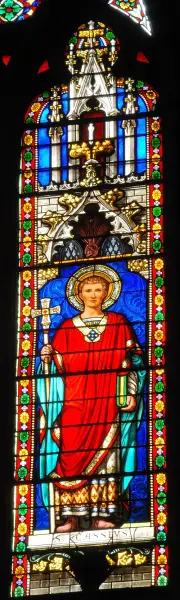
Cassius of Clermont is honoured as a Christian martyr of the third century in the Auvergne. He was a senator, a member of the governing class of Roman Gaul, who was brought to the Christian faith by Austromoine, the apostle of that region. He died in about the year 264 at Clermont-Ferrand, together with a company of companions: Victorinus, himself a pagan priest before the same missionary converted him, and Maximus, Anatolius, Linguinus and others. They were killed by Chrocas, the chieftain of the Alemanni, whose war band was invading Roman Gaul at the time, and the tradition reports that Chrocas put to death a total of 6,266 Christians at Clermont in that invasion, a number that belongs to legend rather than to countable history but that measures the scale of the remembered catastrophe. Gregory of Tours, writing in the sixth century, mentions a church of Saint Cassius the Martyr standing at Clermont, which shows that his cult was already established there within three hundred years of his death. He is venerated in the Roman Catholic and Eastern Orthodox churches, and his feast is kept on 15 May. A stained glass window in the church of Saint-Eutrope at Clermont-Ferrand still depicts him.
The Complete Life
A Senator Converted
Cassius belonged to the class of Roman Gaul from which the church's earliest notable converts were drawn, the curial aristocracy of the provincial towns. He was a senator, which in the usage of the third-century empire means a member of a city's local senate or ordo, a landowner with duties of office and taxation rather than a legislator of Rome itself. His conversion came through Austromoine, the missionary bishop remembered as the apostle of the Auvergne, who according to the same tradition had been sent to Gaul among the first band of evangelists and whose work at Clermont, the Arverni of the Romans, gathered both humble and distinguished believers. The conversion of a senator was no small gain for a missionary congregation: it gave the young Christian community a protector with standing, wealth and acquaintance with the way the empire worked. Cassius was not alone in this at his city, for Victorinus, who died with him, had been a pagan priest before the same preacher brought him into the church, so that the community at Clermont contained, within a generation of its foundation, both a former priest of the old cults and a sitting member of the civic senate. What office Cassius held, whether he married, how old he was, the Acts do not say; his life, as so often with the martyrs of Gaul, is known only from its ending.
§ Introduction
Chrocas at the Gates
The death of Cassius belongs to one of the darkest chapters of third-century Gaul, the irruptions of the Alemanni across the imperial frontier. The tradition gives the invader a name and a number: Chrocas, the chieftain of the Alemanni, whose host fell upon Roman territory and reached the country of the Arverni, and who, the same tradition reports, slaughtered 6,266 Christians at Clermont in the course of the invasion. The figure is plainly a legendary tally rather than a census, but it encodes a real memory of a town overrun and its people killed, and it fixes the reputation of the assault as a persecution in the martyrological sense, since those who died were remembered as dying for the faith rather than merely in war's way. Among them were Cassius the senator, Victorinus the former pagan priest, Maximus, Anatolius and Linguinus, and others whose names the account keeps only as a company. The date assigned is about the year 264, which falls in the troubled middle decades of the century when the frontier defences of the empire repeatedly failed and the barbarian confederations raided deep into the provinces. That a bishop's city, a Christian congregation gathered around its senator and its convert priest, should be destroyed in such a raid, made the whole company martyrs at once and gave the church of the Auvergne its first great roll of honour.
§ Introduction
The Church of Saint Cassius
The cult of Cassius at Clermont is attested early and by the highest authority. Gregory of Tours, the sixth-century historian and bishop who is the principal source for the religious history of Merovingian Gaul, mentions a church of Saint Cassius the Martyr at Clermont, which establishes that within roughly three centuries of the martyrdom a substantial church stood there under his invocation, and that his memory had passed from family tradition into public liturgy. In a city that had been the seat of a bishop since apostolic times according to its own claims, the martyr senator took his place beside the missionary bishop who had converted him, and the pair came to define the sacred history of the Auvergne. Devotion to Cassius and his companions has continued in the region ever since: he is venerated in the Roman Catholic Church and in the Eastern Orthodox Church, his feast stands on 15 May, and the church of Saint-Eutrope at Clermont-Ferrand preserves a stained glass image of him, a senator in glass with the palm of a martyr. His cult is remembered in the old Catholic Encyclopedia's notices on the diocese of Clermont, in the Benedictines' Book of Saints, and in the scholarly database of the Cult of Saints in Late Antiquity at Oxford, which carries a study of him; the modern pilgrim who looks for him will find him where Gregory found him, in the stones and the calendar of the city that keeps his name.
§ Introduction
Timeline
- 264
A senator brought to Christianity by the missionary Austromoine, Cassius was killed at Clermont-Ferrand with Victorinus, Maximus, Anatolius, Linguinus and others as the Alemanni under Chrocas raided Roman Gaul.
§ Introduction
- 264
Chrocas's assault on Clermont is traditionally credited with the deaths of 6,266 Christians in all.
§ Introduction
The Record
- Symbols
- Stained glass image at the church of Saint-Eutrope, Clermont-Ferrand
- Canonization
- Pre-congregation; an early martyr of Roman Gaul venerated at Clermont
Prayer
Bibliography
Show 4 sources
- Goyau, Georges. "Diocese of Clermont." The Catholic Encyclopedia, Vol. 4. New York: Robert Appleton Company, 1908.
- "Saints Cassius et Victorin", Nominis.
- Benedictine Monks, Book of the Saints. Kessinger Publishing, 2003, p. 59.
- Wojtalik, Katarzyna. "Cassius, martyr of Clermont." The Cult of Saints in Late Antiquity, University of Oxford.
Profile text adapted from the Wikipedia article, licensed CC BY-SA 4.0.
Pray with this saint every day
Save St. Cassius of Clermont to your favorites, read the full profile, and get feast-day reminders in the Saints app.
Get the Saints AppFree on the App Store for iPhone and iPad