
died c. 420·Feast September 2
St. Castor of Apt
Lawyer, Monk and Bishop of Apt in Late Roman Gaul
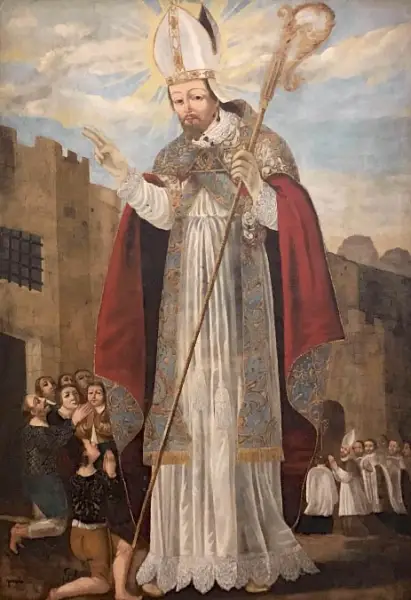
Overview
Castor, who died around the year 420, was bishop of Apt in Gaul, possibly the fourth holder of that see. Born at Nîmes, perhaps the brother of Bishop Leontius of Fréjus, he was educated at Arles and, after his father's death, practised as a lawyer. Undertaking the case of a wealthy widow with an only daughter, he not only won it but pursued it to the imperial court and obtained a rescript that ended the lawsuit for good. On his return he married the widow's daughter when she came of age; a few years later, when the widow herself died, husband and wife by mutual agreement entered religion, she into a nunnery and he into the monastic life he had chosen. Castor founded the monastery of Saint-Faustin at Manauque in Provence under the rule of John Cassian, and though he refused the office of abbot, he accepted it out of obedience when the dying first abbot commanded him. Later made bishop of Apt, he wrote to John Cassian at Marseille asking him to compose a book on the customs of the monks of Egypt and Palestine, the De institutis coenobiorum. In 419 Pope Boniface I named a bishop Castorius among fourteen Gallic bishops ordered to a synod concerning Maximus of Valence. Castor died a natural death on 21 September, in an unknown year of the reign of Honorius, and his remains are preserved in the cathedral of Apt, whose patron he is.
The Complete Life
A Lawyer of Nîmes
Castor was born at Nîmes, the great city of Roman Narbonensis whose amphitheatre and temple still stand, and the tradition ventures that he may have been the brother of Leontius, bishop of Fréjus, which would make him a member of one of those Gallo-Roman families that gave the church of the south its earliest hierarchy. His education was received at Arles, the prefectural capital of the late Roman diocese of the Gauls, where the rhetorical schools trained the lawyers and administrators of the empire, and on the death of his father Castor took up that career, practising at the bar. The one case of his that history preserves shows the man. A wealthy widow with a single daughter was engaged in a lawsuit, and Castor undertook her cause; he did not merely win the case in the ordinary course but travelled to the imperial court itself and secured a rescript, an answer under the emperor's own authority, which ended the litigation once and for all. It was an extraordinary exertion for a young advocate, and the widow's gratitude shaped the whole of his subsequent life: on his return, when her daughter had reached marriageable age, she pressed her daughter's hand, and the possession of all her goods, upon him, and pressed so warmly that he consented to the marriage. He lived a few years as a husband, until the death of his mother-in-law.
§ Life
The Monastery at Manauque
The vocation of Castor was worked out between marriage and monasticism in the manner of the ascetic awakening of the early fifth century. When his mother-in-law died, he and his wife came to a mutual agreement to leave the married state for the religious life: she entered a nunnery, and Castor embraced the monastic profession, the same double conversion which the age of Paulinus of Nola had made familiar among the Gallo-Roman gentry. He did not enter an existing house but founded one, raising the monastery of Saint-Faustin at Manauque, the Monanque of modern Provence, and he set it under the monastic rule of John Cassian, the eastern practice which Cassian had recently brought from Egypt and Palestine to his own foundation of Saint-Victor at Marseille. This choice of the eastern observance, in preference to the various western rules then competing, identifies Castor with the Provençal school of monasticism from which Benedict would later take so much. Characteristically, the founder refused to be the abbot; but when the first abbot lay near death, he commanded Castor out of obedience to accept the succession, and obedience, the very virtue the rule taught, overcame the founder's humility. From the government of that monastery the church would shortly call him to govern a diocese.
§ Life
Bishop and Correspondent of Cassian
Raised to the see of Apt, probably the fourth bishop of that ancient town at the foot of the Luberon, Castor continued to serve the monastic movement he had helped plant. As bishop he wrote to John Cassian, by then the celebrated abbot of Saint-Victor at Marseille, and asked him to compose a treatise on the customs of the monks of Egypt and Palestine; the request produced the De institutis coenobiorum, Cassian's great systematic account of eastern coenobitic life, its institutes and its eight principal faults, which became one of the foundational texts of western monasticism and a principal source from which Benedict of Nursia drew. In this sense a large part of the rule of the west stands at two removes from a letter written by the bishop of Apt. Castor's episcopate also involved him in the discipline of the Gallic church: on 13 June 419 Pope Boniface I addressed a letter to fourteen named bishops together with the remaining bishops of the Gauls and Septimania, instructing them to meet in synod before the first of November to judge the charges against Maximus, bishop of Valence, and the list of those summoned includes a Castorius, whom the tradition identifies with Castor of Apt. The identification makes him one of the metropolitans and senior bishops on whom the papacy relied, at the very moment when the see of Rome was beginning to exercise regular jurisdiction in Gaul.
§ Life
A Natural Death
Unlike so many of the saints of his century, Castor was not a martyr: he died a natural death, on the twenty-first of September, in a year the sources cannot name, within the reign of the Emperor Honorius. That reign ended on 15 August 423, when Honorius died at Ravenna, and so the death of the bishop of Apt must be placed sometime before that summer, which is why the tradition assigns it to about 420. The date within the year, 21 September, has kept its place in the memory of the church even while the year was lost, an instructive instance of how calendars preserve what chronicles forget. He had governed his monastery and then his diocese under the shadow of the collapse of Roman power in Gaul, through the usurpations and invasions of Honorius's reign, and he died before the great settlement that would reorganise the church of Gaul under its new barbarian masters. The manner of his death, quiet and in old age, in the bed of a bishop of a small Provençal see, is itself part of his witness, for he belonged to that generation of Gallic bishops who were not called to blood but to the patient building of monasteries, synods and correspondence, the infrastructure of a church that would outlive the empire that had sheltered it.
§ Life
The Cathedral of Apt
The veneration of Castor has never left the town he governed. His remains rest to this day in the cathedral of Apt, a Romanesque church standing over the older shrines of the city, and he is honoured as one of the patrons of that cathedral and of the diocese it served until the modern reorganisations folded it into larger circumscriptions. His feast is kept on 2 September, close to the day of his death as the old calendars recorded it. The modern historian can follow his traces in the instruments collected by Albanès in the Gallia christiana novissima, which prints the documents of the church of Aix and its neighbours, in Duchesne's Fastes épiscopaux, which ordered the episcopal lists of southern Gaul into critical sequence, in the Jaffé regesta of papal letters, which carry the summons of 419, and in Germain's history of the church of Nîmes, which preserves the traditions of his native city. Devotional pages keep his memory for the diocese of Nîmes and for Catholic internet readers, and the French scholarship of the nineteenth century, Catholic and anticlerical alike, did its careful work on his dates. A saint whose life was spent in lawsuits, marriage, a cloister and a small episcopal town, he remains most of all the friend and instigator of Cassian, the bishop whose letter called into being a classic of the monastic tradition.
§ Veneration
Timeline
- 13 Jun 419
Pope Boniface I names a Castorius among fourteen bishops of Gaul and Septimania ordered to hold a synod before 1 November over accusations against Maximus of Valence.
§ Life
- 21 Sep 420
Dies of natural causes on 21 September, in a year unknown within the reign of Emperor Honorius.
§ Life
- 423
Death of Honorius on 15 August closes the reign within which Castor is known to have died.
§ Life
The Record
- Major works
- Letter to John Cassian requesting the De institutis coenobiorum·Monastery of Saint-Faustin at Manauque in Provence
- Patron of
- Apt, France
- Symbols
- Bishop's vestments·The monastic rule of John Cassian
- Canonization
- Pre-congregation; an early Gallic bishop whose remains rest in the cathedral of Apt
Prayer
Bibliography
Show 5 sources
- Joseph Hyacinthe Albanès, Gallia christiana novissima..., Volume 1: Province d'Aix. Montbéliard: Société anonyme imprimerie Montbéliardaise, 1899, pp. 195–199.
- Alexandre C. Germain, Histoire de l'église de Nîmes, Volume 1. Nîmes: Giraud, 1838, pp. 41–42.
- Duchesne, Louis (1907). Fastes épiscopaux de l'ancienne Gaule, I. Provinces du Sud-Est, 2nd ed. Paris: Fontemoing, p. 282.
- Philippus Jaffé and S. Loewenfeld, Regesta pontificum Romanorum, Volume 1. Leipzig: Veit, 1885, p. 53, no. 349.
- "The Saints of the Diocese of Nîmes."
Profile text adapted from the Wikipedia article, licensed CC BY-SA 4.0.
Pray with this saint every day
Save St. Castor of Apt to your favorites, read the full profile, and get feast-day reminders in the Saints app.
Get the Saints AppFree on the App Store for iPhone and iPad