
died c. 400·Feast February 13
St. Castor of Karden
Hermit-Priest of the Moselle Valley
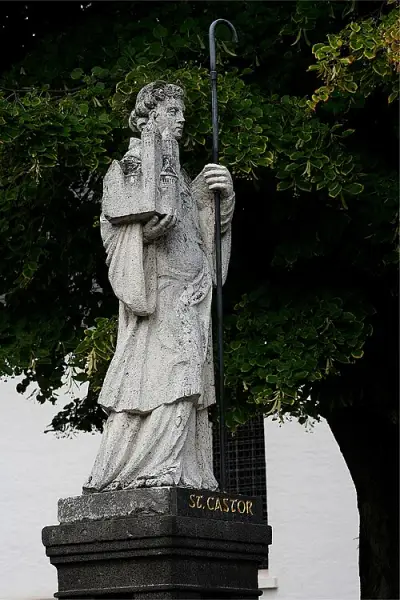
Overview
Castor, whose name appears in German as Kastor von Karden, was a fourth-century priest and hermit whom the Catholic Church and the Eastern Orthodox Church alike honour as a saint. Around the year 345 he was a pupil of Maximinus, bishop of Trier, and it was Maximinus who ordained him priest. Like his teacher, he may well have come from the region of Aquitaine, in the south-west of Gaul. At his ordination he went to settle at Karden, on the river Moselle, living there as a hermit in the company of various like-minded men who gave themselves to an ascetic discipline and formed a small religious community. Among his companions were the Aquitanian pilgrim Saint Potentinus together with the two sons of Potentinus, Felicius and Simplicius. Castor lived to an advanced age and died at Karden around 400. By 791 a reliquary in his honour already stood at Karden and was translated into the local Paulinus church; in 836 Archbishop Hetto of Trier carried the relics to Koblenz, where the Basilica of St Castor grew up around them. Castor is the patron of Koblenz, and his feast is kept on 13 February.
The Complete Life
A Pupil of Maximinus of Trier
The fourth century, in which Castor lived, was the century in which the ascetic life took hold of the western provinces of the Roman world. Men who might have become civic grandees went instead to the edges of cultivated land, to marshes, islands and river valleys, to fast and pray; and the Gallic church, from Martin of Tours onward, made their discipline one of the shapes holiness was expected to take. Castor belongs to the first generation of that movement in the Rhineland. His formation was episcopal rather than monastic in the later sense: about the year 345 he attached himself as a pupil to Maximinus, who then occupied the see of Trier, the great metropolitan church of the German provinces, and it was this bishop who ordained him priest. The tradition adds a plausible detail of provenance, that like his teacher he may have been a native of Aquitaine, the region south of the Loire which in exactly these decades was exporting bishops, monks and missionary priests to the north. Aquitanian clergy had a name for learning and for ascetic rigour, and the pairing of a Maximinus and a Castor, teacher and disciple, moving from the south-west to the Moselle, fits a pattern that the careers of many fourth-century churchmen confirm. What drew Castor from a pupil's bench to a hermit's cell was not recorded; but the step itself, from service in a great cathedral city to solitude on a modest river, is the whole of his vocation told in a single motion.
§ Introduction
The Community on the Moselle
At his ordination, Castor went to Karden, a settlement on the Moselle downstream from Trier, and settled there as a hermit in the company of various companions. The sources name three of them with particular care: the Aquitanian pilgrim Saint Potentinus, and the two sons of Potentinus, Felicius and Simplicius. The little group gave itself to the disciplines of the ascetic life and formed a small community of religion, one of the earliest on the German Moselle. Such a foundation was not a monastery in any formal sense; it was a cluster of cells around a shared discipline of prayer, work and fasting, of the kind that dotted the river valleys of Gaul before any rule bound them together. The presence of Potentinus, described as a pilgrim from Aquitaine, suggests that Karden lay on one of the routes by which devout travellers moved between the south-west of Gaul and the Rhine, and that hermitages such as this one served the passing faithful as well as God. A priest in their midst gave such a settlement its natural centre: the eucharist, celebrated for the brothers and for the country people around them. Castor governed no diocese and wrote no rule that survives; his mission was simply to hold a place of prayer on the Moselle for half a century. He died at Karden at an advanced age, around the year 400, leaving a community remembered well enough that its founder was never forgotten.
§ Introduction
From Karden to Koblenz
The afterlife of Castor is a history of his bones. By the year 791, four centuries after his death, a reliquary dedicated to him already stood at Karden, and in that year it was translated, solemnly and publicly, into the Paulinus church of the town, an act that shows both that his cult was established and that the community of Karden wished to house it worthily. A generation later the relics moved again, and farther. In 836 Hetto, archbishop of Trier, carried them to Koblenz at the confluence of the Moselle and the Rhine, and over them rose the church that became the Basilica of St Castor, one of the great churches of the middle Rhine. The translation belongs to the age in which Carolingian prelates were assembling the relics of saints as anchors of civic and political identity, and Koblenz gained in Castor a patron it keeps to this day. The Basilica of St Castor stands as his major shrine, and his feast is kept on 13 February. Veneration was never confined to one confession: he is honoured by the Catholic Church and by the Eastern Orthodox Church alike, a breadth natural to a saint who lived centuries before the parting of the churches. At Karden itself his memory remained attached to the site of his hermitage, so that the two towns between them preserve both the stillness of his life and the splendour of his cult.
§ Veneration
Timeline
- 345
Becomes a pupil of Maximinus, bishop of Trier, and probably reaches the Moselle from Aquitaine.
§ Introduction
- 345
Receives priestly ordination from Maximinus and makes his home as a hermit at Karden on the Moselle in company with others.
§ Introduction
- 400
Dies at Karden at an advanced age.
§ Introduction
- 791
A reliquary already dedicated to Castor at Karden is translated into the Paulinuskirchen there.
§ Veneration
- 836
Archbishop Hetto of Trier translates the relics to Koblenz, the origin of the Basilica of St Castor.
§ Veneration
The Record
- Major works
- Ascetic community at Karden on the Moselle
- Patron of
- Patron of Koblenz
- Canonization
- Pre-congregation; a Rhenish hermit-priest honoured since late antiquity
Prayer
Bibliography
Show 2 sources
- "Kastor van Karden." Heiligen-3s. Retrieved 27 March 2009.
- "Heiliger Kastor von Karden." Kirchensite.de. Retrieved 27 March 2009.
Profile text adapted from the Wikipedia article, licensed CC BY-SA 4.0.
Pray with this saint every day
Save St. Castor of Karden to your favorites, read the full profile, and get feast-day reminders in the Saints app.
Get the Saints AppFree on the App Store for iPhone and iPad