
mid 3rd century·Feast December 1
St. Castritian
Mid-Third-Century Bishop of Milan
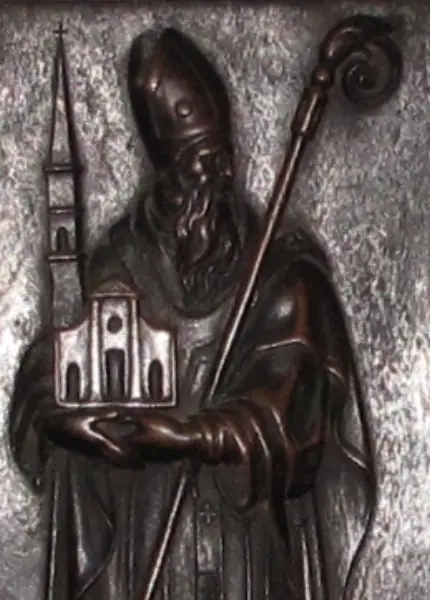
Overview
Castritian, in Latin Castritianus and in Italian Castriziano, was bishop of Milan in the middle of the third century and is honoured by the Catholic Church as a saint, his feast falling on 1 December. He stands in the Ambrosian succession between Caius and Calimerius, at a period from which almost nothing certain survives about the lives or the government of the bishops of the city. His body, it is said, was buried in a graveyard near Porta Romana, a short distance from the modern Basilica of Saint Calimerius, and his relics were afterwards moved into the church of San Giovanni in Conca, a building pulled down across the nineteenth and twentieth centuries. Medieval texts, among them the eleventh-century Historia Dataria, supplied his life with legendary detail: an episcopate of forty-one years beginning in the year 97, shortly after the emperor Domitian, and a consequent death in 138, as well as the setting apart, as a church, of a house given by a man named Philips. Modern scholars, working from fourth-century documents, judge an early house church with a garden between Porta Ticinese and Porta Magenta to be likely, whatever the medieval chronology may invent.
The Complete Life
A Name in the Ambrosian Succession
Castritian appears in the records of the church of Milan as a bishop of the mid-third century, seated between Caius and Calimerius in the list of those who governed the see before Ambrose made it famous. The Milanese church kept the names of its early bishops with care, but almost nothing else: of Castritian's life, his family, his formation or his conduct as a pastor, the ancient sources say in effect that they do not know. This silence is itself instructive. The third century was the age of intermittent persecution, when church records were dangerous things to keep, and the bishops of northern Italy governed congregations that met in private houses and faced periods of suppression. A man who accepted the episcopate in such circumstances accepted a burden that could end in confiscation, exile or death; the office was not yet surrounded by the civic dignity it would later carry. That Milan remembered Castritian at all, and fixed his place in the succession between two other barely documented shepherds, shows a community determined to preserve the continuity of its hierarchy even when it could preserve little else. His vocation, so far as it can be seen, was simply to hold the see, to ordain, to baptise and to hand on an intact church to Calimerius, in the decades before the peace of Constantine transformed the position of every bishop in the empire.
§ Life
The Cemetery by Porta Romana
The tradition reports that Castritian was buried in a graveyard beside Porta Romana, within a short distance of the modern Basilica of Saint Calimerius, the church that preserves the name of his successor. Burial outside or beside a city gate was the custom of the Roman world, whose law long kept the dead beyond the walls, and the cemeteries along the roads leaving Milan became in time the sacred geography of the Milanese church, crowded with the tombs of its bishops and martyrs. The report of the burial place, thin as it is, carries the mark of genuine local memory, for it agrees with what is known of early Christian interment in the city. Later, at a date the sources do not give, his relics were translated into the church of San Giovanni in Conca, in the heart of medieval Milan, where they rested until that church itself was demolished across the nineteenth and twentieth centuries, one of the losses by which the modern city erased much of its ecclesiastical topography. Thus the bishop's body, from a grave by a gate, passed to a shrine in a market square, and finally out of the visible fabric of the city altogether. What remains is his place in the calendar and in the succession, and the December feast by which the church of Milan continued to thank God for a shepherd of whom it knew almost nothing but the name.
§ Life
Legend and Likely Truth
In the Middle Ages, silence about an early bishop invited invention. Texts of that era, among them the Historia Dataria of the eleventh century, furnished Castritian with a biography: an episcopate lasting forty-one years, a reign said to have begun in the year 97, shortly after the emperor Domitian, and a death in 138 accordingly. The same legendary material credited him with consecrating as a church a house donated by a certain Philips. Modern scholarship rejects the chronology outright, for the documented succession of Milanese bishops cannot be stretched back into the first century; there were no such early dates to be had. Yet the legend is not without a kernel. Students of the question, supported by documents of the fourth century, consider it likely that an early house church with a garden stood in the area between Porta Ticinese and Porta Magenta, a real and ancient site of Christian worship, whatever the date of the bishop associated with it. The case of Castritian thus illustrates how the memory of the churches was built: a genuine name, a genuine tomb, a genuine place of assembly, around which later ages arranged dates and donations that the evidence cannot support. His cult endures in the Catholic Church, whose calendar keeps his feast on 1 December, honouring a third-century shepherd whose certain history is brief, and whose legendary history is long.
§ Life
Timeline
- 97
His episcopate is said to begin shortly after Emperor Domitian, in the legendary chronology of the eleventh-century Historia Dataria.
§ Life
- 138
The same legendary tradition assigns his death to this year, after a supposed episcopate of forty-one years.
§ Life
The Record
- Canonization
- Pre-congregation; an early bishop of Milan honoured in the Ambrosian tradition
Prayer
Bibliography
Show 3 sources
- Ruggeri, Fausto (1991). I Vescovi di Milano. Milano: NED. pp. 7-8. ISBN 88-7023-154-2.
- Cazzani, Eugenio (1996). Vescovi e arcivescovi di Milano. Milano: Massimo. p. 11. ISBN 88-7030-891-X.
- Pasini, Cesare (1988). "Castriziano di Milano, santo (sec. IV)". Dizionario della Chiesa Ambrosiana, vol. 2. Milano: NED. pp. 764-765. ISBN 88-7023-102-X.
Profile text adapted from the Wikipedia article, licensed CC BY-SA 4.0.
Pray with this saint every day
Save St. Castritian to your favorites, read the full profile, and get feast-day reminders in the Saints app.
Get the Saints AppFree on the App Store for iPhone and iPad