
died 286·Feast March 26
St. Castulus
Chamberlain of Diocletian, Martyr of the Via Labicana
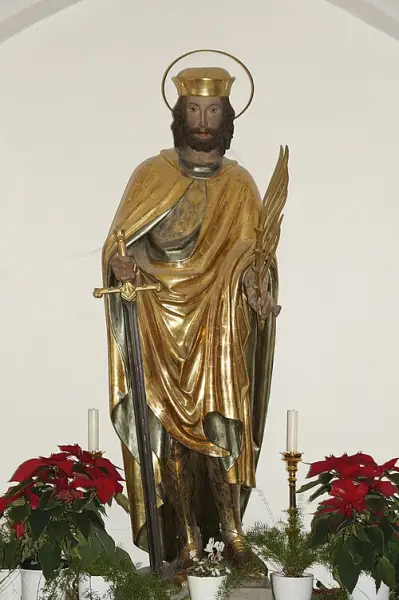
Overview
Castulus, put to death in 286, is honoured as a martyr and saint. Tradition makes him the emperor Diocletian's chamberlain, an officer, a valet, and the husband of Saint Irene of Rome. A convert to the Christian faith, he gave refuge to believers under his own roof and organised acts of worship within the emperor's palace itself, reasoning that it was the one place a Roman investigation would be slow to search; Mark and Marcellian numbered among those he hid. He belongs to the circle of saints connected with the life and legend of Sebastian. Together with his friend Tiburtius he brought many men and women to the faith and led them to Pope Caius for baptism. Betrayed by an apostate named Torquatus, he was brought before Fabian, the prefect of the city, tortured, and put to death by being buried alive in a pit of sand on the Via Labicana. Irene, who is said to have recovered and buried the body, was herself martyred around 288. A church on the site of his death at Rome existed by the seventh century at latest, and his cult flourished in Bavaria after his relics reached Moosburg, where Duke Henry the Lion began the Kastulus Minster in 1171; further relics were carried to Landshut in 1604 and rest in St Martin's church there and in the Saint Castulus church of Prague. He is patron of shepherds and is invoked against erysipelas, lightning, horse theft, wildfire and drowning.
The Complete Life
A Chamberlain at Diocletian's Court
The man the Church honours as Castulus enters tradition not as a soldier or a peasant but as a courtier: chamberlain, in the language of the accounts, an officer or valet serving the emperor Diocletian himself. Such a position placed him in the closest daily proximity to the ruler under whom the last and fiercest persecution of the ancient Church would break, and it implies a man of proven discretion, trusted with the private rooms and private affairs of the most guarded figure in the Roman world. Tradition further names him the husband of Saint Irene of Rome, a woman who is remembered in connection with the Sebastian legend and who would herself be martyred within about two years of his death. Nothing is recorded of where Castulus was born or how he first heard the gospel; what is recorded is that he embraced a faith whose public profession was becoming dangerous, while continuing to serve at a court where the old gods were taken for granted. Converts in his situation had every reason for silence, and most of them, presumably, kept it. The interest of Castulus's story lies precisely here: a man whose profession was domestic order in the palace of persecution became one of the instruments by which the persecuted Church survived inside the capital, and the confidence of his imperial master became, for a time, the safest wall the Christians of Rome possessed.
§ Biography
Services in the Palace
After his conversion, Castulus put his house and his position at the service of the Church. He sheltered Christians in his own home, and he went further: he arranged for religious services to be held inside the palace of the emperor, on the calculation that the imperial residence was the last location a Roman investigation would think of searching. It was bold, and it was shrewd. The persecuting edicts made Christian assembly a crime, and the authorities hunted the meetings in private houses and in the catacombs; but to raid the emperor's own palace was an act no minor official would risk, and so the most dangerous place in the empire became, for a time, one of the most secure. Among the believers he hid were the twin deacons Mark and Marcellian, whose arrest and deliverance belong to the Passion of Sebastian; Castulus belongs among the holy figures gathered around the life and legend of that martyr, a circle that also includes his wife Irene and his friend Tiburtius. The pattern of his vocation is the familiar one of the clandestine Church: homes opened as refuges, the sacraments celebrated in secret, the liturgy kept alive in the interstices of a hostile order. What distinguishes Castulus is the stage on which he played it. He did not flee to the margins of Roman society; he remained at its centre, in the service of the persecutor, and used the trust placed in him to protect the people his master had outlawed.
§ Biography
Winning Converts with Tiburtius
Castulus's work was not only protective but apostolic. Together with his friend Tiburtius he brought many men and women to the Christian faith, and having prepared them he led them to Pope Caius, the bishop of Rome, to be baptised. The detail is worth noticing: converts won in private were presented publicly, in a period when baptism was no light matter, for it sealed a person's entry into a community under legal disability and, in years of active persecution, marked them for attention. That Pope Caius received them at all indicates the quiet continuity of the Roman church's life between the outbreaks of enforcement, catechumens instructed, fonts prepared, bishops at their post. The partnership with Tiburtius, himself venerated as a martyr, gave the mission a shared face: two men of the court and the city, moving among households and workshops, persuading, preparing, and delivering to the font. Every such convert multiplied the risk, since each new Christian was another name that an informer could sell. In the end the mission was betrayed from within its own circle: an apostate named Torquatus, a man who had abandoned the faith he had perhaps only recently embraced, gave Castulus up, and the chamberlain was taken before Fabian, the prefect of the city, the official charged with enforcing the imperial will in Rome. The arrest closed the apostolate and opened the interrogation.
§ Biography
The Sand Pit on the Via Labicana
Before Fabian, prefect of the city, Castulus underwent torture and refused, as martyrs do in the accounts, to deny the faith he had served. His execution was of a piece with the rough improvisation of Roman capital punishment: he was buried alive in a pit of sand on the Via Labicana, the ancient road running east-south-east out of Rome, beyond which the paving and the milestones of the classical world soon gave way to open country. Death by live burial was an infliction reserved in the popular imagination for the most degraded, and to impose it on a chamberlain of the court was a deliberate humiliation, the destruction of a great man in the manner of a common criminal. His wife Irene is credited with recovering the body and giving it honourable burial, an act of piety and of courage, since the remains of executed Christians belonged, in law, to no one who dared claim them. The tradition adds that she followed him within about two years, martyred herself around 288. Thus the household that had sheltered Mark and Marcellian and received the converts of Tiburtius's mission was extinguished in the space of a single persecution. What survived was the memory of the manner of the death, which fixed the saint's attribute, a spade, in the imagination of later Christian art, and gave the Church a patron who knows what it is to be hidden in the earth and to rise in glory.
§ Biography
Honoured Without a Process
Castulus belongs to the vast company of pre-congregation saints, the men and women of the early centuries whose recognition rested on no formal process because no such process yet existed. In the Church of the third and fourth centuries a martyr was honoured by the community that buried him: the anniversary of his death was kept at his tomb, the eucharist was celebrated over the grave, and his name entered the local lists from which, in time, the martyrologies of East and West were compiled. The cult of Castulus shows this pattern exactly. In the West his feast is kept on 26 March, and more particularly on 27 March in the dioceses of Freising and Munich, whose churches received his cult with the Bavarian translation of his relics; the East, receiving the same tradition by other channels, commemorates him on 18 December. The calendar, not a congregation, declared him a saint. His patronage has the practical stamp of medieval popular devotion: he is the patron of shepherds and cowherds, and is invoked against erysipelas, against lightning, against horse theft, against wildfires and against drowning, a catalogue of the dangers of a rural world that saw in the man buried in sand a protector against the sudden catastrophes of field and weather. Christian art gives him the spade of his martyrdom, so that the instrument of his death became the badge of his intercession.
§ Introduction
From the Via Labicana to Bavaria
A church dedicated to Castulus stood at Rome, on the site of his martyrdom by the Via Labicana, from at least the seventh century, evidence that within three hundred years of his death the place of his execution had become a station of prayer. The greater part of his later history, however, belongs to Bavaria. His relics were taken to Moosburg, north-east of Munich, and there Duke Henry the Lion, one of the most formidable princes of the twelfth century, began in 1171 the construction of the Kastulus Minster, a collegiate church raised to shelter the martyr's bones and to serve the pilgrims they drew. The choice made Castulus, a Roman of Diocletian's court, one of the great patrons of the Bavarian countryside. In 1604 portions of the relics were carried in solemn procession to Landshut, where they still rest in the church of St Martin; others are venerated in the Saint Castulus church of Prague, so that the martyr of the Labican road is now claimed by three cities far from the place of his blood. The distribution is a small map of the Middle Ages itself, in which the bones of the early martyrs were the currency of civic piety, carried from Rome to the young cities of the north and housed in buildings that still stand over them. His cult also survives in the liturgy of the Eastern Orthodox Church, which keeps his memory in December, uniting East and West around a chamberlain who hid the Church and was hidden in the earth.
§ Veneration
Timeline
- 286
Betrayed by the apostate Torquatus, he is tortured and executed by live burial in a sand pit on the Via Labicana at Rome
§ Biography
- 288
His wife Irene of Rome, who buried his body, is herself martyred, according to tradition
§ Biography
- 1171
Duke Henry the Lion begins building the Kastulus Minster at Moosburg in Bavaria, where his relics were taken
§ Veneration
- 15 May 1604
Parts of his relics are carried in solemn procession to Landshut
§ Veneration
The Record
- Patron of
- Patron of shepherds·Patron of cowherds·Invoked against erysipelas·Invoked against lightning·Invoked against horse theft·Invoked against wildfires·Invoked against drowning
- Symbols
- Spade
- Canonization
- Pre-congregation; a Roman martyr of the Diocletianic persecution
Prayer
Bibliography
Show 4 sources
- "Saints, December 18." Justin Popović (in Serbian). Archived 28 November 2011 at the Wayback Machine.
- Brewer, Ebenezer Cobham. A Dictionary of Miracles: Imitative, Realistic, and Dogmatic. London: Chatto and Windus, 1901, p. 11.
- "Santos." ACI Prensa, 29 July 2007. Retrieved 27 June 2011.
- Lill, Georg, and Leinberger, Hans (1942). Hans Leinberger, der Bildschnitzer von Landshut: Welt und Umwelt des Künstlers. Bruckmann, p. 42.
Profile text adapted from the Wikipedia article, licensed CC BY-SA 4.0.
Pray with this saint every day
Save St. Castulus to your favorites, read the full profile, and get feast-day reminders in the Saints app.
Get the Saints AppFree on the App Store for iPhone and iPad