
7th century – 685·Feast May 10
St. Catald
Seventh-Century Irish Monk and Bishop of Taranto
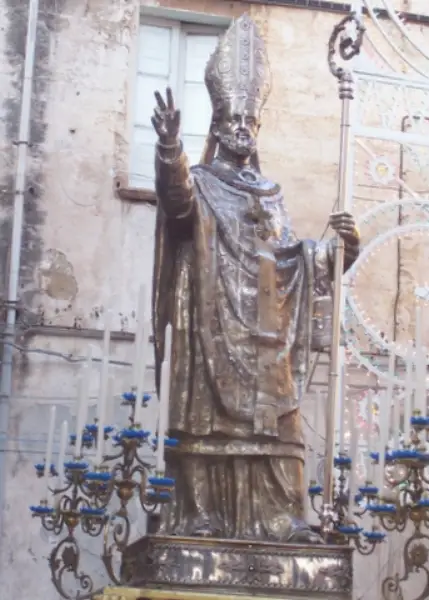
Overview
Catald was an Irish monk of the seventh century, also remembered under the names Cataldus, Cathaldus and Cathal. A native of Munster, he joined the community of Carthage at Lismore in County Waterford, the celebrated monastic school where he eventually succeeded his master as head. Tradition holds that he was consecrated a bishop while still in Ireland. Yearning for solitude, he set out on pilgrimage to Jerusalem. Homeward bound, his vessel was wrecked on the Italian coast close to Taranto, where the local people urged the stranger to take charge of their church. He consented and governed the church of Taranto until his death in 685. Miracles of protection were credited to his intercession, notably the deliverance of the city from plague and from floods that had devastated the surrounding region. When his tomb was opened in the eleventh century, a gold cross deposited at the time of burial was recovered, and his relics were afterwards enclosed in the high altar of the cathedral. His memory spread across southern Italy and Sicily: he was honored as patron by the Sicilian Normans, and churches, towns and parishes from Palermo to Lazio bear his name.
The Complete Life
A Munster Disciple at Lismore
The seventh century in Ireland was an age of great monastic schools, and Catald belongs entirely to that world. He was born in Munster, the southern of Ireland's provinces, and as a young man attached himself to Carthage, founder and teacher of the school of Lismore in County Waterford. Lismore was one of the most famous seats of learning in the Irish Church, drawing students from across the country and sending them out again as monks, priests and bishops. Catald proved a worthy disciple, so much so that on Carthage's departure he stepped into his master's place, carrying forward the work of teaching and governing the community. The tradition of the Irish Church remembers him as a bishop, and it is generally believed that he received episcopal consecration before ever leaving his homeland. Yet the same tradition records a tension in his heart: alongside the burdens of leadership lay a longing for solitude, a desire to withdraw from the crowded life of a school and seek God alone. That longing eventually carried him far from Lismore. Resolving to visit the holy places, he set out on the long and hazardous journey to Jerusalem, the goal of pilgrims from every Christian land. Ireland at this time was sending missionaries across Europe, men such as Columbanus and Gall, and Catald's pilgrimage belongs to that same missionary ferment. His departure from Waterford would prove decisive, for although he intended to return home, events beyond his control would keep him in the Mediterranean world and give his name to cities and churches that honor him still, from the heel of Italy to the mountains of Sicily.
§ Biography
Shipwreck and the Church of Taranto
The decisive turn in Catald's story came at sea. Sailing homeward from Jerusalem, his ship was wrecked on the coast of southern Italy near Taranto, the ancient port city of Apulia. Such a disaster, which might have ended a pilgrimage in tragedy, instead opened a new ministry. The people of Taranto received the Irish bishop and, according to the tradition, pressed him to remain and take charge of their church. Catald accepted this unexpected call, exchanging the solitude he had sought for the pastoral care of a foreign city, and he governed the church of Taranto for the remainder of his life, dying there in 685. His presence was long remembered as a source of protection. When plague threatened Taranto, and again when floods struck the neighboring countryside, the citizens attributed their deliverance to his intercession, and he became the object of a strong local cult. His burial was honored with a gold cross laid in his coffin, a token recovered many centuries later when the tomb was opened in the eleventh century. On that occasion his relics were afterward enclosed within the high altar of the cathedral at Taranto, where the Cattedrale di San Cataldo still stands as the archiepiscopal seat. The saint of an Irish school thus became thoroughly Italian in devotion: patron of Taranto, invoked against pestilence and tempest, and a bridge between the monastic learning of Waterford and the churches of the Mediterranean.
§ Biography
Patron of Cities and Churches
Catald's cult spread remarkably far for a saint whose recorded life is so brief. His feast is kept on 10 May. He was venerated as patron by the Sicilian Normans, who carried his name into the island they conquered, and he remains the patron saint of Corato in the Metropolitan City of Bari, Apulia. The cathedral of Taranto, dedicated to San Cataldo, serves as the seat of the Archdiocese of Taranto and houses the relics placed in its high altar after the eleventh-century opening of his tomb. Sicily preserves two notable churches under his invocation: the Church of San Cataldo in Palermo, recognized as a UNESCO World Heritage Site for its distinctive domed architecture, and the Church of San Cataldo at Erice, which serves as a parish church. On the Italian mainland, the parish church of Montenero Sabino in the province of Rieti, Lazio, is likewise dedicated to him. His name has passed into the map of Italy itself: the town of San Cataldo in Sicily and the modern seaside resort of San Cataldo in the Apulian province of Lecce both bear it. Major shrines associated with him include Lismore in County Waterford and Taranto itself, linking the two ends of his journey. For pilgrims and devotees, Catald stands as a figure of the Irish missionary age, a bishop thrown by shipwreck onto a stranger's shore who answered the call to serve, and whose intercession against plague, drought and storm is still sought by the communities that treasure his memory.
§ Legacy
Timeline
- 600
Born in Munster in the seventh century; becomes disciple and successor of Carthage at the Lismore school
§ Biography
- 685
Dies at Taranto, his see after a shipwreck ended his return from Jerusalem
§ Introduction
- 685
Venerated as a saint from about this time, a pre-congregation canonization
§ Introduction
- 1000
Coffin opened in the eleventh century, revealing a gold cross; relics encased in the cathedral's high altar
§ Biography
The Record
- Patron of
- Invoked for protection from plagues, droughts and storms·Patron saint of Corato, Apulia·Patron of the Sicilian Normans
- Symbols
- Gold cross from his tomb·Bishop's vestments
- Canonization
- Pre-congregation; venerated from about 685
Prayer
Bibliography
Show 3 sources
- Jerome Murphy-O'Connor (2008). The Holy Land: An Oxford Archaeological Guide from Earliest Times to 1700. Oxford Archaeological Guides. Oxford: Oxford University Press. ISBN 978-0-19-923666-4.
- Erice la Montagna del Signore, "La Chiesa di San Cataldo", accessed 21 August 2025.
- Antiche Strutture, entry in the website of the Comune of Montenero Sabino.
Profile text adapted from the Wikipedia article, licensed CC BY-SA 4.0.
Pray with this saint every day
Save St. Catald to your favorites, read the full profile, and get feast-day reminders in the Saints app.
Get the Saints AppFree on the App Store for iPhone and iPad