
9th century·Feast January 19
St. Catellus of Castellammare
Ninth-Century Hermit Bishop of Stabia
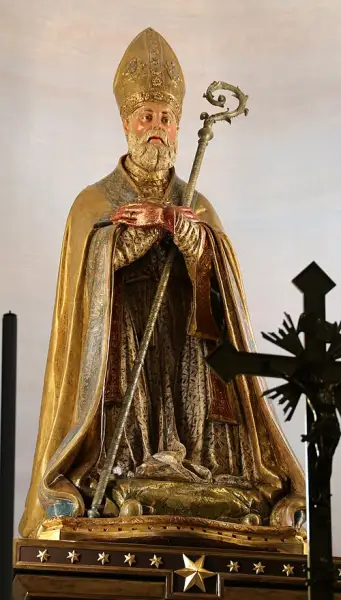
Overview
Saint Catellus, known in Italian as San Catello, was a bishop of Castellammare di Stabia in Campania during the ninth century. He is inseparable from his close friend Saint Antoninus of Sorrento, who had fled the Lombard invasions and found refuge at Castellammare. Catellus, though the city's bishop, wished to embrace the eremitical life; he resigned his office and entrusted the pastoral care of the town to Antoninus while he withdrew to Monte Aureo. The arrangement did not hold. Antoninus, desiring to be a hermit himself, persuaded Catellus to resume his see, and then retired to a natural grotto on the same mountain. In time Catellus again withdrew to Monte Aureo, devoting himself to prayer and attending to his diocese only intermittently. A reported apparition of Saint Michael moved the two friends to raise the stone oratory that today bears the names Monte San Angelo and Punta San Michele. Catellus afterwards faced a charge of witchcraft brought by a priest of Stabia named Tibeius, and he was held at Rome until a newly elected pope released him. Returning to Stabia, he devoted himself to enlarging the church he had helped found. His cult was confirmed in 1729, and a chapel in Castellammare Cathedral honors him.
The Complete Life
Between the See and the Mountain
Catellus stands among those bishops of southern Italy whose hearts were divided between the government of a church and the desert they longed for. As bishop of Castellammare di Stabia, the ancient Stabiae on the Bay of Naples, he exercised a real pastoral office in a city exposed to the political storms of the early medieval Mediterranean. His friendship with Antoninus of Sorrento, who had fled south before the Lombard invasions, gave that division its particular shape. When Antoninus arrived at Castellammare, Catellus was already contemplating withdrawal; he surrendered his office and committed the town's church to the newcomer, taking up residence on Monte Aureo, the mountain that rises above the coast. The experiment satisfied neither man for long. Antoninus discovered in himself the same desire for solitude, and it was he who urged Catellus back to the episcopal throne before retiring to a natural grotto on the mountain he had chosen. Catellus obeyed, resuming the care of the diocese, yet the pull of Monte Aureo remained. In time he returned to its slopes for good, attending to his diocese only at intervals, a compromise between the cloister and the cathedral that many medieval bishops would recognize. His is a vocation lived in tension: a man who twice laid down authority and twice took it up, seeking God on the heights while the plain below still called for its shepherd.
§ Introduction
Oratory, Accusation and Return
The mission of Catellus was carried out in two arenas: the building of a sanctuary and the endurance of an unjust prosecution. On Monte Aureo, according to the tradition, an apparition of Saint Michael the Archangel came to Catellus and Antoninus, and at the heavenly visitor's prompting the two friends constructed a stone oratory that is still known as Monte San Angelo or Punta San Michele. Such mountain sanctuaries dedicated to Michael multiplied across southern Italy in this period, and this one remains the most tangible monument of their partnership. The second arena was harsher. A priest of Stabia named Tibeius accused the bishop of witchcraft, a charge that carried him off to imprisonment in Rome. Catellus languished there until the accession of a new pope, whose intervention set him free. The episode belongs to a long history of prelates slandered by local rivals, and the tradition preserves it without embellishment. His release marked a final chapter rather than a defeat: Catellus came home to Stabia and threw his remaining strength into the work he had begun years before, enlarging the church he had helped to found. Meanwhile his friend Antoninus accepted the invitation of the people of Sorrento and settled among them, becoming abbot of the Benedictine monastery of San Agrippino in succession to Boniface. The two men who had exchanged a see between them ended their lives as neighbors in holiness along the Sorrentine coast.
§ Introduction
The Confirmation of 1729
What is known of Catellus depends on sources that are themselves ancient but late relative to his life. An anonymous chronicler writing toward the end of the ninth century composed the account on which his biography rests, and the same material survives in the documents treating his friend Antoninus, whose lives were told together. One of these lives was edited in 1626 by the Theatine father Antonio Caracciolo, an instance of the scholarly attentiveness of post-Tridentine hagiography. The formal recognition of the saint came through the machinery established after the Council of Trent for regulating local cults. On 13 September 1729 the Sacred Congregation confirmed the cult of Catellus, an act equivalent to the ratification of centuries of popular veneration rather than a modern canonization process with miracles and judicial inquiry. He is honored in both the Roman Catholic Church and the Eastern Orthodox Church, and his feast falls on 19 January. Devotion to him remains anchored in place: a Chapel of San Catello stands within the cathedral of Castellammare di Stabia, and he is invoked as patron of the city and of the diocese. For the Church of Campania he represents the continuity of episcopal and eremitical ideals through the turbulent centuries between the Lombard wars and the settled Catholicism of the eighteenth century.
§ Veneration
Timeline
- 1626
Theatine father Antonio Caracciolo brings out an edited account of the saint's life
§ Veneration
- 13 Sep 1729
The Sacred Congregation formally confirms his cult
§ Veneration
The Record
- Major works
- Stone oratory of Monte San Angelo (Punta San Michele), built with Saint Antoninus after an apparition of Saint Michael
- Patron of
- City and diocese of Castellammare di Stabia
- Canonization
- Cultus confirmed by the Sacred Congregation on 13 September 1729
Prayer
Bibliography
Show 4 sources
- Sant' Antonino di Sorrento.
- Saints of January 19: Catellus of Castellammare (archived 2016-03-04 at the Wayback Machine).
- Catellus di Giuseppe Zingone (in Italian).
- San Catello (in Italian).
Profile text adapted from the Wikipedia article, licensed CC BY-SA 4.0.
Pray with this saint every day
Save St. Catellus of Castellammare to your favorites, read the full profile, and get feast-day reminders in the Saints app.
Get the Saints AppFree on the App Store for iPhone and iPad