
possibly 4th century·Feast October 17
St. Catervus
Martyr and First Evangelist of Tolentino
Overview
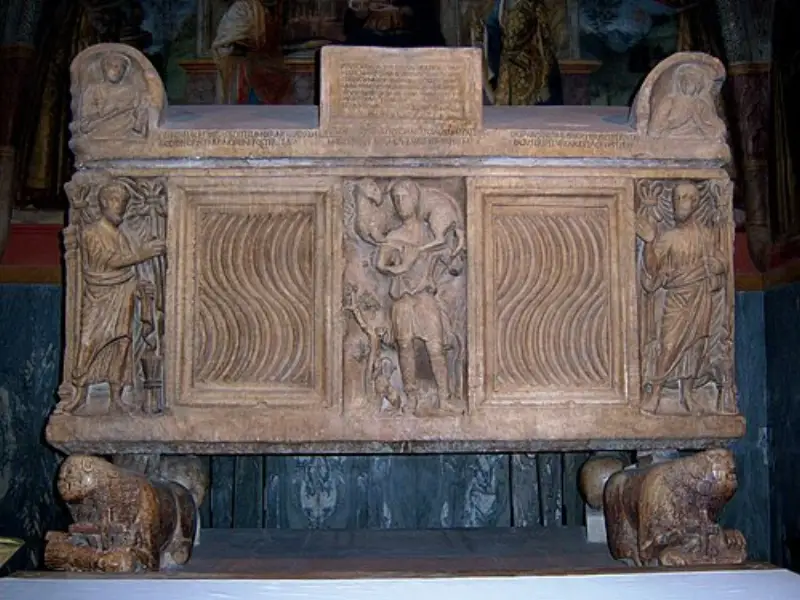
Saint Catervus, in Italian San Catervio, is the patron saint of Tolentino in the Marche and is remembered as the man who first brought the Christian faith to that city. He probably lived in the fourth century, an era whose local evidence is slight: only by the fifth century are bishops attested at Tolentino. The inscription on his sarcophagus gives his full name as Flavius Julius Catervus, and everything else about his rank can be read from that monument: a man of noble, senatorial family who rose to the office of prefect, he died at fifty-six, and his wife Septimia Severina commissioned the fine marble sarcophagus that was to hold them both. Its reliefs show the Good Shepherd and the Magi in adoration, early Christian subjects of unusual quality. Christian tradition holds that Catervus was martyred for his evangelization of the city. The Cathedral of San Catervo, which appears to stand on the site of his Roman mausoleum, preserves the sarcophagus with his relics. The tomb was opened in 1455 and his head transferred to a reliquary; in 1567 his body came to light beside those of Septimia Severina and their son Basso, along with roughly two thousand coins.
The Complete Life
A Senator Becomes a Christian
The evidence for Catervus is monumental rather than literary: almost everything securely known about him was carved in marble. The tabula, or inscription panel, of his sarcophagus names him in full as Flavius Julius Catervus, a style that announces his membership in the late Roman aristocracy. He was, the tradition drawn from the monument holds, of noble senatorial rank and advanced to the office of prefect, one of the administrative posts through which the empire governed Italy in late antiquity. For such a man to embrace Christianity in the fourth century was a consequential act. The century opened with the great persecutions of Diocletian and closed with a Christian emperor, and in between families of the old order had to decide whether the new faith was compatible with their standing. Catervus chose Christ and, according to the local memory of Tolentino in the Marche, brought the Christian religion to that city, becoming its first evangelist. He married Septimia Severina, with whom he had at least one son, Basso, and the family was buried together, a household converted and commemorated as a unit. Catervus died at the age of fifty-six. His widow commissioned for them both a marble sarcophagus of the kind produced for wealthy Christians of the period, carved with scenes from the repertoire of early Christian art, and this monument, surviving in the cathedral of Tolentino, is the anchor of everything the Church remembers about him.
§ Introduction
Martyrdom and a Household's Rest
The Christian tradition of Tolentino holds that Catervus was martyred for his role in establishing the faith there, a claim that stands alongside the archaeological witness of his tomb without contradiction: many early Christians of high rank suffered precisely because their conversion was public and influential. His death at fifty-six, sometime in the fourth century if the dating is right, left his wife Septimia Severina to carry out the burial. She provided a marble sarcophagus for both of them, carved with two of the most beloved images of early Christian art, the Good Shepherd carrying the lost sheep and the Magi bringing their gifts to the Christ Child, the latter a favorite subject for those who wished to show the nations offering homage to the true King. The body of Catervus was laid in a Roman mausoleum, and the cathedral that bears his name appears to have been raised directly upon its site, so that the church and the tomb have never been separated. When the sarcophagus was opened in 1455, the head of the saint was removed to a reliquary so that the faithful could honor it more closely. A further opening in 1567 revealed his body accompanied by the remains of Septimia Severina and of their son Basso, together with a hoard of roughly two thousand coins deposited in the tomb, material that later numismatists would study as evidence for the cult's history.
§ Christian tradition and veneration
The Cathedral of San Catervo
Catervus remains the patron saint of Tolentino, a city in the Marche whose Christian memory he embodies. The Cathedral of San Catervo holds his relics in the original fourth-century sarcophagus, one of the few Italian cathedrals whose principal shrine is an intact paleochristian monument; scholars from Baedeker's handbook of the 1890s to the archaeologists of the twentieth century, among them G. Wilpert, Marco Ioli and Aldo Nestori, have described and photographed its carvings. The apparent continuity between the saint's Roman mausoleum and the later church building gives the site an unusual archaeological interest, since it suggests that Christian worship at Tolentino grew directly out of the veneration of this one tomb. The coins found within the sarcophagus were published by Giancarlo Alteri in a dedicated monograph, a reminder that even the material residue of burial became part of the story. His feast is kept on 17 October, and the inscription naming him, recorded as CIL IX 5566 in the standard corpus of Latin inscriptions, fixes his identity for scholarship. That Tolentino possessed bishops by the fifth century is attested in the Catholic Encyclopedia's account of the united sees of Macerata and Tolentino, a fact that gives context to the tradition of an earlier evangelist. Catervus thus stands at the head of the local church's history: a noble convert, a martyred missionary, and a patron whose monument has outlasted nearly every document of his age.
§ Christian tradition and veneration
Timeline
- 400
By the fifth century Tolentino is known to have had bishops.
§ Introduction
- 1455
His sarcophagus is opened and his head is transferred to a reliquary for greater veneration.
§ Christian tradition and veneration
- 1567
His body is found alongside those of his wife Septimia Severina and son Basso, with about two thousand coins in the sarcophagus.
§ Christian tradition and veneration
The Record
- Patron of
- Patron saint of Tolentino, Italy
- Symbols
- Fourth-century marble sarcophagus carved with the Good Shepherd and the Adoration of the Magi
- Canonization
- Pre-congregation; martyred for bringing Christianity to Tolentino
Prayer
Bibliography
Show 5 sources
- Catholic Encyclopedia: "United Sees of Macerata and Tolentino".
- Santi e beati: San Catervo.
- Baedeker, Italy: handbook for travellers Part II, 11th ed. 1893, p. 110; G. Wilpert, I Sarcophagi Cristiani antichi (1929-36), plates 71-73; Marco Ioli, Il sarcofago paleocristiano di Catervio nel Duomo di Tolentino, 1971.
- Aldo Nestori, Alla ricerca del Mausoleo di Catervio a Tolentino.
- Giancarlo Alteri, Le monete dal sarcofago di Catervio (Istituto poligrafico e Zecca dello Stato, Libreria dello Stato) 1996.
Profile text adapted from the Wikipedia article, licensed CC BY-SA 4.0.
Pray with this saint every day
Save St. Catervus to your favorites, read the full profile, and get feast-day reminders in the Saints app.
Get the Saints AppFree on the App Store for iPhone and iPad