
1806-1876·Feast November 28
St. Catherine Labouré
Virgin, Daughter of Charity of Saint Vincent de Paul
Overview
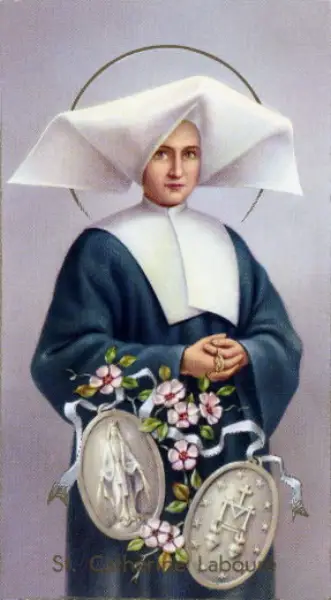
Zoe Labouré was born on 2 May 1806, the ninth of eleven children of a farming family in Burgundy. Her mother died when she was nine, and the girl reportedly embraced the Virgin Mary as her mother from that point on. A dream of a priest she later recognized as Vincent de Paul pointed her toward the Daughters of Charity; after resisting family pressure, including a spell working in a Paris eatery for poor workers, she entered the novitiate at the motherhouse on the Rue du Bac in April 1830. There, in the chapel, she said she received apparitions: first of the heart of St. Vincent, then, on 27 November 1830, of Mary within an oval of light, standing on a globe, with rays of grace falling from her hands. Mary, she reported, asked for a medal struck with this image, promising great graces to those who wore it. After two years of discreet testing, her confessor took the request to the archbishop; the medal, made by the goldsmith Adrien Vachette, spread by the millions and fed the devotion that preceded the 1854 definition of the Immaculate Conception. Catherine told no one but her spiritual directors. She spent her last forty years in humble service at the Hospice d'Enghien near Paris, feeding and nursing the aged poor, working the farm, and cleaning stables, until her death on 31 December 1876.
The Complete Life
Early Life
Zoe Labouré was born on 2 May 1806 in Burgundy, the ninth of eleven living children of Pierre Labouré, a farmer, and Madeleine Louise Gontard. Her family called her Zoe, though they rarely used the name; the world would come to know her as Catherine. Her mother died on 9 October 1815, when Zoe was nine, and the loss set the shape of her interior life: she is said to have taken the Virgin Mary as her mother from that time forward. She and her sister Marie Antoinette went to live with an aunt at Saint-Rémy, a village some nine kilometers from home. There, in a dream, she saw a priest she did not yet know — later recognized as Vincent de Paul — who told her that it was good to care for the sick, that she fled from him now but would one day be glad to come to him, and that God had plans for her. At twelve she returned to her father's farm to run the household after her mother's fashion, and grew into a tall, silent, capable young woman.
§ Early life
Conversion and Vocation
Catherine's path to religious life ran through family resistance. Her father, opposed to her entering the Daughters of Charity, packed her off to his brothers' Paris eating house for poor workers — a strategy that backfired, since the daily sight of working poverty deepened her desire to nurse the sick as a Daughter. Her novitiate opened on 21 April 1830, at the motherhouse on the Rue du Bac in Paris and professed her vows on 30 January 1831. She had told no one of the dream at Saint-Rémy until, arriving at the motherhouse, she saw a portrait of Vincent de Paul and recognized the priest of her girlhood.
§ Early life
Mission and Ministry
Catherine's mission unfolded within an ordinary Daughter's working life. Professed, she was sent at once to the Hospice d'Enghien at Reuilly, then just outside Paris, where the Daughters cared for aged men and women. She spent the next forty-six years there — not as a visionary celebrated in chapels, but as the sister who fed the old men at table, worked the hospice farm, looked after the poultry, cleaned the stables, and held authority quietly as procuratrix of the house. The contrast is the point of her biography: the woman through whom, by her own account, the Miraculous Medal reached the world spent the whole of that world's enthusiasm in a back kitchen, and let her own identity stay unknown even within her community. She told only her confessors of the apparitions, and took the secret to confession so well that the Daughters of Charity learned she was the visionary only after her death.
§ Introduction
Spirituality and Teaching
The visions she reported at the Rue du Bac belong to 1830, the months after her arrival. That April the relics of Vincent de Paul were carried into the Paris church of the Vincentians, an event kept with a novena, and during those days she three times beheld above the shrine — the one holding the relic of his right arm — what she took to be his heart, successively white, red and black; she read the colors as foretelling the fortunes of the Vincentian families and a coming change of government in France, and her chaplain told her to set the matter from her mind. On 19 July 1830, wakened by a child's voice, she found the Virgin in the chapel, who told her that God meant to charge her with a mission; that she would be contradicted and must not fear; that everything passing within her was to be told her director; and that times were evil in France and in the world. Then, on 27 November 1830, in evening meditation, Mary stood before her inside an oval of light upon a globe, light streaming from her hands, the frame's rim bearing the petition beginning 'O Mary, conceived without sin.' The reverse, as the frame turned, showed the cross above the letter M and the two hearts, with a crown of twelve stars; and to her question why some rays fell short of the earth came the answer that these were the graces nobody asks for. The medal was the commission: the image struck on one, and great graces promised to the wearers.
§ Introduction
Trial and Final Years
Catherine's trials were interior and unglamorous: the two years during which her confessor tested and observed her before taking the request higher; the lifelong silence; the ordinary attrition of half a century of hospice labor. She died at the Hospice d'Enghien on 31 December 1876, at seventy. When her body was later exhumed it was found incorrupt, and it now rests visible beneath the side altar of the chapel of the Rue du Bac — the same chapel in which, as a young novice, she had said she saw the Virgin, so that the pilgrims who come for the medal stand over the sister who never claimed it.
§ Introduction
Canonization
The cause for Catherine's beatification opened on the discovery of her incorrupt body. Pope Pius XI beatified her on 28 May 1933, and Pope Pius XII canonized her on 27 July 1947. Her liturgical commemoration varies by calendar: obligatory memorial on 28 November in the Vincentian Family's calendar, optional memorial in the Archdiocese of Paris, and 31 December in the 2004 Roman Martyrology.
§ Death and legacy
Legacy
The Miraculous Medal, struck from the design Catherine reported and executed by the goldsmith Adrien Vachette after her confessor carried the request — without naming her — to the archbishop of Paris, became one of the most widely worn devotional objects in Catholicism, adopted by millions within a few years. Its inscription, 'conceived without sin,' preceded by a generation the definition of the Immaculate Conception in 1854 and helped prepare Catholic opinion for the dogma; it is the standard account of the medal's historical role. Catherine herself has become the patroness of seniors, from her forty years of care for the aged; churches under her name continue to be built, among them one under construction in Putatan, Sabah, Malaysia.
§ The Virgin Mary
Timeline
- 2 May 1806
Born at Fain-lès-Moutiers in Burgundy, ninth of the eleven living children of Pierre Labouré, a farmer, and Madeleine Louise Gontard
§ Early life
- 9 Oct 1815
Her mother dies, leaving her an orphan at nine; she moves with her sister to their aunt's house at Saint-Rémy
§ Early life
- 21 Apr 1830
Begins her novitiate at the convent on the Rue du Bac in Paris; that month she reports visions of the heart of Vincent de Paul
§ Early life
- 19 Jul 1830
On the eve of the feast of St Vincent de Paul, hears a child call her to the chapel, where she reports the Virgin Mary giving her a mission
§ The Virgin Mary
- 27 Nov 1830
Reports that Mary appears during evening meditation showing the oval frame with rays and the words now on the Miraculous Medal, asking that medallions be struck
§ The Virgin Mary
- 30 Jan 1831
Takes her vows at the Rue du Bac convent
§ Early life
- 30 Jan 1831
Immediately after professing vows, is sent to the Hospice d'Enghien at Reuilly, where she spends the next forty years caring for the elderly and infirm
§ Later life and service to the poor and elderly
- 8 Dec 1854
Pope Pius IX proclaims the dogma of the Immaculate Conception, a teaching the medal's inscription had helped popularize
§ The Virgin Mary
- 31 Dec 1876
Dies at the Hospice d'Enghien aged 70; her body, found incorrupt, now rests beneath the altar in the Rue du Bac chapel
§ Death and legacy
- 28 May 1933
Beatified by Pope Pius XI at Vatican City
§ Introduction
- 27 Jul 1947
Canonized by Pope Pius XII at Vatican City
§ Introduction
The Record
- Patron of
- The elderly and seniors·The Miraculous Medal and its wearers
- Symbols
- Daughters of Charity habit·The Miraculous Medal
- Canonization
- Beatified by Pope Pius XI on 28 May 1933; canonized by Pope Pius XII on 27 July 1947
Prayer
Bibliography
Show 12 sources
- ↑ Poole, Stafford (1 October 1999). "Pierre Coste and Catherine Laboure: The Conflict of Historical Criticism and Popular Devotion" . Vincentian Heritage Journal . 20 (2): 253– 302. ISSN 0277-2205 .
- ↑ "Catherine Labouré | Chapelle Notre-Dame de la Médaille Miraculeuse" . archive.wikiwix.com . Archived from the original on 4 December 2021 . Retrieved 3 November 2021 .
- ↑ Aladel, C.M., M. (1880). The Miraculous Medal, its Origin, History, Circulation, Results . Philadelphia: H.L.Kilner & Co. pp. 2– 3.
- ↑ Crapez, C.M., Edmond (1920). Venerable Sister Catherine Laboure, Sister of Charity of St. Vincent De Paul . London: Burns, Oates, & Washbourne. p. 9.
- ↑ Catholic Online. "Saint Catherine Labouré" . Catholic Online . Archived from the original on 19 September 2002 . Retrieved 4 February 2021 .
- ↑ Chiron, Yves (2007). Enquête sur les apparitions de la Vierge . Perrin. pp. 175– 177. ISBN 978-2-262-02832-9 .
- 1 2 Dirvin, C.M., Joseph I. (2009) [1958]. Saint Catherine Laboure of the Miraculous Medal . Tan Books & Publishers, Inc. ISBN 0-89555-242-6 .
- ↑ "St. Catherine Laboure" . Catholic News Agency . 28 November 2012. Archived from the original on 6 April 2012 . Retrieved 20 December 2012 .
- ↑ Mack, John (2003). The museum of the mind: art and memory in world cultures . British Museum.
- ↑ Free, Missel. "8 décembre immaculé conception" . Missel Free . Archived from the original on 29 April 2009 . Retrieved 4 February 2021 .
- ↑ Tiblis, Laurence. "Home" . The Miraculous Medal Shrine . Retrieved 3 July 2020 .
- ↑ René Laurentin et Patrick Sbalchiero (2007). Dictionnaire des 'apparitions' de la Vierge Marie . Fayard. pp. 704– 705. ISBN 9782213-671321 .
Profile text adapted from the Wikipedia article, licensed CC BY-SA 4.0.
Pray with this saint every day
Save St. Catherine Labouré to your favorites, read the full profile, and get feast-day reminders in the Saints app.
Get the Saints AppFree on the App Store for iPhone and iPad