
c. 287 – c. 305·Feast November 25
St. Catherine of Alexandria
Virgin martyr, scholar princess of the Catherine wheel
Overview
Catherine of Alexandria is, by tradition, an early fourth-century Christian virgin and martyr who died under the emperor Maxentius. Her legend presents her as a princess and learned scholar of Greco-Egyptian descent, the daughter of Constus, governor of Alexandria, and his wife Sabinella. A vision of the Virgin Mary and the Christ Child brought her to the Christian faith around the age of fourteen, and she is said to have won hundreds of converts. When persecution broke out, she confronted Maxentius and rebuked his cruelty; he assembled fifty pagan philosophers and orators to refute her, but she prevailed in the dispute, and several defeated adversaries declared themselves Christians and were executed. Imprisoned and tortured, she was fed, the legend says, by a dove, visited by Christ, and tended by angels; more than two hundred visitors, including the empress Valeria Maximilla, were converted at her cell and subsequently martyred. Refusing a place in the imperial household, she was condemned to die on a spiked breaking wheel, which shattered at her touch, and was then beheaded, milk rather than blood flowing from her neck. Her body was reputedly rediscovered at Mount Sinai around the year 800, and the monastery bearing her name became a great pilgrimage centre. One of the Fourteen Holy Helpers, she was among the most beloved saints of the Middle Ages, though modern scholarship doubts her historicity.
The Complete Life
A learned daughter of Alexandria
The traditional account of Catherine's early years places her birth in Alexandria, the great Greek city of Roman Egypt, around 287, during the reign of Maximian. Her father is named Constus, or Costus, the governor of Alexandria, and her mother Sabinella, so that the legend presents her as a princess of the provincial administration rather than a peasant. She is described as Greco-Egyptian, a child of the mixed society that crowded Alexandria's libraries and lecture halls. From an early age she gave herself to study, and the legend makes her a noted scholar while still an adolescent, accomplished in the learning that her city famously housed. The decisive turn of her childhood came through a vision: the Virgin Mary appearing with the Child Jesus persuaded her to embrace Christianity, a conversion dated to about her fourteenth year. From that point she is credited with bringing hundreds of people into the faith. Modern historians note that no surviving text mentions her before the ninth century, and some suggest the legend grew from oral memories of women persecuted in the Diocletianic persecutions, or even from confusion with the neoplatonist philosopher Hypatia. Yet even the cautious Catholic Encyclopedia writer Léon Clugnet insisted that doubt about the texts does not amount to doubt about the saint's existence, and her cult rests on centuries of devotion rather than on documented biography.
§ Life
Chosen for Christ
Catherine's vocation, in the legend, is a vocation to both learning and virginity. The vision of Mary and the Christ Child that converted her around the age of fourteen also fixed the shape of her life: she became a Christian scholar who would argue for her faith, and a consecrated virgin whose allegiance belonged to Christ alone. The tradition does not present her entering any community or accepting any office; her vocation unfolded in the public arena of Alexandria itself, in a city under pressure from imperial persecution. When the persecutions began under Maxentius, she did not hide. Instead she went to the emperor in person and rebuked him openly for his cruelty toward Christians, an act of defiance that put her life at risk and set in motion the disputations for which she is remembered. The same boldness appears later in her story, when Maxentius offered her a place in his own imperial household, with all the security and honour that implied. She refused, saying that her life was already vowed entirely to Christ, and so chose death over a comfortable apostasy. This refusal is the hinge of her vocation narrative: the learned princess who might have taken a position at court instead took the path of the confessor. Later devotion would elaborate her betrothal to Christ into the mystic marriage scenes of medieval art, in which the Infant or adult Christ places a ring on her finger.
§ Life
The debate before the emperor
Catherine's mission, as her legend tells it, was a mission of public argument. Having rebuked Maxentius for his cruelty, she was answered not with immediate execution but with a scholarly ambush: the emperor summoned fifty of the finest pagan philosophers and orators available, expecting them to demolish her Christian arguments in open debate. The outcome reversed his expectations. Catherine won the dispute, and her eloquence did what imperial force could not; several of the philosophers sent against her were themselves convinced, declared themselves Christians on the spot, and were immediately put to death for it. The story thus presents her as an apologist whose chief weapon was reasoned persuasion, a patroness in later centuries of philosophers, theologians, preachers and scholars. Her mission continued in prison. During her confinement more than two hundred people came to see her, drawn by reports of the young woman who had confounded the empire's intellectuals; among them was Maxentius' own wife, Valeria Maximilla. All of them, the legend states, were converted to Christianity and subsequently suffered martyrdom for it. The mission of Catherine is therefore depicted as doubly fruitful and doubly costly: every victory of her argument produced new martyrs, until the persecution she had protested had consumed her converts, her visitors and finally herself. Medieval Christendom read this as the triumph of Christian wisdom over pagan philosophy, embodied in a teenage girl.
§ Life
The dove, the angels and the crown
The legend clothes Catherine's imprisonment with signs of divine favour. Thrown into prison after torture, she was fed each day, the story says, by a dove sent from heaven; Christ himself visited her cell, urging her to fight bravely and promising her a crown of everlasting glory; and angels came and treated her wounds with salve. These consolations turn the prison into a scene of mystical communion, and they explain the moral authority that drew over two hundred visitors, among them the empress Valeria Maximilla, to seek her out and be converted. At the heart of her spirituality stands the promise of the crown, at once the crown of her royal rank, cast aside, and the crown of martyrdom, embraced. Later devotion added the theme of the mystic marriage: from the early fourteenth century the mystic marriage of Saint Catherine appears in hagiographical literature and soon afterwards in art, showing Christ, usually as an infant in the Virgin's arms, placing a ring upon her finger, while in the Golden Legend's version he appears grown, amid a great crowd of angels and the whole celestial court. She herself entreated Christ, most versions of her passio relate, at the moment of her death, that he would answer the prayers of all who remembered her martyrdom and called upon her name, a promise that became the foundation of her intercessory cult.
§ Torture and martyrdom
The wheel that broke
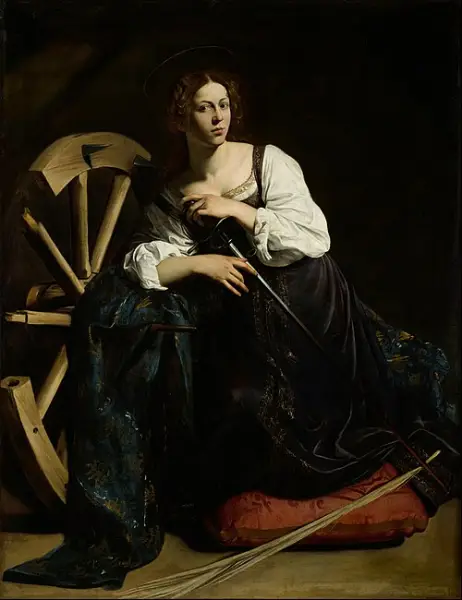
Catherine's final trial compressed into days the whole drama of her legend. The emperor's patience ran out when she refused his offer of a place in his household, answering that her whole life was given over to Christ. Maxentius, enraged, condemned her to death on a spiked breaking wheel, an instrument designed to break the body slowly and publicly. The legend records that at her touch the wheel shattered, a miraculous failure of the machinery of execution that has given the world both her principal emblem and the name Catherine wheel. Frustrated by torture and defeated by miracle, the emperor fell back on the sword: Catherine was to be beheaded. In one of the strangest details of the passio, she herself ordered the execution to begin, meeting death with the composure of a commander rather than a victim. When the blow fell, a milk-like substance rather than blood was said to have flowed from her neck. She was probably seventeen or eighteen years old, her death placed around 305. Centuries later her body was reported found on Mount Sinai, uncorrupt, hair still growing, and emitting a stream of healing oil; carried to the monastery that now bears her name, it made Sinai the destination of countless pilgrims seeking cures, and the site where her story ended and her cult began.
§ Torture and martyrdom
A saint before the age of canonisation
Catherine belongs to the era before formal canonisation: her sanctity was recognised by the acclamation and devotion of the churches rather than by any process at Rome, and she is listed as pre-congregation. Her name entered the Roman Martyrology with its commemoration on 25 November, and she was honoured in the Catholic Church, the Eastern Orthodox and Oriental Orthodox churches, the Anglican Communion and Lutheranism alike. In Catholic tradition she holds a further rank as one of the Fourteen Holy Helpers, the band of saints invoked together in time of plague and need, and as such she was 'unceasingly praised by preachers and sung by poets', in the words of the 1908 Catholic Encyclopedia. Her place on the general calendar was not untroubled. In 1969, after the Second Vatican Council's reform of the liturgy, her feast was removed from the General Roman Calendar, a decision reflecting the historical doubts that surround her; in 2002 it was restored as an optional memorial. The Eastern churches kept her throughout: the Russians, Serbs and Bulgarians celebrate her on 24 November, a date traced by one Synaxarion note to a fifteenth-century transfer by the Fathers of Sinai so that the feast could be kept with greater solemnity, while the Coptic Church honours her on 29 Hathor.
§ Veneration
The most famous of virgin martyrs
Catherine of Alexandria was arguably the most important of the late medieval virgin martyrs and one of the most influential saints of the entire Middle Ages. Her cult received its decisive impulse from the reported rediscovery of her body at Mount Sinai around the year 800, and it spread across Christendom through pilgrimage narratives such as those of John Mandeville and Felix Fabri, through scattered shrines in France and England, and through the great western shrine at Rouen, which claimed her fingers; Edward the Confessor was said to have brought a phial of her oil from Sinai to Westminster. Her fame reached into learning and language: St Catharine's College, Cambridge, was founded on her feast day in 1473 for scholars of theology and philosophy, and countless colleges, schools and churches bear her name. She was held up by Christine de Pizan and Geoffrey de la Tour Landry as a pattern for young women, an exemplar of virginity and chastity whose role as a model sometimes eclipsed her role as intercessor. Her name is stamped on the map, from Santa Catarina in Brazil to Santa Catalina Island off California, on the Catherine wheel firework, and on a lunar crater. Modern scholarship may doubt her existence, but the tradition she created shaped art, education and devotion for a thousand years.
§ Legacy
Timeline
- 287
Born at Alexandria in Roman Egypt, traditionally the daughter of Constus, the city's governor under Emperor Maximian, and his wife Sabinella
§ Life
- 305
Under persecution by Emperor Maxentius she rebukes him and defeats fifty pagan philosophers in debate; several converts among them are executed
§ Life
- 305
Tortured and imprisoned, she converts more than 200 visitors, including the empress Valeria Maximilla, all of whom are martyred
§ Torture and martyrdom
- 305
Condemned to a spiked breaking wheel that shatters at her touch, she is beheaded on Maxentius' orders
§ Torture and martyrdom
- 501
In the sixth century the Emperor Justinian establishes on Sinai the monastery now known as Saint Catherine's, around the purported burning bush
§ Veneration
- 800
Her body is allegedly rediscovered at Mount Sinai, with hair still growing and healing oil issuing from it, spurring her medieval cult
§ Medieval cult
- 976
The Menologium compiled for Emperor Basil II gives the earliest surviving account of her life, some six centuries after her martyrdom
§ Historicity
- 25 Nov 1473
Robert Woodlark founds St Catharine's College, Cambridge, on her feast day, for scholars studying theology and philosophy
§ Medieval cult
- 1689
Dimitry of Rostov's Book of the Lives of the Saints places her Russian Orthodox feast on 24 November
§ Veneration
- 1969
Her feast is removed from the General Roman Calendar
§ Veneration
- 2002
Her feast is restored to the Roman calendar as an optional memorial
§ Veneration
- 2022
She is added to the Episcopal Church liturgical calendar, sharing 24 November with Barbara of Nicomedia and Margaret of Antioch
§ Veneration
In Their Own Words
Although contemporary hagiographers look upon the authenticity of the various texts containing the legend of St. Catherine as more than doubtful, it is not therefore meant to cast even the shadow of a doubt around the existence of the saint.
Assiduous research has failed to identify Catherine with any historical personage.
There is no evidence that Katherine herself was a historical figure and she may well have been a composite drawn from memories of women persecuted for their faith.
Why do you want to lose this crowd with the worship of gods? Learn about God, Creator of the world, and His only Son Jesus Christ, who freed humanity from hell with the cross!
The Record
- Patron of
- Unmarried girls and maidens·Philosophers, theologians, scholars and students·Lawyers, jurists, librarians and archivists·Craftsmen who work with a wheel: potters, spinners, millers and wheelwrights·Nurses and dying people·Preachers and apologists
- Symbols
- breaking wheel (Catherine wheel)·sword·crown at her feet·book·bridal veil and ring·dove
- Canonization
- Pre-congregation; her cult is ancient, commemorated in the Roman Martyrology on 25 November.
Prayer
Bibliography
Show 7 sources
- Walsh, Christine (2007). The Cult of St Katherine of Alexandria in Early Medieval Europe. Aldershot: Ashgate.
- Lewis, Katherine J. (2000). The Cult of St Katherine of Alexandria in Late Medieval England. Boydell. ISBN 978-0-85115-773-3.
- Clugnet, Léon (1908). "St. Catherine of Alexandria". In Herbermann, Charles (ed.). Catholic Encyclopedia. Vol. 3. New York: Robert Appleton Company.
- De Voragine, Jacobus (1995). The Golden Legend: Readings on the Saints. Translated by Granger Ryan, William. Princeton University Press. pp. 334–341. ISBN 978-0691001548.
- Deakin, Michael A. B. (2007). Hypatia of Alexandria, Mathematician and Martyr. New York: Amherst.
- Duffy, Eamon (1992). The Stripping of the Altars: Traditional Religion in England, C.1400-c.1580. Yale University Press. ISBN 978-0-300-06076-8.
- Watts, Edward Jay (2006). City and School in Late Antique Athens and Alexandria. University of California Press. ISBN 9780520244214.
Profile text adapted from the Wikipedia article, licensed CC BY-SA 4.0.
Pray with this saint every day
Save St. Catherine of Alexandria to your favorites, read the full profile, and get feast-day reminders in the Saints app.
Get the Saints AppFree on the App Store for iPhone and iPad