
1413 – 1463·Feast March 9
St. Catherine of Bologna
Poor Clare mystic, writer and painter of Corpus Domini
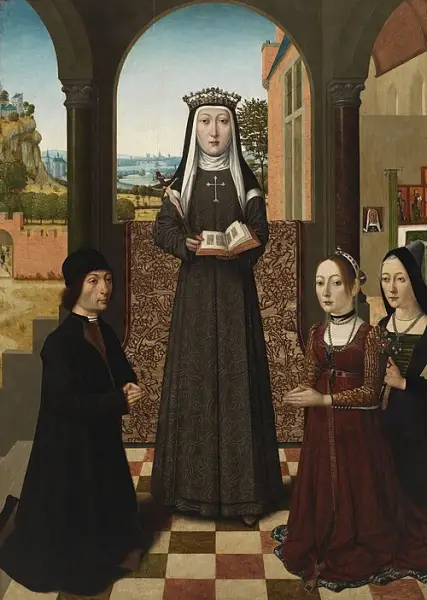
Overview
Catherine of Bologna, born Caterina de' Vigri in Bologna on 8 September 1413, was an Italian Poor Clare nun who became a writer, teacher, mystic and artist. Daughter of a Ferrarese notary in the service of Niccolò III d'Este, she was raised at the Este court in Ferrara as lady-in-waiting to the marchioness Parisina Malatesta, receiving an education in reading, writing, music and the viola, and enjoying access to the court library of illuminated manuscripts. After the marchioness's execution in 1426, Catherine left the court to join a lay community of beguines following the Augustinian rule; in 1431 that house became the Observant Poor Clare convent of Corpus Domini at Ferrara, where she lived for twenty-five years and served as Mistress of Novices. She experienced visions of Christ, the Virgin, Thomas Becket and Joseph, and is credited with foreseeing the fall of Constantinople in 1453. In 1456 she led twelve sisters from Ferrara to found a second Corpus Domini at Bologna, and governed it as abbess until her death on 9 March 1463. Her body, exhumed after a sweet fragrance rose from her grave, remains incorrupt and seated upright behind glass in the Bologna convent. Her treatise Seven Spiritual Weapons, first printed in 1475, circulated widely in translation, and her self-illustrated breviary preserves some of the rare surviving artworks of a fifteenth-century nun. She is honoured as patron of artists.
The Complete Life
From the Este court to the beguine house
Caterina de' Vigri was born in Bologna on 8 September 1413 into an upper-class family: her mother, Benvenuta Mammolini, came from Bologna, and her father, Giovanni Vigri, was a Ferrarese notary employed by Niccolò III d'Este, Marquis of Ferrara. Through that connection the child was raised at the Este court itself, serving as lady-in-waiting to the marquis's wife Parisina Malatesta and forming a lifelong friendship with his natural daughter Margherita d'Este. Court life gave her opportunities unusual for a girl of her time: she was taught to read and write, trained in music and in playing the viola, and given access to the d'Este court library with its illuminated manuscripts. The viola she played survives in a glass case and is thought to be slightly older than she was; it has been studied and reconstructed by modern musicologists. This upbringing shaped both sides of her later fame, the writer and the painter, since she learned letters and images together in a Renaissance court. Her world changed abruptly in 1426, when Niccolò III had Parisina executed for infidelity. Catherine, then about thirteen, left the court for Ferrara, where she entered a beguine household of women living a semi-religious life by the rule of Augustine, while debating among themselves whether to adopt the stricter Franciscan rule instead.
§ Life
Poor Clare of Corpus Domini
The question the beguines had debated resolved itself in favour of the Franciscan observance. In 1431 their house was transformed into the Observant Poor Clare convent of Corpus Domini at Ferrara, a community that began with twelve women and grew to one hundred and forty-four by the end of the century, one measure of the spiritual energy of the Observant reform. Catherine entered this new foundation and lived at Corpus Domini, Ferrara, for most of her life, from 1431 until 1456, rising within the community to the office of Mistress of Novices, the sister responsible for forming the young entrants in the religious life. Contemporaries remembered her as a model of piety. Her years there combined the ordinary round of cloistered poverty with extraordinary gifts: she was credited with miracles and with visions of Christ, of his mother, of Thomas Becket, and of Joseph, and even with foreknowledge of future events, most remarkably the fall of Constantinople in 1453. Alongside this mystical life she worked with her hands, writing religious treatises, lauds and sermons, and copying out her own breviary which she illustrated herself. In 1455 a new call came: the Franciscans and the governors of Bologna asked her to become abbess of a new convent to be founded in that city under the same name, Corpus Domini, and she accepted.
§ Life
Foundress and teacher
Catherine's mission expressed itself in foundations and in teaching rather than in public life. In July 1456 she left Ferrara, taking twelve sisters with her to begin the new community of Corpus Domini at Bologna, and she governed that house as abbess until her death. Her work as Mistress of Novices at Ferrara had already made her a teacher of religious women; at Bologna she became the mother of a whole community, responsible for its observance, its material survival and its spiritual direction. Her words to her sisters were valued enough to be written down and preserved as I Sermoni, copies of her talks to the community that Cardinal Giacomo Biffi later described as part of 'a veritable monument of theology'. She was also a teacher by example and by image: her breviary, with its thousand prayer rubrics and its carefully drawn initials and saint portraits, almost certainly served a didactic purpose within the convent, forming the devotional imagination of the sisters who used it. Her treatise Seven Spiritual Weapons shows the same pedagogic instinct, setting out a practical programme for the interior combat of the religious life. The mission that began with a dozen women in a borrowed house thus reached, through her writing, through her sisters, and through the printed editions of her book, Poor Clare convents across early modern Europe.
§ Life
The seven spiritual weapons
The key to Catherine's spirituality is her treatise Seven Spiritual Weapons Necessary for Spiritual Warfare, which she appears to have first drafted in 1438 and later recast and enlarged, work that continued up to 1456. Although she likely taught its contents to her sisters over many years, she kept the written text concealed until she was near death, when she handed it to her confessor with instructions that a copy be sent to the Poor Clares at Ferrara. A substantial portion of the book describes her visions at length, visions both of God and of Satan, so that the treatise is at once a manual of spiritual combat and a record of mystical experience. Its circulation in manuscript through the network of Poor Clare convents prepared her reputation, and it lent powerful support to the cause of her canonisation. Her spirituality was also practical and aesthetic. She explained that although her religious art consumed precious time, its purpose was to increase devotion, for herself and for others; prayer, work and image-making formed a single discipline. Her visions included Christ, the Virgin Mary, Thomas Becket and Joseph, figures who recur in the portraits she drew in her breviary, suggesting that what she contemplated she also depicted, and that her interior life and her art were aspects of one devotion sustained across forty years of religious life.
§ Literary works
Abbess at Bologna and the incorrupt body
Catherine's last seven years were spent as abbess of Corpus Domini in Bologna, the community she had planted in 1456 with twelve sisters from Ferrara. She governed this house until her death on 9 March 1463, at the age of forty-nine. What followed her death fixed her place in the city's memory. Her first resting place was the convent burial ground; eighteen days after burial, mourners detected a sweet fragrance rising from the earth, and on exhumation the body was found incorrupt. It was eventually moved to a chapel of the convent, where it remains on display to this day, dressed in her religious habit and seated upright behind glass, one of the most striking relic-ensembles of Italian popular devotion. The incorruption gave material force to the reputation for holiness that had surrounded her in life. The Poor Clare Illuminata Bembo, a contemporary, recorded her life in 1469, only six years after her death, preserving testimony while memory was fresh. A strong local cult of Caterina Vigri developed in Bologna during the following decades; she was honoured as a beata from the 1520s, yet formal canonisation did not come until 1712, so that her body sat venerated behind glass for nearly two and a half centuries before Rome pronounced her a saint.
§ Life
From local cult to formal canonisation
The process of Catherine's recognition stretched across almost three centuries. Venerated in her native Bologna for nearly three hundred years before formal canonisation, she was beatified in 1524 by Pope Clement VII at Old St. Peter's Basilica, a step that confirmed the cult which had grown steadily since her death and the exhumation of her incorrupt body in 1463. The promotion to sainthood waited much longer, and was materially assisted by her own book. The Sette Armi Spirituali served the cause of her canonisation powerfully: first printed in 1475, it ran to twenty-one further editions in the sixteenth and seventeenth centuries and was rendered into Latin, French, Portuguese, Spanish, German and English, carrying her name and her doctrine through the convents and devout households of early modern Europe. With such a reputation established, Pope Clement XI canonised her on 22 May 1712 at St. Peter's Basilica. Her feast day is kept on 9 March, the anniversary of her death. Modern scholarship has added a further dimension to her cause: the works discovered around 2000, including the Rosarium Metricum, I Dodici Giardini and I Sermoni, revealed the scale of her literary achievement to a degree that her original promoters could not have known.
§ Literary works
The nun whose art survived
Catherine of Bologna's legacy rests on three pillars: an incorrupt body, a widely translated book, and a rare surviving body of art by a fifteenth-century nun. Her breviary makes her a rare phenomenon of the period, a religious woman whose personal artworks are preserved, with roughly a thousand prayer rubrics and drawn initials containing bust-portraits of saints, giving particular care to images of Clare and Francis and depicting figures from Thomas Becket to Catherine of Alexandria. Her self-taught style drew on needlework and devotional prints, and some of her images show an idiosyncratic inventiveness comparable to the Nonnenarbeiten of German nuns. Other works attributed to her include the Madonna of the Apple in the Cappella della Santa, a possible self-portrait in the autograph manuscript of the Sette Armi Spirituali, a Redeemer, a large painting of St Ursula and her maidens, and a drawing of a Man of Sorrows. As a female artist who set out a reasoned aesthetic, she occupies a distinctive place in art history. Her writings, especially after the discoveries around 2000, are recognised as monuments of late medieval vernacular mysticism, and her treatise helped disseminate that mysticism in the early modern world. She remains patron of artists, an apt patronage for a saint whose pencil and pen served one devotion.
§ Artistic works
Timeline
- 8 Sep 1413
Born Caterina de' Vigri in Bologna, daughter of Benvenuta Mammolini and Giovanni Vigri, a Ferrarese notary serving Niccolo III d'Este.
§ Life
- 1426
After Parisina d'Este's execution at her husband's order, Catherine left court for a beguine household living under the Augustinian rule.
§ Life
- 1431
The beguine house became the Observant Poor Clare convent of Corpus Domini at Ferrara, where she would live until 1456.
§ Life
- 1438
She appears to have first written her treatise Seven Spiritual Weapons, later rewritten and augmented between 1450 and 1456.
§ Literary works
- 1453
Among her reported visions of future events was the fall of Constantinople.
§ Life
- 1455
The Franciscans and the governors of Bologna asked her to become abbess of a new convent of Corpus Domini there.
§ Life
- Jul 1456
She left Ferrara with twelve sisters to begin the new Bologna community, remaining its abbess until her death.
§ Life
- 9 Mar 1463
Died at Bologna; exhumed eighteen days later after a sweet smell rose from the grave, her incorrupt body was placed in a chapel.
§ Life
- 1469
Sister Illuminata Bembo, a contemporary Poor Clare, wrote her biography.
§ Life
- 1475
Seven Spiritual Weapons was first printed, and went through twenty-one further editions in the sixteenth and seventeenth centuries.
§ Literary works
- 1524
Beatified by Pope Clement VII at Old St. Peter's Basilica.
§ Introduction
- 22 May 1712
Canonized by Pope Clement XI at St. Peter's Basilica.
§ Introduction
In Their Own Words
To increase devotion for herself and others.
Now revealed in their surprising beauty. We can ascertain that she was not undeserving of her renown as a highly cultivated person. We are now in a position to meditate on a veritable monument of theology.
Cum reverentia I pray for the sweet love Jesus Christ any person to whom will be noticed about this little work done with the divine aid.
The Record
- Major works
- Seven Spiritual Weapons Necessary for Spiritual Warfare (Sette armi spirituali, printed 1475)·Rosarium Metricum, a 5000-line Latin poem on the life of Jesus·I Dodici Giardini (The Twelve Gardens), a mystical work of her youth·I Sermoni (The Sermons), records of her words to her religious sisters·Lauds, short religious treatises and letters·Autograph breviary copied and illustrated with her own hand; panel paintings including the Madonna of the Apple
- Patron of
- Patron of artists·Invoked against temptations
- Symbols
- carrying the Infant Jesus·religious habit of the Poor Clares·painter's brush and illuminated breviary
- Canonization
- Canonized by Pope Clement XI on 22 May 1712 in St. Peter's Basilica, after beatification by Pope Clement VII in 1524.
Prayer
Bibliography
Show 7 sources
- Arthur, Kathleen G. (2018). Women, Art and Observant Franciscan Piety. Caterina Vigri and the Poor Clares in Early Modern Ferrara. Amsterdam: Amsterdam University Press. ISBN 978-94-6298-4332.
- Bembo, Illuminata (2001) [1469]. Silvia Mostaccio (ed.). Specchio di Illuminazione, Vita di S. Caterina a Bologna. Florence: SISMEL.
- Dunbar, Agnes B.C. (1904). A Dictionary of Saintly Women. George Bell & Sons. p. 160.
- Stephen Donovan (1908). "St. Catherine of Bologna". In Catholic Encyclopedia. 3. New York: Robert Appleton Company.
- Mc Laughlin, Mary Martin (1989). "Creating and Recreating Communities of Women: The Case of Corpus Domini, Ferrara, 1406–1452". Signs. 14 (2): 313.
- Serventi, Silvia, ed. (2000). Caterina Vigri, Laudi, Trattati e Lettere. Florence: SISMEL.
- Wood, Jeryldene M. (1996). Women, Art, and Spirituality. The Poor Clares of Early Modern Italy. Cambridge: Cambridge University Press. pp. 121–144, 196–197.
Profile text adapted from the Wikipedia article, licensed CC BY-SA 4.0.
Pray with this saint every day
Save St. Catherine of Bologna to your favorites, read the full profile, and get feast-day reminders in the Saints app.
Get the Saints AppFree on the App Store for iPhone and iPad