
1447 – 1510·Feast September 15
St. Catherine of Genoa
Mystic of purgatory and nurse of Pammatone hospital
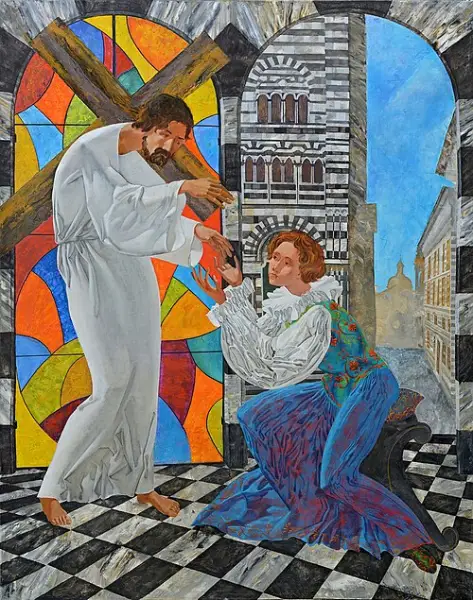
Overview
Catherine of Genoa, born Caterina Fieschi Adorno around 1447 into Genoa's noble Fieschi family, was an Italian mystic remembered chiefly for her service to the sick and poor and for her writings on purgatory. The last of five children of Jacopo Fieschi, later Viceroy of Naples, and Francesca di Negro, she belonged to a house related to two popes and dozens of cardinals. A wish to enter a convent at thirteen was refused on account of her youth, and at sixteen, after her father's death, she was married to the Genoese nobleman Giuliano Adorno, a violent and faithless spendthrift whose feuding family hers had hoped to conciliate. After five years of silent endurance and five more of worldly consolation, she was transformed on 22 March 1473 by an overwhelming sense of God's love felt during confession, an experience that began a life of intense union with God through prayer and almost daily Communion, remarkable for a laywoman of her era. She devoted herself to the sick at Genoa, where her husband, also converted, joined her; ruined financially by his spending, the couple moved into the Hospital of Pammatone, of which she became manager and treasurer. She nursed Genoa's plague victims in 1497 and 1501. She died on 15 September 1510 after a slow and painful final illness. Her thought, preserved in the Life and Doctrine published in 1551, including the Treatise on Purgatory, has made her one of the classic voices of Christian mysticism.
The Complete Life
Daughter of the Fieschi
Caterina Fieschi was born in Genoa around 1447, the youngest of five children in one of the great houses of the Republic. Her father, Jacopo Fieschi, held office as Viceroy of Naples; her mother was Francesca di Negro. The family's standing was extraordinary even by the standards of Italian nobility: the family counted two popes, Innocent IV and Adrian V, among its kin, along with seventy-two cardinals. Into this world of ecclesiastical power and civic ambition Catherine was born, a daughter of privilege whose life would end among the poorest of Genoa's poor. Her first religious stirring came early. At about thirteen she wished to enter a convent, possibly under the influence of her sister Limbania, who was an Augustinian nun, but the convent her confessor approached on her behalf turned her away because of her youth. Rather than persist, she appears to have laid the idea aside and made no further attempt. Her path was redirected entirely by family strategy after her father died in 1463, when she was sixteen: at her parents' wish she was married to Giuliano Adorno, a young Genoese nobleman who had spent years in trade and in military ventures in the Middle East before returning home to wed. The match was almost certainly a device to settle the feud between the two families, and it would bring Catherine a decade of unhappiness before it brought her, indirectly, to God.
§ Early life
A marriage redeemed and a call to the sick
Catherine's vocation took shape in disappointment. The first five years of her marriage she endured in silent, melancholy submission to a husband who was unfaithful, violent-tempered and ruinously extravagant; the next five she sought relief in worldly amusements. After ten years, desperate for a way out, for three months she begged God to let illness keep her bedridden; the request was not granted. What answered instead was grace: on 22 March 1473, during confession, she was seized by a crushing awareness that God loved her, so strong that she left the church without finishing the confession. That moment redefined her marriage and her life. Her conversion was followed, in time, by her husband's own, and Giuliano became a Franciscan tertiary; Catherine herself joined no religious order, remaining a married laywoman. His earlier spending had ruined them financially, and the couple took a decision remarkable for their rank: they moved into the Hospital of Pammatone and gave themselves to works of charity there. Catherine rose to become the hospital's manager and treasurer, running a great Genoese institution rather than a household. Her vocation was thus doubly unusual, a noblewoman who found sanctity inside a disastrous marriage, and a mystic whose prayer issued directly into the administration of a hospital.
§ Conversion
At Pammatone and in the plague
Catherine's mission was lived out in the wards of Genoa. Having moved into Pammatone with her husband, she gave the greater part of her life and her fortune to the sick and the poor, work that continued without interruption through the two plague years that ravaged the city in 1497 and 1501. Plague nursing in Renaissance Italy meant exposing oneself daily to contagion among the dying poor, and Catherine's persistence through both epidemics became a defining feature of her reputation. As manager and treasurer of the hospital she combined contemplation with practical competence, handling the finances and administration of a large charitable institution even while living an intense interior life. Her example converted her own household first: Giuliano joined her in the hospital work before his death in 1497 at the institution he had entered as a ruined man. Her fame beyond Genoa came later and through writing rather than example. The book published in 1551 as the Life and Doctrine of the Blessed Catherine of Genoa described both her actions and her mystical experiences, and its portrait of a married noblewoman managing a plague hospital while living in close union with God gave later generations, including theologians as different as Robert Bellarmine, Francis de Sales and Cardinal Manning, a model of sanctity active in the world.
§ Conversion
Interior inspiration and the fire of purgatory
Catherine's spiritual life after 1473 was marked by an immediate, unmediated union with God. She practised an intense life of prayer without using forms such as the rosary, taking Communion nearly every day, something almost unheard of for the laity of her era, and undergoing remarkable mental experiences that at times approached the pathological; these states formed the subject of Baron Friedrich von Hügel's classic study The Mystical Element of Religion (1908). For roughly twenty-five years she went frequently to confession yet could open her mind to no director, until late in life Father Marabotti was appointed her spiritual guide; she opened to him about her experiences, former and current, and the Memoirs grew out of what he set down. She described her guidance as coming through interior inspiration alone. Her teaching on purgatory, for which she is best known, was original for its time: rather than a place of external punishment, she presented it in terms of the soul's painful yet joyful purification by divine love, so situated between the suffering of hell and the bliss of heaven. Her two most famous works, the Dialogues on the Soul and the Body together with the Treatise on Purgatory, long thought to be the editing of the Augustinian canoness Battistina Vernazza, are now largely attributed by scholarship to Catherine herself, though their final literary shape was given only after she died.
§ Spiritual teaching
Worn out in body and soul
Catherine's last years were spent at Genoa, still bound to the hospital and the poor, while her strength failed. Her death on 15 September 1510, at about sixty-two or sixty-three, came slowly, after many days of pain and suffering, during which she wavered between life and death and experienced visions. The record of those final days, preserved in the accounts drawn from Father Marabotti's notes, presents a death that was itself a mystical passage, the purification she had described in her teaching now worked in her own body. It was a fitting close to a life that had never distinguished sharply between prayer and service: the woman who had managed Pammatone's wards and accounts ended her days as its patient, watched by the community she had served for decades. Her husband Giuliano had died in 1497 at the hospital where he had spent his converted years, so her final illness was endured within the institution that had framed the whole second half of her life. After her death her memory was kept alive in Genoa by those who had known her, and the notes compiled by Marabotti waited forty-one years for print, until the volume of 1551 carried her experience and her doctrine to readers far beyond the city, and prepared the cause that would eventually place her among the canonised.
§ Conversion
Sanctity proved by her writings
Catherine's path to formal recognition followed an unusual route: her sanctity was established on the strength of her texts. The Holy Office scrutinised her writings and found in them doctrine sufficient of itself to demonstrate her sanctity, a judgement that gave her cause a singular foundation. On that basis she was beatified by Pope Clement X on 6 April 1675 in Rome, and canonized by Pope Clement XII on 16 June 1737, also in Rome. Her liturgical feast is kept on 15 September, the day of her death, in local calendars. Beyond the formal process, her writings have continued to work as a living canonisation: they became sources of inspiration for theologians including Robert Bellarmine and Francis de Sales, and for Cardinal Henry Edward Manning in the nineteenth century, while Friedrich von Hügel's 1908 study made her a central case in the modern study of mysticism. Pius XII named her protectress of Italy's hospitals, an office that mirrors the decades she gave to Pammatone. Recognition has extended beyond the Catholic Church: in 2022 she was officially added to the liturgical calendar of the Episcopal Church with a feast on 15 September, and she is honoured also in the Anglican Communion.
§ Beatification and canonization
A mystic for the modern study of religion
Catherine of Genoa's legacy has grown steadily since the 1551 publication of the Life and Doctrine, the book by which she is known outside her native city. From it derive the Dialogues on the Soul and the Body together with the celebrated Treatise on Purgatory, works often printed separately and translated repeatedly, in modern times by Serge Hughes for the Classics of Western Spirituality and by Charlotte Balfour and Helen Douglas Irvine for Sheed & Ward. Her doctrine of purgation, with its emphasis on the purifying action of divine love, stands out as an original contribution to the spirituality of her period and has kept her name alive in theological discussion. Critical scholarship has secured her place as an author: the older theory that the Augustinian canoness Battistina Vernazza had shaped the two works is now discredited, and a large part of both is credited to Catherine, though their final literary form is posthumous. Baron Friedrich von Hügel chose her and her circle as the subject of The Mystical Element of Religion (1908), one of the founding works of the modern study of mysticism, which examined her remarkable and at times almost pathological psychological experiences with seriousness rather than embarrassment. Patroness of Italian hospitals, she remains a patron for all who unite contemplation with the care of the suffering.
§ Spiritual teaching
Timeline
- 1447
Born Caterina Fieschi in Genoa, last of five children of Jacopo Fieschi and Francesca di Negro.
§ Early life
- 1460
At about thirteen she asked to enter a convent, perhaps inspired by her Augustinian sister Limbania, but was refused for her youth.
§ Early life
- 1463
After her father's death she was married at sixteen to the Genoese nobleman Giuliano Adorno, likely to end the feud between their families.
§ Early life
- 22 Mar 1473
During confession she underwent a mystical conversion, seized by an overpowering sense of God's love, and left the church unfinished.
§ Conversion
- 1473
Began a life of near-daily Communion and joined with her converted husband in serving the sick at a Genoa hospital.
§ Conversion
- 1497
Served the sick during the plague that ravaged Genoa, in the year her husband died at the hospital they shared.
§ Conversion
- 1501
Continued nursing Genoa through a second plague outbreak.
§ Conversion
- 15 Sep 1510
Died at Genoa, worn out after a slow and painful illness marked by visions and wavering between life and death.
§ Conversion
- 1551
The Life and Doctrine of Saint Catherine of Genoa was published, the source of her Dialogues and Treatise on Purgatory.
§ Spiritual teaching
- 6 Apr 1675
Beatified at Rome by Pope Clement X after the Holy Office judged her writings alone proof of sanctity.
§ Beatification and canonization
- 16 Jun 1737
Canonized at Rome by Pope Clement XII.
§ Beatification and canonization
- 2022
The Episcopal Church added her to its liturgical calendar, keeping her feast on 15 September.
§ Beatification and canonization
In Their Own Words
I am so plunged and submerged in the source of his infinite love, as if I were quite underwater in the sea and could not touch, see, feel anything on any side except water
I see without eyes, and I hear without ears. I feel without feeling and taste without tasting. I know neither form nor measure ... Everything is mine, for all that is God's seem to be wholly mine. I am mute and lost in God
I do not wish a love which may be described as for God, or in God. I cannot see those words, for and in, without their suggesting to me that something may intervene between God and me; and that is what pure and simple love, by reason of its purity and simplicity, is unable to endure.
In my soul, therefore, I can see no one but God, since I suffer no one else to enter there, and myself less than any other, because I am my own worst enemy.
When God sees the Soul pure as it was in its origins, He tugs at it with a glance, draws it, and binds it to Himself with a fiery love that by itself could annihilate the immortal soul. ... The soul becomes like gold that becomes purer as it is fired, all dross being cast out.
The Record
- Major works
- Life and Doctrine of Saint Catherine of Genoa (published 1551)·Dialogues on the Soul and the Body·Treatise on Purgatory·Memoirs compiled under her direction by Father Marabotti
- Patron of
- Patroness of Italian hospitals (declared by Pope Pius XII)·Invoked for the sick, the poor and the souls in purgatory
- Symbols
- noble Genoese dress of the Fieschi family·hospital and nursing imagery·cross and lily (traditional iconography)
- Canonization
- Beatified by Pope Clement X in 1675 and canonized by Pope Clement XII on 16 June 1737.
Prayer
Bibliography
Show 7 sources
- Capes, Florence. "St. Catherine of Genoa." The Catholic Encyclopedia. Vol. 3. New York: Robert Appleton Company, 1908.
- Jones, Kathleen (1999). Women Saints: Lives of Faith and Courage. Maryknoll, New York: Orbis Books.
- Friedrich von Hügel, The Mystical Element of Religion as Studied in Saint Catherine of Genoa and Her Friends, London: J Dent & Sons, 1908.
- Oxford Dictionary of the Christian Church (Oxford University Press 2005 ISBN 978-0-19-280290-3), article Catherine, St, of Genoa.
- Catherine of Genoa, Purgation and purgatory; The spiritual dialogue, translated by Serge Hughes, Classics of Western Spirituality, New York: Paulist Press, 1979.
- Pope Benedict XVI. "On Catherine of Genoa", General Audience January 12, 2011.
- Chisholm, Hugh, ed. (1911). "Catherine, Saint". Encyclopædia Britannica (11th ed.). Cambridge University Press.
Profile text adapted from the Wikipedia article, licensed CC BY-SA 4.0.
Pray with this saint every day
Save St. Catherine of Genoa to your favorites, read the full profile, and get feast-day reminders in the Saints app.
Get the Saints AppFree on the App Store for iPhone and iPad