
1347-1380·Feast April 29
St. Catherine of Siena
Virgin, Mystic, and Doctor of the Church
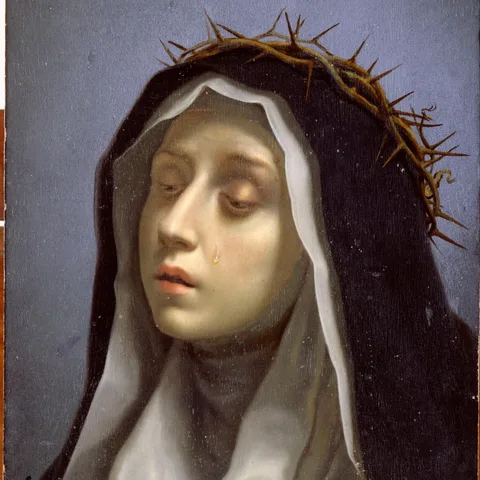
Overview
Caterina di Benincasa, twenty-fourth of a Siena dyer's twenty-five children, was born on 25 March 1347. A childhood vision of Christ enthroned with the apostles and a secret vow at seven set a course her parents tried to turn toward marriage; she answered with fasting and shorn hair until they gave way. She joined the Mantellate, widows and pious women attached to the Dominicans, serving Siena's sick and poor, and around 1368 underwent the mystical marriage she described in her letters. Her nursing at the hospital of Santa Maria della Scala won her a name as a santa donna, followers, and — once Raymond of Capua became her confessor in 1374 — public missions through Italy summoning clergy and cities to reform. In Pisa in 1375 she received the stigmata, invisible at her own request. From 1375 she dictated letters, some 382 of which survive, addressed to popes, kings, the Queen of Naples, and the mercenary John Hawkwood. She traveled to Avignon in 1376 to press Gregory XI to return to Rome, which he did in January 1377; that autumn she began dictating her masterpiece, the Dialogue of Divine Providence. When the Western Schism broke out she went to Rome to uphold Urban VI, canvassing nobles and cardinals until, no longer able to eat or drink, she suffered a stroke and died on 29 April 1380, thirty-three years old.
The Complete Life
Early Life
Caterina di Jacopo di Benincasa came into the world in Siena on 25 March 1347, on the very eve of the Black Death that would devastate Europe. Her mother, Lapa Piagenti, was herself the child of a local poet; her father, Jacopo di Benincasa, earned his living as a cloth dyer, his workshop kept going by the labor of his many sons. Catherine was one of the youngest of that large household; her childhood home still stands in Siena. According to the Life written by her confessor Raymond of Capua, she saw her first vision at five or six, Christ enthroned in glory with the apostles Peter, Paul and John, on the road home from a visit to a married sister, and at seven privately vowed her whole life to God. At sixteen her older sister Bonaventura died in childbirth, and her parents proposed that Catherine marry the widower. She refused by the only means the family understood: a strict fast, a technique she had learned from Bonaventura herself, and the cutting off of her long hair. To Raymond she later passed on the counsel she herself had lived by: to build a cell within the mind, one that could never be fled.
§ Early life
Conversion and Vocation
Catherine's vocation took a form her century barely had a name for — not marriage, not the cloister, but a life of prayer and action in her father's house and then in the city. A vision of Saint Dominic strengthened her desire to belong to his order, and after a serious illness at Bagno Vignoni her mother at last consented to her joining the Mantellate — Siena's circle of pious women, largely widows, who lived a Dominican-influenced rule without taking vows; only after her death were they organized formally as the Third Order. The Mantellate taught her to read, and she lived for a period in almost total silence and solitude at home. Around 1368, aged twenty-one, came the experience she called her mystical marriage to Christ, which she described in her letters as betrothal with a ring not of silver but of his own flesh, and which she habitually said was invisible. In Raymond's account, Christ at that point commanded her to end her secluded existence and go out into the world of men — the order on which everything that follows in her life depends.
§ Early life
Mission and Ministry
Catherine rejoined her family and began working among the sick and the poor of Siena, in the hospitals and in their homes — including, notoriously, the tending of a woman with cancerous breast sores whose pus she gathered in a ladle and drank to conquer her disgust, an episode her biographers never managed to soften. A circle of followers gathered around her, women and men, clergy and laity, whom she called her famiglia. After Raymond of Capua became her confessor in 1374, her mission became public and political: she traveled through the cities of Italy summoning clergy and people to reform, received the stigmata at Pisa in 1375 (invisible at her own request, so she said, lest anyone notice), and turned her attention to the scandal of the popes' residence at Avignon. Her influence with Gregory XI played its part in his decision of 1376 to return to Rome, and the pope then sent her to negotiate peace with the Florentine Republic — a commission extraordinary for a woman of any age.
§ Later life
Spirituality and Teaching
Catherine's teaching survives in three bodies of work, all dictated: some 382 letters, the prayers, and The Dialogue of Divine Providence, dictated between 1377 and 1378 in an ecstatic state she described as hearing rather than composing. The Dialogue sets out her whole theology in the image of Christ the bridge spanning the chasm between God and humanity, the soul's ascent through the knowledge of self, of sin, and of God's mercy, and the recurring conviction that the Church is the vessel of Christ's blood and cannot be served except in and through it. Her letters, addressed to popes, kings, queens, cardinals, merchants and her own followers, mix tenderness and startling directness — she could tell Gregory XI to be a man and do his duty, and tell a despairing nun to bathe in the blood of Christ crucified and want nothing but the crucified. Her Italian, that of an unlettered dyer's daughter, is reckoned among the founding prose of the language's literature.
§ Introduction
Trial and Final Years
After Gregory XI's death in March 1378 and the conclusion of peace with Florence that July, Catherine returned briefly to Siena. The election of Urban VI and the Great Schism of the West that followed — the cardinals' withdrawal to Fondi and the election of Clement VII, which split Christendom's obedience — drew her to Rome in the last year of her life. There she prayed, fasted, dictated, and wrote letter after letter to the princes and cardinals of Europe urging obedience to Urban and the defense of the vessel of the Church. The effort consumed her. She died in Rome on 29 April 1380, aged thirty-three, exhausted by the rigorous fasting that had long since ruined her health. Her funeral and burial took place at the Basilica of Santa Maria sopra Minerva, where her body remains.
§ Introduction
Canonization
Catherine's cult spread with remarkable speed once she was dead. Canonization came on 29 June 1461 from Pope Pius II — a Sienese himself — roughly eight decades after her death. Pius IX declared her patron of Rome in 1866, and Pius XII patron of Italy together with Francis of Assisi in 1939. On 4 October 1970 Paul VI declared her a Doctor of the Church — the second woman, days after Teresa of Ávila — and in 1999 John Paul II named her a patron saint of Europe. Her feast is kept on 29 April.
§ Introduction
Legacy
Catherine is one of the defining figures of medieval Catholicism: a laywoman with no institutional office who moved the papacy itself, and an author whose dictated works earned her a doctorate of the Church. For Italian literature the Dialogue and the letters are foundational vernacular prose. For political history she is the woman who helped end the Avignon papacy and who spent her last strength defending the unity of the Church against the Schism. Her image in art — the stigmatized mystic, the visionary, the writer at her desk — has made her one of the most painted of all saints, and her counsel to build a cell inside one's mind has outlived every controversy she entered. Siena claims her house, Rome her body, and the whole Latin Church her books.
§ Introduction
Timeline
- 25 Mar 1347
Born at Siena, daughter of the dyer Jacopo di Benincasa and Lapa Piagenti, shortly before the Black Death reached Europe.
§ Early life
- 1368
Experienced what her letters describe as a mystical marriage with Christ, at about twenty-one, and soon left her seclusion to serve the sick and poor.
§ Later life
- May 1374
Made her first journey to Florence, probably for interview by the Dominican General Chapter, and acquired Raymond of Capua as confessor.
§ Later life
- 1375
In Pisa she worked to turn that city and Lucca from the anti-papal league, and there, by Raymond's account, received the stigmata visible only to herself.
§ Later life
- 1375
Began dictating letters to scribes, widening her audience toward princes and prelates and urging the papacy's return from Avignon.
§ Later life
- Jun 1376
Traveled to Avignon as ambassador of Florence, seeking peace with the Papal States, and urged Gregory XI to return to Rome.
§ Later life
- 1377
In the early months helped found a strict-observance women's monastery at Belcaro outside Siena, then spent the year preaching peace at Rocca d'Orcia.
§ Later life
- Jan 1377
Gregory XI brought his administration back from Avignon to Rome, a step to which Catherine's urging is argued to have contributed.
§ Later life
- Oct 1377
Began dictating The Dialogue of Divine Providence in October, completing it by November 1378.
§ Works
- 18 Jun 1378
During the Ciompi revolts in Florence she was nearly assassinated; peace between Florence and Rome was agreed the following July.
§ Later life
- Nov 1378
Summoned to Rome by Urban VI at the outbreak of the Western Schism, she stayed at his court winning support for his legitimacy.
§ Later life
- 26 Feb 1380
Having been unable since the start of the year to eat or swallow water, she lost the use of her legs.
§ Later life
- 29 Apr 1380
Died in Rome at thirty-three, eight days after a massive stroke; she was buried in the Basilica of Santa Maria sopra Minerva.
§ Later life
- 29 Dec 1460
Beatified on 29 December, a step followed by her canonization the next summer.
§ Introduction
- 29 Jun 1461
Canonized by Pope Pius II.
§ Veneration
- 1597
Her feast joined the universal calendar, kept on 29 April, the anniversary of her death.
§ Veneration
- 1628
Feast moved to 30 April to avoid clashing with St Peter of Verona's day.
§ Veneration
- 13 Apr 1866
Declared co-patron of Rome by Pope Pius IX.
§ Patronage
- 18 Jun 1939
Named joint patron of Italy with Francis of Assisi by Pope Pius XII.
§ Patronage
- 4 Oct 1970
Declared a Doctor of the Church by Pope Paul VI, days after Teresa of Avila became the first woman so honored.
§ Veneration
- 1 Oct 1999
Proclaimed a patron saint of Europe by Pope John Paul II.
§ Patronage
In Their Own Words
Build a cell inside your mind, from which you can never flee.
Bathe in the blood of Christ crucified. See that you don't look for or want anything but the crucified, as a true bride ransomed by the blood of Christ crucified – for that is my wish. You see very well that you are a bride and that he has espoused you – you and everyone else – and not with a ring of silver but with a ring of his own flesh.
Father, into Your Hands I commend my soul and my spirit
If you are what you ought to be, you will set fire to all Italy, and not only yonder.
Oimé, non più tacere! Gridate con centomiglia di lingue. Veggo che, per lo tacere, el mondo è guasto, la Sposa di Cristo è impalidita
The Record
- Major works
- The Dialogue of Divine Providence (Il Dialogo)·Letters (382 survive)·Prayers (26 survive)
- Patron of
- Italy·Europe·Rome·Siena·Nurses·The sick·Against fire·Against bodily ills and miscarriage·People ridiculed for their piety
- Symbols
- Dominican tertiary habit·Lily·Ring of the mystical marriage·Stigmata·Crucifix and book·Crown of thorns
- Canonization
- Canonized by Pope Pius II on 29 June 1461; declared Doctor of the Church by Pope Paul VI on 4 October 1970; patron of Europe proclaimed by Pope John Paul II in 1999
Prayer
Bibliography
Show 12 sources
- ↑ Holy Men and Holy Women Celebrating the Saints (E-book) . Church Publishing Incorporated. 2009. Archived (PDF) from the original on 7 September 2012 . Retrieved 15 April 2026 .
- ↑ "Notable Lutheran Saints" . Resurrectionpeople.org . Archived from the original on 16 May 2019 . Retrieved 16 July 2019 .
- ↑ Longo, F. Thomas (2006). "Cloistering Catherine: Religious Identity in Raymond of Capua's Legenda Maior of Catherine of Siena". Studies in Medieval and Renaissance History . 3 : 25– 69.
- ↑ Haegen, Anne Mueller von der; Strasser, Ruth F. (2013). "St. Catherine of Siena: Mystic, Politician, and Saint". Art & Architecture: Tuscany . Potsdam: H.F.Ullmann Publishing. p. 334. ISBN 978-3-8480-0321-1 .
- 1 2 (in Italian) Pope Pius XII , Pontifical Brief , 18 June 1939 .
- 1 2 (in Italian) Proclamation to Doctor of the Church , Homily, 4 October 1970 .
- 1 2 Proclamation of the Co-Patronesses of Europe , Apostolic Letter, 1 October 1999 . Archived 20 November 2014 at the Wayback Machine
- 1 2 Liturgical Feast of St. Bridget , Homily, 13 November 1999 .
- ↑ "Saint Catherine of Siena | Biography, Facts, Miracles, & Patron Saint of | Britannica" . Encyclopedia Britannica . 15 July 2023.
- 1 2 3 Gardner, Edmund Garratt (1908). "St. Catherine of Siena" . Catholic Encyclopedia . Vol. 3.
- ↑ "House of St. Catherine of Siena – Siena, Italy" . ItalyGuides.it . Retrieved 23 June 2025 .
- ↑ Skårderud 2008 , p. 411.
Profile text adapted from the Wikipedia article, licensed CC BY-SA 4.0.
Pray with this saint every day
Save St. Catherine of Siena to your favorites, read the full profile, and get feast-day reminders in the Saints app.
Get the Saints AppFree on the App Store for iPhone and iPad