
1856 – 1918
St. Catherine Schneider
Martyred Tutor of the Russian Imperial Court
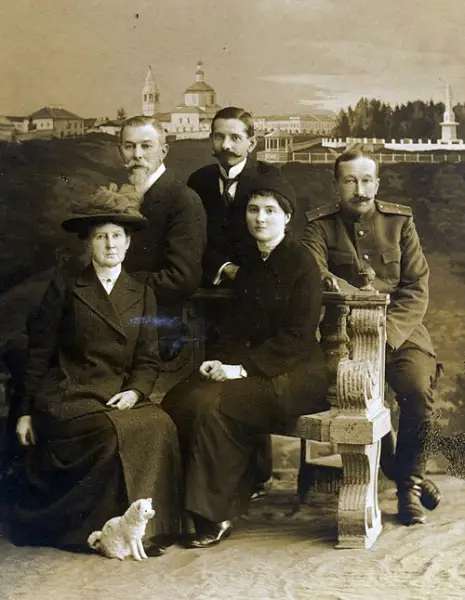
Overview
Henrietta Catharina Luisa Schneider, in Russian Ekaterina Adolfovna Shneyder and known to those around her as Trina, belonged to the Baltic German community and held a tutoring post at the court of Tsar Nicholas II and Tsarina Alexandra. Her birth took place at Saint Petersburg on 20 January 1856, into that same Baltic German world, she was the niece of a former imperial physician, Dr. Hirsch, and the daughter of a Hof-Councillor. Some years before the Empress's arrival she had taught Russian to Grand Duchess Elizabeth Fyodorovna, and she later gave the same instruction to Alexandra before that princess's marriage into the imperial house. A courtier recalled a character of exceptional sweetness and goodness of heart, joined to a primly Victorian strictness: she once forbade the four grand duchesses to perform a play because its text contained the word stockings. Devoted to the Empress, she willingly shared Alexandra's captivity after the Revolution of 1917; at Ekaterinburg the guards parted her from the family, and months of imprisonment at Perm followed. In September 1918 she and the lady-in-waiting Anastasia Hendrikova were driven to a forest outside Perm, ordered to march forward, and killed with a rifle butt. Their bodies were recovered by the Whites in May 1919. The Russian Orthodox Church Outside Russia canonized both as martyrs in 1981, notwithstanding Schneider's lifelong Lutheran faith.
The Complete Life
Teacher of Empresses
Catherine Schneider found her vocation in the schoolroom of an empire. Born in Saint Petersburg in 1856 to a Baltic German family that had put down roots in the Russian capital, she belonged to that community of German descent which supplied the imperial court with physicians, officials and governesses; her uncle Dr. Hirsch had served as physician to the tsars, and her father held the rank of Hof-Councillor. Her profession was the teaching of Russian, and her pupils were among the most consequential women of the age. She first taught the language to Princess Elisabeth of Hesse, the future Grand Duchess Elizabeth Fyodorovna, before that princess married Grand Duke Sergei Alexandrovich. Years later the same service was required for her younger sister Alix, and Schneider prepared the future Tsarina Alexandra for her entrance into Russian life by teaching her the language of her adopted country. The position gave her a permanent place at court in the decades that followed, close to the Empress and to the four grand duchesses. Those who knew her described a character of singular gentleness, joined to a strictness of manner that belonged to her time and class: she would not allow the imperial daughters to stage a play in which the word stockings appeared. The nickname Trina, by which she was known in the household, suggests an affection that such exactness did not diminish. Her life's work was quiet, loyal and formative: she gave the Empress of Russia her Russian voice.
§ Introduction
Perm, September 1918
The Revolution of 1917 swept away the world Schneider had served, and her response to it was fidelity. Devoted to the Empress, she followed Alexandra willingly into the imprisonment that began with the fall of the monarchy, sharing the confinement that moved from palace to fortress. At Ekaterinburg, where the imperial family was eventually held, the elderly teacher was separated from her charges and sent to Perm, an industrial city on the western slope of the Urals. There she was imprisoned for months alongside Anastasia Hendrikova, a lady-in-waiting of the court who had likewise attached herself to the family's fortunes. In September 1918, as the civil war deepened and the Bolshevik regime moved against those connected with the fallen dynasty, the two women were taken from their prison, driven out to a forest beyond the city, ordered to walk forward into the trees, and beaten to death with a rifle butt. Schneider was in her sixty-third year; Hendrikova was thirty-one. The manner of their killing, without trial and without ceremony, was shared by many victims of that period. The following May, after Perm fell to the Whites, their bodies were recovered, yet where they were finally laid to rest has never been established, and the graves of the two women who would be counted among Russia's new martyrs remain unknown.
§ Biography
A Lutheran Among the New Martyrs
The story of Catherine Schneider's glorification is one of the stranger footnotes to the Romanov tragedy. In 1981 the Russian Orthodox Church Outside Russia, the émigré church that had kept the memory of the revolution's victims alive for six decades, canonized a great company of new martyrs and confessors of the Russian yoke. Among them were the members of the imperial family and, with them, the servants who had shared their fate. Schneider and Hendrikova were both numbered among the martyrs in that act. What makes Schneider's case unusual is her confession: she remained a Lutheran throughout her life and never joined the Orthodox Church, so that her canonization by an Orthodox jurisdiction honored a Christian of another tradition as a martyr for Christ. The decision reflected the character of the ROCOR calendar, which commemorates those who died for the faith or in fidelity to the Christian order that Bolshevism destroyed, and it has drawn comment ever since as an instance of ecumenical breadth in the midst of persecution's memory. Her life spans the whole arc of the late imperial period: born three years before the emancipation of the serfs, she taught the language of Russia to its last empress and died at the hands of the regime that replaced her. With Hendrikova she is remembered among the new martyrs whose common grave is the Russian forest.
§ Introduction
Timeline
- 20 Jan 1856
Born in Saint Petersburg to a Baltic German family, daughter of a Hof-Councillor
§ Biography
- 1917
Loyally follows the Empress into captivity after the Russian Revolution, later being parted from the family at Ekaterinburg
§ Biography
- 4 Sep 1918
After months in a Perm prison, driven to a forest with Anastasia Hendrikova and killed with a rifle butt
§ Biography
- May 1919
White forces recover her remains and Hendrikova's, though their burial spot is never identified
§ Biography
- 1981
Numbered among the new martyrs by the Russian Orthodox Church Outside Russia
§ Introduction
In Their Own Words
Infinitely sweet tempered and good hearted.
The Record
- Canonization
- Canonized as a martyr by the Russian Orthodox Church Outside Russia in 1981
Prayer
Bibliography
Show 4 sources
- King, Greg, and Wilson, Penny, The Fate of the Romanovs, John Wiley and Sons, 2003.
- Rappaport, Helen, Four Sisters: The Lost Lives of the Romanov Grand Duchesses. Pan Macmillan, 2014. ISBN 978-1-4472-5935-0.
- "Famous and Infamous Germans from Russia" (archived 2008-03-05).
- "Nicholas II's Circle".
Profile text adapted from the Wikipedia article, licensed CC BY-SA 4.0.
Pray with this saint every day
Save St. Catherine Schneider to your favorites, read the full profile, and get feast-day reminders in the Saints app.
Get the Saints AppFree on the App Store for iPhone and iPad