
died c. 230·Feast November 22
St. Cecilia
Virgin martyr of Rome and patron of music
Overview
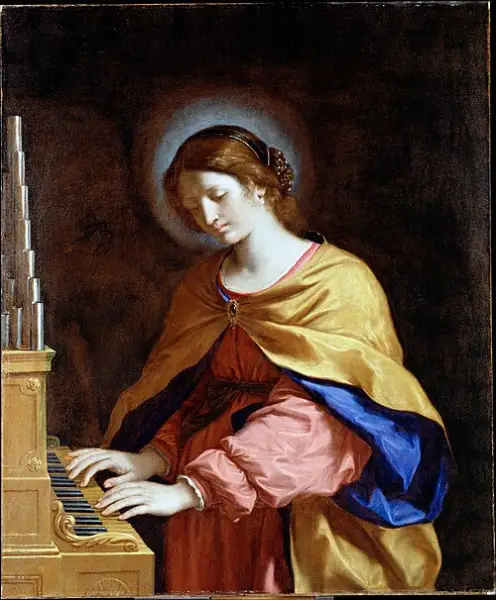
Cecilia of Rome stands among the most celebrated of the early Roman virgin martyrs, venerated by Catholics, Eastern Orthodox, Anglicans, and Lutherans alike. Popular tradition makes her a noblewoman of the imperial city who, bound by a vow of virginity, was compelled by her parents to marry a pagan nobleman named Valerian. At the wedding, while the musicians played, she sang to God in her heart, the gesture that would make her the patron saint of music. She won her husband and his brother Tiburtius to the faith through the counsel of Pope Urban I, and both men suffered martyrdom under the prefect Turcius Almachius before Cecilia herself was condemned. Three blows of the executioner's sword failed to kill her; she survived three days more, begged the pope to transform her house into a church, and then passed to her reward. She was buried in the Catacomb of Callixtus and later translated to the basilica of Santa Cecilia in Trastevere, raised on the site of her house. When her tomb was opened in 1599, witnesses reported her body incorrupt, as if asleep. Johann Peter Kirsch held that the martyr's existence is a historical fact, though some details of her acts bear the mark of pious fiction. Her feast on 22 November fills churches and concert halls with music in her honor.
The Complete Life
A Noblewoman's Vow
Cecilia, according to the account that has been told of her since antiquity, was a noblewoman of Rome, a daughter of one of the great families of the imperial city. Her very name belongs to that world: Cecilia was the name borne generally by the women of the plebeian clan of the Caecilii, and the legends that mistook it for a personal name invented for it a whole treasury of fanciful etymologies, among them the lily of heaven and the way for the blind, catalogued by Chaucer in The Second Nun's Tale. From her youth she had consecrated herself to God by a vow of virginity, carrying the secret of that consecration in a household that had other plans for her. Roman daughters of her rank were expected to marry and to knit their families into the web of the aristocracy, and her parents arranged a match with a nobleman named Valerian, a pagan of good standing. On the wedding day, robed and crowned as custom demanded, Cecilia sat apart from the music and revelry, singing to God in her heart, the silent prayer that later generations would remember as the founding gesture of all sacred music. Beneath the festivities, a divided household awaited the night when her vow would be put to the test.
§ Life
The Angel and the Lily Crown
When the marriage feast was over and the time came for the union to be consummated, Cecilia revealed to her husband the vow she had made to God. An angel, she told him, stood guard over her consecration: harm her, and heaven would punish; honor her virginity, and he would know the angel's love. Valerian answered that he would believe what he could not see, and Cecilia sent him along the Appian Way to the third milestone, where Pope Urban would wash him in the waters of baptism. Valerian obeyed, and returning found the angel at his wife's side, placing on her head a chaplet of roses and lilies. The conversion of the house did not stop there: at Cecilia's prompting, Valerian's brother Tiburtius also came to the faith, and the brothers devoted themselves to Christian works, burying the bodies of the martyrs whom the authorities had cast out unburied. A Roman soldier named Maximus, converted by their witness, joined their company. In the space of a few days the pagan household of a Roman nobleman had become a center of the persecuted church, bound together by a young bride whose quiet constancy had accomplished what no argument could.
§ Life
Martyrdom of a Household
The faith professed so openly in Cecilia's house soon drew the attention of the Roman authorities. The prefect Turcius Almachius seized Valerian and Tiburtius, and the brothers suffered martyrdom for their refusal to renounce the faith they had newly embraced; Maximus, the soldier converted by their courage, perished with them. Cecilia's own turn came next. According to the traditional acts, she was condemned to die by suffocation in the baths of her own home, but the heat did her no harm; a soldier was then sent to behead her, and he struck her neck three times without being able to sever her head from her body, for Roman law forbade a fourth blow. The dying virgin was left where she fell, and for three days she lingered, ministered to by the church. With her last breaths she made her final disposition: she asked the pope to consecrate her house as a church, so that the dwelling of the Christian household she had founded might become a permanent house of God. The request was fulfilled, and the basilica of Santa Cecilia in Trastevere stands to this day on the site where the noblewoman lived, converted her family, and died, her home transformed by her blood into an altar of the Roman church.
§ Life
The Song Within
The spirituality of Cecilia is summed up in a single image that the church has never ceased to contemplate: at her own wedding, amid the wedding music of the world, she sang in her heart to the Lord. Her song was inaudible, interior, and it expressed the whole orientation of her life, a heart given to God while her body moved through the obligations of a Roman noblewoman's day. From that interior consecration flowed everything the tradition records of her: the courage to disclose her vow, the gentle firmness with which she guided Valerian to baptism, the confidence that an angel stood beside what had been promised to God. Her dying added a final note to the song, for she endured the failure of the executioner's sword for three days, using the time to bequeath her house to the church in an act of dispossession that made a patrician dwelling into a shrine for the poor and the persecuted. Later ages found in her a figure of what sacred music should be: not ornament, but prayer carried by sound, the liturgy's way of singing to God in the heart. It is for this that composers from Palestrina's contemporaries to Arvo Pärt have laid their works at her feet.
§ Life
Burial and the Incorrupt Body
After her death, Cecilia's body was laid to rest in the Catacomb of Callixtus, the great Christian cemetery on the Appian Way where the bishops of Rome of the third century were buried, and there she slept among the martyrs of the persecutions. In time her remains were translated to the basilica of Santa Cecilia in Trastevere, the church that had risen over her own house. The original basilica was built there in the fourth century, and in the ninth Pope Paschal I deposited within it relics honored as hers, among the many he gathered from the graves of Rome's martyrs. The most famous chapter in the history of her tomb came in 1599, when Cardinal Paolo Emilio Sfondrati, leading a renovation of the basilica, had the remains excavated and reported that the body was incorrupt, lying as though the saint were simply asleep. Multiple witnesses attested what was seen, and the young sculptor Stefano Maderno recorded the body in marble in the attitude in which it was found, a statue that still lies beneath the altar of the basilica. The church has never forgotten the sight: Cecilia, who had survived the three strokes of the sword, was believed to have been preserved beyond corruption in her grave of more than thirteen centuries.
§ Santa Cecilia in Trastevere
A Martyr of the Canon of the Mass
Cecilia belongs to the company of saints whose canonization belongs to the church's oldest memory, before any formal process existed: she was honored as a martyr from the generations immediately following her death, and no pope ever canonized her because no pope needed to. Christians have kept her feast of 22 November from roughly the fourth century onward, and the Canon of the Mass in the Latin rite recites her name at the heart of every Roman Eucharist, in the small company of virgin martyrs honored there. The learned Johann Peter Kirsch, examining her acts, judged that a real martyr stood behind the legend, even as he acknowledged that the narrative drawn up during the fifth and sixth centuries bears in places the mark of devout embellishment; the relation between Cecilia, Valerian, Tiburtius, and Maximus recorded in the Acts of the Martyrs, he judged, has some historical foundation. The scholar Giovanni Battista de Rossi argued on the testimony of Venantius Fortunatus that she perished in Sicily under Marcus Aurelius between 176 and 180, but the popular Roman tradition of her passion under Alexander Severus about 230 remains the received account. No mention of her appears in the Depositio Martyrum, but an early record preserves a Roman church founded by a lady of her name.
§ Life
The Music of Her Name
No martyr of the early Roman church has gathered around her name such a chorus of music as Cecilia. Because she sang to God in her heart while the musicians played at her wedding, she became the patron of music itself, of singers, of organ builders and luthiers, and of poets, and her feast on 22 November became the occasion of concerts and festivals across the world. The first recorded festival in her honour was held at Évreux in Normandy in 1570, and in 1585 Sixtus V founded the Accademia Nazionale di Santa Cecilia in Rome, one of the oldest musical institutions on earth. The feast inspired poems by John Dryden and Alexander Pope and a great stream of compositions: Purcell's Ode to St. Cecilia and Hail! Bright Cecilia, three oratorios of Charpentier, Handel's Ode for St. Cecilia's Day and Alexander's Feast, Gounod's St. Cecilia Mass, and Benjamin Britten's Hymn to St Cecilia, written to Auden's poem by a composer born on her feast day. Her image with organ or viola fills the galleries of Europe, from Raphael's Ecstasy to the mosaics of Trastevere. Cistercian nuns beside her basilica still shear the lambs whose wool becomes the pallia of new archbishops, binding her house to the living hierarchy of the church.
§ Legacy
Timeline
- 230
According to the traditional account, martyred at Rome under the emperor Alexander Severus, together with the household of Valerian.
§ Life
- 1570
A festival of music in her honour was celebrated for the first time in the Norman town of Évreux.
§ Patron of musicians
- 1585
Pope Sixtus V issued the papal bull Ratione congruit, founding the Accademia Nazionale di Santa Cecilia in Rome under her patronage.
§ Patron of musicians
- 1599
Cardinal Paolo Emilio Sfondrati excavated her remains during renovations of Santa Cecilia in Trastevere and reported the body incorrupt.
§ Santa Cecilia in Trastevere
- 1882
St. Cecilia's Abbey was founded at Ryde on the Isle of Wight, whose nuns live by the Rule of Saint Benedict.
§ Legacy
- 1994
The Cecyliada festival of sacred, choral, and contemporary music, named for her, began in Police, Poland.
§ Patron of musicians
- 19 Nov 2000
Arvo Pärt's Cecilia, vergine romana, commissioned for the Great Jubilee, was premiered by the Accademia Nazionale di Santa Cecilia under Myung-whun Chung.
§ In music
In Their Own Words
sang in her heart to the Lord
The Record
- Major works
- Conversion of her family home into a church, at her dying request; the site became the basilica of Santa Cecilia in Trastevere
- Patron of
- Sacred music·Organ builders and luthiers·Singers and musicians·Poets·Archdiocese of Omaha·Albi, France·Mar del Plata, Argentina
- Symbols
- Portative organ·Flute·Violin·Harp·Roses·Songbird
- Canonization
- Pre-congregation; among the most famous Roman martyrs, commemorated by name in the Canon of the Mass and honored since about the fourth century
Prayer
Bibliography
Show 7 sources
- Kirsch, Johann Peter (1908). "St. Cecilia". In Herbermann, Charles (ed.). Catholic Encyclopedia. Vol. 3. New York: Robert Appleton Company
- Chisholm, Hugh, ed. (1911). "Cecilia, Saint". Encyclopædia Britannica. Vol. 5 (11th ed.). Cambridge University Press. p. 593
- Fr. Paolo O. Pirlo, SHMI (1997). "St. Cecilia". My First Book of Saints. Sons of Holy Mary Immaculate - Quality Catholic Publications. pp. 280-282. ISBN 978-971-91595-4-4
- Goodson, Caroline J. (February 2007). "Material memory: rebuilding the basilica of S. Cecilia in Trastevere". Early Medieval Europe. 15: 2-34. doi:10.1111/j.1468-0254.2007.00197.x
- Leonard Foley, OFM, revised by Pat McCloskey. "Saint of the Day: Saint Cecilia". Franciscan Media. ISBN 978-0-86716-887-7
- Lovewell, B.E. (1898). The Life of St. Cecilia. Yale Studies in English. Boston: Lamson, Wolffe, and Company
- Dom Gaspar LeFebvre, OSB (1952). The Saint Andrew Missal, with Vespers for Sundays and Feasts. Saint Paul, MN: E. M. Lohmann Co. p. 1685
Profile text adapted from the Wikipedia article, licensed CC BY-SA 4.0.
Pray with this saint every day
Save St. Cecilia to your favorites, read the full profile, and get feast-day reminders in the Saints app.
Get the Saints AppFree on the App Store for iPhone and iPad