
c. 620 – 664·Feast October 26
St. Cedd
Bishop of London and evangelist of the East Saxons
Overview
Cedd, born around 620 in the Kingdom of Northumbria, was an Anglo-Saxon monk and bishop who evangelised the Middle Angles and the East Saxons and played a notable part in the Synod of Whitby. Raised on Lindisfarne under Aidan of the Irish Church, he belonged to a remarkable family of four priestly brothers, among them Chad, later bishop of Mercia; all four bore names of British Celtic origin. Cedd owed his formation as priest and scholar to the Irish tradition of Aidan and his successor Finan, with its emphasis on monastic organisation, asceticism and biblical study. In 653 Oswiu of Northumbria sent him with three other priests to preach to the Middle Angles, where Peada's conversion opened the way for numerous converts of all classes. Recalled by Oswiu, he was dispatched to the East Saxon kingdom at the request of Sigeberht the Good, whose people he reconverted. In recognition of this success Finan ordained him bishop for the East Saxons, and he is accordingly listed among the bishops of London. A man of firm discipline, he excommunicated a thegn living in an unlawful marriage and dared to denounce King Sigeberht himself for visiting the man's house. He founded monasteries at Tilaburg and Ithancester in Essex, and became abbot of Lastingham in Northumbria, purifying its site with a forty-day fast. As interpreter at the Synod of Whitby in 664 he bridged the Celtic and Roman parties and accepted the Roman Easter. Returning to Lastingham, he died of plague on 26 October 664.
The Complete Life
A Lindisfarne upbringing
Almost everything known about Cedd comes from Book 3 of Bede's Ecclesiastical History of the English People, and the following picture rests on that single but rich source. He was born in the Kingdom of Northumbria, probably in the early 620s, since Bede's first datable reference to him shows him already a priest in 653. He was one of four brothers, Cedd, Chad, Cynibil and Cælin, every one of whom became a priest, and two of whom, Cedd and Chad, became bishops. Despite the family's apparent Northumbrian standing, all four brothers bear names of British Celtic, not Anglo-Saxon, origin, a detail that hints at the mixed population of seventh-century Northumbria. Cedd was probably the eldest and was acknowledged as head of the family, taking the lead among the brothers, with Chad marked out as his chosen successor. He was brought up on the island of Lindisfarne under Aidan, the monk-bishop from Iona, and his whole formation as priest and scholar evidently came from Aidan and the community on that holy island. He was close to Aidan's successor Finan, and unlike many Northumbrians who went to study in Ireland, he is not listed among the wandering scholars; his schooling was Lindisfarne itself, in the Irish tradition of asceticism, biblical interpretation and eschatological seriousness that Bede repeatedly says he and Chad absorbed.
§ Background
Formation in the Celtic Rite
Cedd's vocation was shaped decisively by the church culture into which he was born. Aidan had come to Northumbria from Iona bearing a set of practices known as the Celtic Rite, which differed from the usage of continental Christendom in more than the obvious points of dispute, the computus by which the date of Easter was calculated and the shape of the monastic tonsure. At root the difference was organisational: instead of the diocesan structure then evolving on the continent, the Celtic church built its life on monasteries, which supported peripatetic missionary bishops moving through the country rather than ruling fixed territorial sees. The tradition laid heavy stress on personal asceticism, on the close study of Scripture, and on the last things. Aidan himself was famous for his austerity and for his indifference to wealth and power, walking the kingdom on foot and giving away what he received. Bede several times emphasises that Cedd and his brother Chad took on this example and its traditions, and it was a formation that marked Cedd's whole career: a bishop who was also a missionary and a monk, who founded monasteries rather than palaces, and who fasted for forty days to prepare a site for prayer. The death of Aidan in 651 sent many Northumbrians, Chad among them, to study with the Irish, but Cedd stayed, and the Irish tradition remained the native language of his spirituality until the Synod of Whitby tested it late in his life.
§ Background
Middle Angles and East Saxons
Cedd's public mission opened in 653, when Oswiu of Northumbria despatched him, with three fellow priests named Diuma, Atta and Betti, to bring the Gospel to the Middle Angles, one of the core peoples of Mercia in the mid-Trent valley. The occasion was political as much as religious: Peada, son of the pagan Penda, was sub-king of the Middle Angles and had consented to baptism as the condition of marrying Alchflaed, Oswiu's daughter, travelling north to negotiate both his bride and his baptism. Cedd and his colleagues accompanied Peada home and won numerous converts of all classes. Bede records, contrary to expectation, that Penda placed no obstacle in the way of preaching to his own Mercians, and shows him sympathetic to Christianity at that point, against his usual reputation as a devoted pagan. Even so, their work gained little ground across Mercia at large; the effective evangelisation of that kingdom fell to Cedd's brother Chad more than a decade later. Cedd himself was soon recalled by Oswiu and sent out with a single companion to the kingdom of the East Saxons, whose ruler Sigeberht the Good had asked for missionaries to reconvert his people after the failure of the earlier Roman mission from Canterbury. His prospects there were strengthened by Northumbria's growing power, sealed by Penda's final defeat in 655. After making conversions he returned to Lindisfarne, where Finan ordained him bishop for the East Saxons, so that he is counted among the bishops of London, then an East Saxon town.
§ Bishop of the East Saxons
Monastic foundations and monastic discipline
Cedd's spirituality was monastic and penitential in the Lindisfarne mould, and it expressed itself above all in foundations. He founded many churches in Essex, and he established monasteries at Tilaburg, probably East Tilbury though possibly West Tilbury, and at Ithancester, almost certainly Bradwell-on-Sea, whose ancient chapel of St Peter still stands by the sea. At the request of Œthelwald, sub-king of Deira, he also became abbot of Lastingham in his native Northumbria; Bede records how the king was put in touch with Cedd through Cælin, another of the bishop's brothers, who served on the royal staff. The foundation rite itself reveals the man: Cedd undertook a forty-day fast to purify the site, and when urgent royal business called him away after thirty days, his brother Cynibil completed the fast for him. Cedd held the abbacy of Lastingham until his death, while continuing his work as missionary bishop and diplomat, travelling far from the monastery and delegating its daily care to other priests; Chad, who followed him as abbot, did likewise. The brothers regarded Lastingham as a monastic base, a place of retreat providing intellectual and spiritual support for their wider labours. His discipline as a pastor was equally austere. He demanded personal commitment and did not fear the powerful: he excommunicated a thegn living in an unlawful marriage, forbade Christians to eat at the man's table, and went in person to denounce King Sigeberht for continuing to visit, foretelling that the king would die in that house.
§ Monastic foundations
Whitby, plague and death
Cedd's last years fell in the year of crisis, 664. Brought up in the Celtic Rite, he faced the question of the competing traditions directly at the Synod of Whitby, the council held within the Northumbrian kingdom to settle the differences over the dating of Easter and the tonsure. The debate was slowed because those taking part could barely follow one another's tongues, probably Old Irish, Old English, Frankish, Old Welsh and Latin, and Bede recounts that Cedd interpreted for both sides. Command of languages, together with his credentials as a royal envoy, probably made him central to the debate, and contemporaries saw such interpretation as a sign of the Holy Spirit's presence, an undoing of Babel. When the council decided for the Roman usage, Cedd accepted the Roman dating of Easter, abandoning the practices of the Irish of Dál Riata, and returned to his work in Essex. A short time later he went back to Northumbria and to Lastingham, where plague struck him down; he died of it on 26 October 664. His first burial was a simple grave at Lastingham; when a stone church was later built his body was translated to a shrine inside it, and Chad succeeded him as abbot. Straight after his passing, thirty monks journeyed north from Essex to pay him homage, and all but one small boy died there of the same plague. In Essex, where some had reverted to paganism amid the epidemic, Wulfhere of Mercia sent Bishop Jaruman to continue Cedd's work and restore the faith.
§ Final years
A saint of three traditions
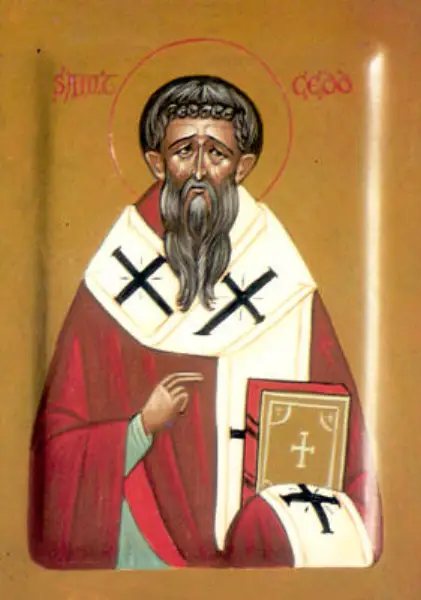
Cedd's sanctity was recognised by the devotion of the church immediately after his death, and his cult has never required a formal canonisation: he stands among the pre-congregation saints. His commemoration is kept on 26 October, the anniversary of his death, and he is honoured in an unusually wide circle of traditions, venerated in Anglicanism, in the Roman Catholic Church, and in the Eastern Orthodox Church, which keeps his feast on 7 January. The crypt of the present parish church at Lastingham occupies the place of his shrine at St Mary's, the shrine itself having been destroyed during the Danish period. He is titled the Evangelist of the Middle Angles and East Saxons, a designation that captures the two fields of his missionary labour, and he is invoked as patron of Essex, of Lastingham, and notably of interpreters, a patronage drawn straight from his service at the Synod of Whitby. In iconography he is shown as a bishop bearing a model of Bradwell-on-Sea church, the chapel that still survives from his monastery of Ithancester. The liturgical colour for St Cedd's Day is white, as for other saints who were not martyrs, with white hangings and vestments marking the feast of a bishop and confessor who died in bed rather than at the hands of persecutors.
§ Commemorations
Essex Day and the chapel by the sea
Cedd's legacy is most alive in the county he evangelised. In the Church of England his commemoration on 26 October is kept as St Cedd's Day, which is also known as Essex Day, an identification of the saint with his region that few Anglo-Saxon missionaries enjoy. The Diocese of Chelmsford made the anniversary a jubilee: in 1954, the thirteenth centenary of Cedd's mission to Essex was kept as St Cedd's Year; Chelmsford Cathedral, though already under the patronage of St Mary the Virgin, received the added dedication of St Cedd together with St Peter, the dedicatee of Cedd's Bradwell chapel; the festivities even included a rally at West Ham United's Boleyn Ground. Places still bear his name or claim his footsteps: the town of Chediston is named after him, and the Gospel Oak at Polstead in Suffolk, an ancient tree whose original trunk collapsed in 1953, numbers among the places where local tradition says he preached, with an open-air service conducted there each first Sunday in August beside the successor trees. Historians value him too, as a window on the seventh-century church: a Celtic-trained bishop working within an English kingdom, accepting Roman obedience at Whitby, and linking the age of Aidan to that of his own brother Chad, the great bishop of Mercia. His career shows how the conversion of England was carried by such men, one mission, one monastery and one disputed calendar at a time.
§ Commemorations
Timeline
- 620
Born around 620 in the Kingdom of Northumbria, one of four brothers, all of whom became priests.
§ Background
- 651
Death of Aidan of Lindisfarne, whose Irish tradition formed Cedd's whole priestly and scholarly training.
§ Background
- 653
Oswiu despatched him alongside Diuma, Atta and Betti to preach among the Middle Angles, winning numerous converts.
§ Mission to Mercia
- 654
Recalled by Oswiu and sent to the East Saxons at Sigeberht the Good's request; ordained bishop for the East Saxons by Finan at Lindisfarne.
§ Bishop of the East Saxons
- 655
Penda's final defeat confirmed Northumbrian hegemony and strengthened Cedd's mission in Essex.
§ Bishop of the East Saxons
- 660
Denounced King Sigeberht for visiting an excommunicated thegn; the king was murdered that year.
§ Bishop of the East Saxons
- 664
Acted as interpreter for both sides at the Synod of Whitby and accepted the Roman dating of Easter.
§ Final years
- 26 Oct 664
Died of the plague at Lastingham; thirty monks came from Essex to honour him and all but one boy died there too.
§ Final years
- 664
Bishop Jaruman was dispatched by Wulfhere of Mercia to restore Christianity when parts of Essex reverted to paganism.
§ Final years
- 1954
The Diocese of Chelmsford kept the 13th centenary of his Essex mission as St Cedd's Year, dedicating its cathedral to him.
§ Commemorations
The Record
- Major works
- Mission to the Middle Angles (653)·Mission and episcopate among the East Saxons, with London as his see·Monastic foundations at Tilaburg (East or West Tilbury) and Ithancester (Bradwell-on-Sea) in Essex·Abbacy of the monastery of Lastingham in Northumbria·Interpretation at the Synod of Whitby (664)
- Patron of
- Essex·Lastingham·interpreters
- Symbols
- Bishop holding a model of the church at Bradwell-on-Sea
- Canonization
- Pre-congregation; venerated since his death in the Roman Catholic Church, the Orthodox Church and Anglicanism.
Prayer
Bibliography
Show 7 sources
- Bede. Ecclesiastical History of the English People, Book 3, chapters 21–23, 25–27 and 30.
- Higham, Nicholas J.; Ryan, Martin J. (2013), The Anglo-Saxon World, Yale University Press, ISBN 978-0-300-12534-4.
- Mayr-Harting, Henry. The Coming of Christianity to Anglo-Saxon England. 1991. Pennsylvania State University Press. ISBN 978-0-271-00769-4.
- Koch, J.T. (2006), Celtic Culture: A Historical Encyclopedia, ABC-CLIO, ISBN 1-85109-440-7.
- Powicke, F. Maurice and E. B. Fryde, Handbook of British Chronology, 2nd ed., London: Royal Historical Society, 1961.
- Fletcher, Richard. The Conversion of Europe: From Paganism to Christianity 371–1386. HarperCollins, 1997. ISBN 0-00-255203-5.
- Cave, Diana. St Cedd: Seventh-century Celtic saint. PublishNation, London 2015. ISBN 978-1-326-29593-6.
Profile text adapted from the Wikipedia article, licensed CC BY-SA 4.0.
Pray with this saint every day
Save St. Cedd to your favorites, read the full profile, and get feast-day reminders in the Saints app.
Get the Saints AppFree on the App Store for iPhone and iPad