
fl. c. 6th century·Feast July 5
St. Cenydd
Crippled Hermit of the Gower Peninsula
Overview
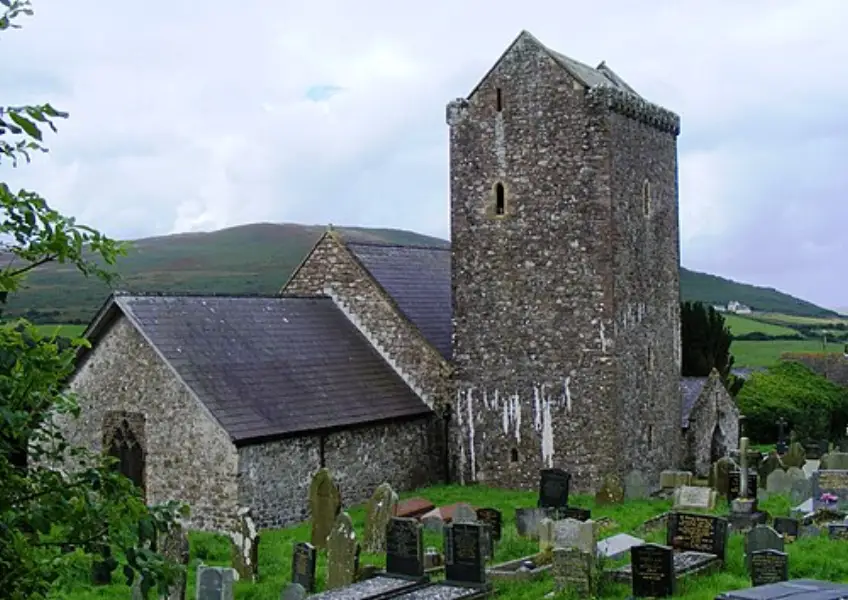
Cenydd, known in modern Welsh as Cennydd and in French as Kinède, and sometimes rendered in English as Kenneth, was a Christian hermit living on the Gower Peninsula in Wales during the sixth century. He is credited with founding the church at Llangennith, which remains his major shrine together with Languidic in Brittany. Liturgical calendars and place-name evidence point to a genuine historical figure behind the cult, although the surviving legend is late and plainly derivative, so little about his life can be asserted with confidence. The medieval story makes him a Breton prince, the child of an irregular union within the royal house of Domnonée, exposed as a crippled infant on the Loughor estuary and miraculously sustained by birds. He later lived as a hermit, and when Saint David is said to have healed him while travelling to the Synod of Brefi in 545, Cenydd asked that his infirmity be given back to him. His feast at Llangennith, kept on 5 July, was long marked by a bird effigy raised on the church tower and by a dish of whitepot.
The Complete Life
A Child of the Estuary
The historical Cenydd stands behind a tradition that is easier to reverence than to verify. Welsh calendars and the dense clustering of place-names around the western Gower suggest that a real sixth-century hermit lies beneath the legend, but the story itself survives only in Welsh sources gathered by John Capgrave in the fifteenth century and printed in the Nova Legenda Angliae, far too late to carry much weight. In that tale Cenydd is a Breton prince, the son of a king the text calls Dihoc, generally identified with Deroch II of Domnonée, and the child of a union between that king and his own daughter. Summoned by Arthur to the Christmas court at Aber Llychwr, near Loughor, the father was still faced with the pregnancy when he returned. The infant, born a cripple, was set in a cradle woven of osiers and committed to the tide of the Loughor estuary, a mode of exposure that befell several early British saints. Carried out to Worm's Head, the child was kept alive there by seagulls and by angels who brought a miraculous bell shaped like a breast, by which he was nourished and brought up in the Christian faith. Whatever the facts, the story fixed the image of a saint whose whole life began in abandonment and ended in solitude.
§ Legend
The Hermit's Choice
Cenydd's answer to a childhood of miracle was not a throne but a cell. He became a hermit on the Gower, and the tradition is firm that his companionship was thin: a single servant, and one whose honesty did not survive the test. The story tells that robbers were received hospitably at the hermitage, and that the servant stole a spear from the guests; the theft was discovered, and the dishonesty of the only human company the saint kept was laid bare. The tradition connecting him with Burry Holms, the tidal island at the northern end of Rhossili Bay, preserves the memory of a pre-Norman hermitage there, and the foundation of the church at Llangennith on the mainland opposite is credited to him, giving the cult a fixed centre that it has never lost. A different and frankly unreliable strand, owing much to Iolo Morganwg, would make him a son of Gildas who married and fathered a son, Ffili, afterwards a bishop and the supposed namesake of Caerphilly, before entering Llanilltud Fawr as a monk under Saint Illtud. The church has always been wiser to keep to the simpler figure: a crippled solitary, fed by birds, praying by the western sea.
§ Legend
The Infirmity He Would Not Surrender
The most telling episode in the Cenydd tradition occurred in 545, when Saint David, journeying to the Synod of Brefi, cured the hermit of his lameness. The healing might stand as the high point of a lesser saint's legend; for Cenydd it became instead the occasion of a choice. He preferred to remain as he had been born, and prayed that the infirmity might be restored to him. The gesture belongs to an old and austere spirituality, one that read bodily weakness not as an enemy to be conquered but as a share in the cross to be carried willingly, and that suspected nothing so much as a comfort graciously accepted. It is the spirituality of the exposed infant of Worm's Head, who had learned in childhood that God suffices for the abandoned. Around this poor and paradoxical figure the devotional imagination of the Gower built its feast. At Llangennith, until the early twentieth century and again in recent years, his festival on 5 July was marked by raising an effigy of a bird on a pole above the church tower, recalling the creatures said to have reared him, and by eating whitepot, a slow-baked pudding of milk, flour, sugar and dried fruit, cousin to a rice pudding and native to the cooking of Gower. A translation feast on 27 June, recorded by William Worcester and apparently belonging to some North Welsh church, is also noted.
§ Feast day
Legacy in Wales and Beyond
Cenydd's cult has proved remarkably durable for a saint of whom almost nothing certain is known. Llangennith keeps his feast on 5 July, and the old festival customs, the bird effigy on the tower and the whitepot, have been revived in recent years after a lapse. In Brittany he is chiefly honoured at Languidic, and a chapel of Saint-Quidy is dedicated to him at Ploumelin, or Plumelin in modern French spelling, a place not to be confused with Plomelin, which also lies in Brittany. The hermitage remains associated with Burry Holms keep his memory on the island at the mouth of Rhossili Bay. More unexpectedly, an incised stone whose carved images seem to retell his legend came to light in the 1880s, when the Cumbrian church of St Mungo at Dearham was undergoing restoration; it is shown there still under the name of the Kenneth Stone, and no one has yet explained how the cult of a Gower hermit reached so far north. In modern Wales his name is carried by the Church of St Peter and St Cenydd at Senghenydd, by St. Cenydd Community School in Caerphilly, and by the St Cenydd Leisure Centre, so that a saint whose legend is a tissue of wonders is now remembered in school halls as much as in shrines.
§ Feast day
Timeline
- 545
Saint David, journeying to the Synod of Brefi, cured Cenydd of his lameness, but the hermit prayed to have his infirmity returned.
§ Legend
- 1880
Renovation work at St Mungo's Church, Dearham in Cumbria uncovered an incised stone showing scenes apparently of Cenydd's legend, now called the Kenneth Stone.
§ Legend
The Record
- Major works
- Foundation of the church at Llangennith·Pre-Norman hermitage on Burry Holms
- Patron of
- Llangennith
- Canonization
- Pre-congregation; venerated in the Orthodox Church, the Roman Catholic Church and the Church in Wales
Prayer
Bibliography
Show 5 sources
- Holweck, F. G., A Biographical Dictionary of the Saints. St. Louis, MO: B. Herder Book Co., 1924, p. 202
- McAvoy, Liz Herbert, Anchoritic Traditions of Medieval Europe, Boydell & Brewer Ltd, 2010, p. 203, ISBN 9781843835202
- Owen, Hywel Wyn (2015), The Place-Names of Wales, University of Wales Press, p. 22, ISBN 9781783161645
- Baring-Gould, Sabine & Fisher, John (1907), Lives of the British Saints, The Honourable Society of Cymmrodorion
- Farmer, David Hugh (1978), The Oxford Dictionary of Saints, Oxford: Oxford University Press
Profile text adapted from the Wikipedia article, licensed CC BY-SA 4.0.
Pray with this saint every day
Save St. Cenydd to your favorites, read the full profile, and get feast-day reminders in the Saints app.
Get the Saints AppFree on the App Store for iPhone and iPad