
c. 493 – 575·Feast October 10
St. Cerbonius
Confessor Bishop of Populonia in Tuscany
Overview
Cerbonius, in Latin Cerbo and in Italian Cerbone or Cerbonio, was bishop of Populonia on the Tuscan coast during the age of the barbarian invasions, dying in 575 on the island of Elba. Pope Gregory the Great speaks well of him in the eleventh book of his Dialogues. One tradition makes him a North African of Christian parents, ordained priest by a bishop named Regulus, who fled the persecution of the Arian Vandals with Regulus, Felix and other clergy, landed in Tuscany after a storm and lived there as a hermit. Chosen bishop of Populonia after the death of Florentius, he fell under complaint for celebrating Mass at daybreak rather than at the customary hour, and was summoned to Rome, curing fevered men and taming wild geese on the way, until Pope Vigilius granted him liberty to say Mass at whatever morning hour he wished. Condemned by King Totila to be killed by a wild bear for sheltering Roman soldiers, he was spared when the bear crouched and licked his feet; exiled to Elba, he died there about 575 and was buried at Populonia. He is patron of Massa Marittima, whose cathedral holds his supposed sarcophagus.
The Complete Life
Flight from Africa
One tradition concerning Cerbonius begins far from the Tuscan coast, in North Africa, where he was born around 493 of Christian parents and was ordained priest by a bishop called Regulus, or Regolo in Italian, a namesake but no relation of the Regulus of the Scottish legend. The Africa of his youth lay under Vandal rule, and the Arianism of the conquerors made the position of Catholic communities steadily worse until persecution dispersed them. Cerbonius escaped together with Regulus, a companion named Felix, and certain other priests, and after a storm at sea the little company made land in Tuscany. There they settled as hermits, and there the wars of the age found them in turn: with the struggle between Byzantine and Gothic forces raging through Italy, Regulus was accused of helping the Byzantines, imprisoned, and beheaded by the Goths. It was out of this school of loss that Cerbonius was called to the episcopate. When Florentius, called Fiorenzo, bishop of Populonia, died, the citizens and clergy asked that the African refugee succeed him, and the hermit became a diocesan bishop on the coast of the Tyrrhenian Sea. An entirely different tradition would place him instead at Massa Marittima around 544, and the devotion of that city, which grew strong once it became an episcopal centre, has kept the rival memory alive; both cannot be true, and each has had its defenders.
§ Traditions and legends
The Mass at Daybreak
What most sharply characterises Cerbonius in the legend is a habit of prayer at an hour others thought unreasonable. Rising every Sunday before daybreak, he said Mass then rather than at the customary later hour, and his people, frustrated by a schedule they had not chosen, complained of him to Pope Vigilius. The pope, taking the complaint at face value, sent legates to Piombino to fetch the bishop to Rome, and the messengers, arriving to find him at breakfast, leapt to the conclusion that he was eating before Mass and accused him of heresy, when in fact he had already celebrated. On the road to Rome the character of the man showed itself: three men afflicted with fever were cured through him, and when wild geese made a nuisance of themselves he tamed them with the sign of the cross, so that they followed him all the way to Saint Peter's and only flew off when he blessed them again, the origin of the goose as his emblem. In Rome he went at first light into the pope's own chamber and roused him from bed, asking whether Vigilius did not hear the angels singing; the pope heard nothing of the kind, but recognised in the question a soul living on another clock, granted him freedom to celebrate at whatever hour of the morning suited him, and sent him back to his church. The story is a parable of devotion incommodious to the respectable.
§ Traditions and legends
Totila's Bear and the Burial at Populonia
The most famous scene of Cerbonius's later life belongs to the invasion of Tuscany by Totila, king of the Ostrogoths. The bishop had hidden several Roman soldiers, and for this the king ordered him to be thrown to a wild bear. The beast, however, was stopped in its tracks before him: it rose onto its hind legs and gaped its jaws wide, then dropped back onto its paws and licked the saint's feet, a humiliation of the intended execution that iconography has remembered ever after, for the bear licking his feet is one of his standing attributes. Totila, balked of a spectacle, commuted the sentence to exile on the island of Elba, and there the old bishop remained. Growing sick near the end, around 575, he begged to be buried at Populonia, on condition that those who buried him should return at once to Elba; his friends obeyed, and although the ship carrying his body met a heavy storm it came safely to port. He was laid in the ground and his followers went quickly back to their island, and very soon afterwards the Lombards seized Populonia, a catastrophe the saint was said to have foreseen and by his instruction to have escaped, saving his people at the cost of resting in a city soon taken from them.
§ Encounter with Totila
Legacy
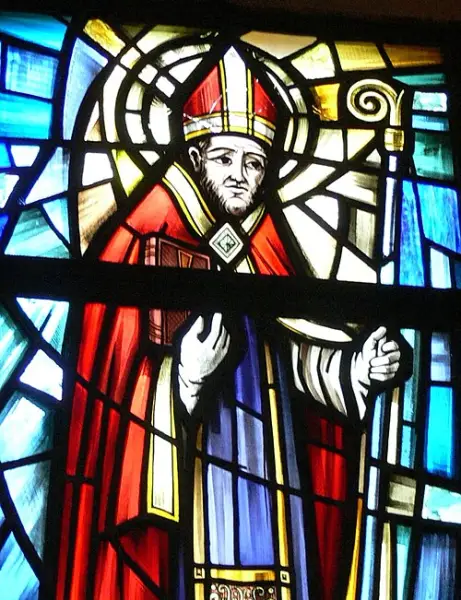
Cerbonius's cult is strongest at Massa Marittima, which honours him as patron. The thirteenth-century cathedral there, dedicated to him, contains a Gothic sarcophagus of 1324 that is supposed to be his tomb, and an alternate local tradition, which made him bishop of the city around 544, grew in strength once Massa Marittima became an episcopal centre in its own right. At Baratti, on the bay below ancient Populonia, there is a fountain and a chapel dedicated to him, and the place has its proverb: Chi non beve a San Cerbone, e un ladro o un birbone — drink at Saint Cerbonius's fountain or be counted a thief or a rascal — a saying that ties the saint to the everyday manners of his country. He is venerated in the Roman Catholic Church and in the Eastern Orthodox Church, his feast falling on 10 October, and he is among the bishops whom Pope Gregory the Great thought worth naming in the Dialogues. A distinct Saint Cerbonius is honoured at Verona, and the two must not be confounded. Stained glass at the Sanctuary of the Madonna del Monte on Elba, at Marciana, preserves his image, tying the exile's memory to the island where he died.
§ Veneration
Timeline
- 493
Born in North Africa around this year, by the tradition preserved in his legend
§ Introduction
- 544
An alternate tradition makes him bishop of Massa Marittima at about this time
§ Traditions and legends
- 575
Died on Elba, old and sick, during the exile King Totila had imposed on him
§ Traditions and legends
- 575
His body crossed a stormy sea to Populonia and was buried there, after which his companions hurried back to Elba
§ Traditions and legends
- 1324
A Gothic sarcophagus, honoured as his tomb, was set up at Massa Marittima
§ Veneration
The Record
- Patron of
- Massa Marittima
- Symbols
- Geese·A bear licking his feet
- Canonization
- Pre-congregation; praised by Pope Gregory I in Book XI of his Dialogues and venerated in the Roman Catholic and Eastern Orthodox Churches
Prayer
Bibliography
Show 4 sources
- "Saint of the Day", Washington, DC: St. Patrick Catholic Church, archived from the original on 2019-08-04, retrieved 2012-02-22
- "San Cerbone, il santo patrono di Massa Marittima", archived from the original on 2007-07-22, retrieved 2007-08-01
- San Cerbonio (Cerbone) di Populonia
- Sabine Baring-Gould, The Lives of the Saints, 12 vols. (Oxford: Oxford University, 1877), 228-9
Profile text adapted from the Wikipedia article, licensed CC BY-SA 4.0.
Pray with this saint every day
Save St. Cerbonius to your favorites, read the full profile, and get feast-day reminders in the Saints app.
Get the Saints AppFree on the App Store for iPhone and iPad