
c. 1184 – c. 1242·Feast July 16
St. Ceslaus
Polish Dominican Missionary of Silesia
Overview
Ceslaus, in Polish Czesław, was a Polish Dominican priest and missionary of the first half of the thirteenth century, born around 1184 at Kamień Śląski in Silesia and died at Wrocław on 15 July 1242. Born into the noble family of Odrowąż, he was a relative, and possibly the brother, of Saint Hyacinth of Poland. Philosophy he studied at Prague, theology and law at Bologna's university, and on his return he settled at Kraków as a canon, with the care of the Sandomierz church as its custodian. In or about 1218 he travelled to Rome in the party of his uncle Ivo, bishop of Kraków; moved by the fame of Dominic of Guzmán, Ceslaus and Hyacinth sought admission to the Order of Friars Preachers and received the habit from Dominic himself in 1220 after a shortened novitiate. Sent back to their own country as missionaries, the friars founded a house at Friesach in Austria and then went on to Kraków, whence Ceslaus went first to Prague and later to Wrocław; in that city he raised a large priory, and from it he worked across Bohemia, Poland, Pomerania and Saxony. He was later provincial superior for Poland, and is credited with delivering Wrocław from a Mongol siege by his prayers. His cult was confirmed in 1713 and his feast is kept in the Dominican Order on 16 July.
The Complete Life
A Nobleman of Odrowąż
Ceslaus was born around 1184 at Kamień Śląski in Silesia, into the noble family of Odrowąż, one of the great houses of medieval Poland. The family gave the church more than one notable son: Ceslaus was a relative, and possibly the brother, of Hyacinth of Poland, the apostle of the north who was himself to be canonised, and his uncle Ivo became Bishop of Kraków. Given such connections, his education followed the best path available to a gifted young Pole of his rank. He studied philosophy at Prague, then pursued theology and the juridical disciplines at the University of Bologna, one of the great schools of Europe, acquiring the learning that would later serve a preaching order. Coming home, he took up residence at Kraków as a canon, charged also with the custodianship of the Sandomierz church, positions that brought him income, standing and a comfortable ecclesiastical career. That career was interrupted in the most decisive way when duty took him to Rome and brought him face to face with a new kind of religious life then taking shape under Dominic of Guzmán. Everything in his training, the schools of Prague and Bologna, the administrative habit of a canonry, the connections of his house, would prove unexpectedly apt for the Order of Preachers, which demanded exactly learned men willing to go anywhere.
§ Biography
The Habit from Dominic's Hands
Around 1218 Ceslaus accompanied his uncle Ivo, now Bishop of Kraków, on the journey to Rome. The city was then alive with the reputation of Dominic of Guzmán, whose recent miracle of resuscitating the nephew of Cardinal Stefano di Fossa Nova, killed in a fall from his horse, was on every tongue. Hearing of the great sanctity of the founder, Ceslaus and Hyacinth together sought admission into the Order of Friars Preachers. The timing placed them at the very fountainhead of the new institute. The following year, 1219, Honorius III invited Dominic and his brethren to make their home at Santa Sabina, the old Roman basilica, an offer taken up by early 1220; Hyacinth and Ceslaus, with Herman and Henry, belonged to the first group of students at the Dominican studium in Rome, the seed from which, centuries later, would grow the College of Saint Thomas at Santa Maria sopra Minerva and the Pontifical University of Saint Thomas Aquinas, the Angelicum. After an abbreviated novitiate in 1220 Dominic himself clothed the Polish novices with the habit of the Order. For a man of Ceslaus's background, formed in the schools and the chapter, the novitiate compressed into months the stripping away of status that the religious life ordinarily works over years, and he emerged a friar.
§ Biography
Missionary in the North
Once the novices had finished their training, Dominic dispatched the young Poles homeward as missionaries, and the pattern of Ceslaus's remaining life was set. The little band established a friary at Friesach in Austria, then proceeded to Kraków, from which Hyacinth sent Ceslaus on to Prague, the metropolis of Bohemia, where he laboured with much fruit throughout the diocese. From Prague he went to Wrocław in Silesia, where he founded a large priory that became the base of his apostolate, and from it his missionary reach stretched over an immense tract, taking in Bohemia, Poland, Pomerania and Saxony, a sweep of country from the Bohemian heartland to the Baltic plain. The work was that of the early Dominicans everywhere: preaching, the instruction of clergy and people, the founding of convents from which further preaching could radiate. It was also, for the friars of the north, work carried out in the shadow of grave danger, for the same decades saw the Mongol invasions that broke over Poland and threatened the region's very existence. Ceslaus's reputation as a preacher and superior grew with the province he was building, and following Hyacinth's death he was elected provincial for Poland, the office in which tradition places him during the gravest crisis of his city.
§ Biography
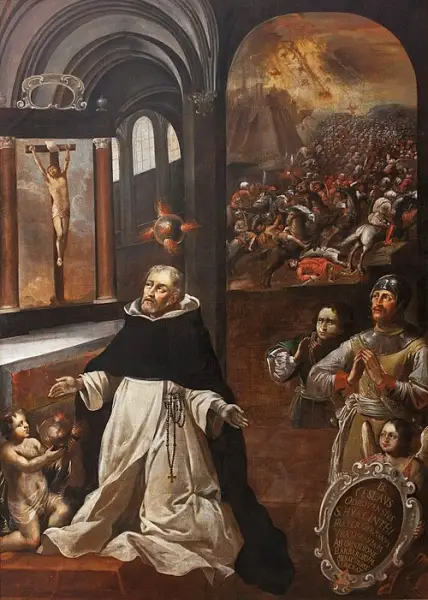
The Mongol Siege and a Holy Death
The closing chapter of Ceslaus's life belongs to Wrocław and to a moment of public terror. While he was superior of the convent there, all Poland was threatened by the Mongols, and the city of Wrocław was besieged. The people, having no other resource, sought the aid of Ceslaus, and by his prayers the impending calamity was miraculously averted, the deliverance that fixed his memory in the city's history. His sanctity was otherwise marked by the ordinary currency of hagiography: four people are credited to him as called back from death. His end came at Wrocław, the date given by tradition as 15 July 1242, in the city he had made his own, and burial followed in the same city: his tomb now stands in Wrocław's church of St. Adalbert and is still a place of pilgrimage, the stone memorial of a friar who had exchanged a Sandomierz custodianship for the roads of four peoples. The deathbed scene is unrecorded, and the chronology of his last years is thin, but the essentials survive in the cult that grew immediately around the grave: a preacher, a founder of houses, a deliverer of the city in its extremity, and a man whose memory needed no official prompting to endure among the people he had served.
§ Biography
Confirmation of the Cult
Ceslaus was never canonised in the modern sense, and for seven centuries he needed no such process. Having always been venerated as a blessed, he enjoyed an immemorial cult in Silesia and in the Dominican Order, centred on his tomb in Wrocław, and the church at length gave that cult its legal recognition. Pope Clement XI, whose pontificate saw a number of such confirmations of ancient local cults, beatified him at Saint Peter's Basilica on 27 August 1712, and the confirmation of his cult is dated to 1713. The distinction between beatification and the confirmation of a long-standing cult is exactly what his case illustrates: the pope did not so much add a new blessed as acknowledge a devotion that had never lapsed. Throughout the Order of Preachers his memorial falls on 16 July, one day after the date traditionally assigned to his death, placing him in the order's calendar beside Hyacinth, his greater kinsman and fellow disciple of Dominic, and among the first generation of Polish Dominicans. In the literature of the order he is counted among the beatified members, and the Catholic Encyclopedia preserves the traditional account of his life and miracles. Devotion to him has remained chiefly Silesian and Dominican, faithful to the field in which he worked.
§ Biography
Legacy
Ceslaus's legacy is written into the geography of the Polish church. The priory he founded at Wrocław became one of the important Dominican houses of central Europe, and the Church of St. Adalbert, where his tomb lies, keeps his memory in the city he is said to have saved. His missionary range, from Prague through Bohemia into Poland, Pomerania and Saxony, helped lay the network of Dominican foundations through which the order carried the reform of preaching in the north, an enterprise he shared with Hyacinth, his relative and perhaps brother, whose own canonisation gave the family its place in the universal calendar. As a figure of the Odrowąż house he also illustrates the way the early Dominican movement drew its first recruits disproportionately from the educated nobility of central Europe, men whose schools and connections became the order's instruments. The deliverance of Wrocław from the Mongol siege remains his defining popular image, and the four resurrections attributed to him kept his name in the catalogues of wonder-working friars. His cult, confirmed in the early eighteenth century and kept on 16 July throughout the Order of Preachers, continues to join Silesian civic piety to the Dominican family, a blessed of the first Dominican generation still honoured at the place of his burial.
§ Biography
Timeline
- 1184
Born around this year at Kamień Śląski in Silesia, of the noble Odrowąż family
§ Biography
- 1218
Accompanied his uncle Ivo, Bishop of Kraków, to Rome, and with Hyacinth sought admission to the Order of Friars Preachers
§ Biography
- 1219
Entered the Dominican studium at Rome as one of its first students, after Honorius III settled Dominic's friars at Santa Sabina
§ Biography
- 1220
Received the religious habit from Dominic himself, after an abbreviated novitiate, together with Hyacinth, Herman and Henry
§ Biography
- 15 Jul 1242
Died at Wrocław; his tomb is in the Church of St. Adalbert in that city
§ Biography
- 27 Aug 1712
Beatified at Saint Peter's Basilica by Pope Clement XI
§ Biography
- 1713
Pope Clement XI confirmed his long-standing cult, after generations of veneration as a blessed
§ Biography
The Record
- Major works
- Foundation of the large Dominican priory at Wrocław·Friary at Friesach in Austria, established with Hyacinth
- Canonization
- Cult confirmed by Pope Clement XI in 1713, having been beatified at Saint Peter's Basilica on 27 August 1712
Prayer
Bibliography
Show 4 sources
- "St. Ceslas, Confessor", Butler's Lives of the Saints
- "St. Ceslaus", The Catholic Encyclopedia, New York: Robert Appleton Company
- "CATHOLIC ENCYCLOPEDIA: St. Hyacinth", newadvent.org
- An Account of the Miracles of St. Dominic
Profile text adapted from the Wikipedia article, licensed CC BY-SA 4.0.
Pray with this saint every day
Save St. Ceslaus to your favorites, read the full profile, and get feast-day reminders in the Saints app.
Get the Saints AppFree on the App Store for iPhone and iPad