
c. 295 – 303
St. Cessianus
Child Martyr of the Diocletian Persecution
Overview
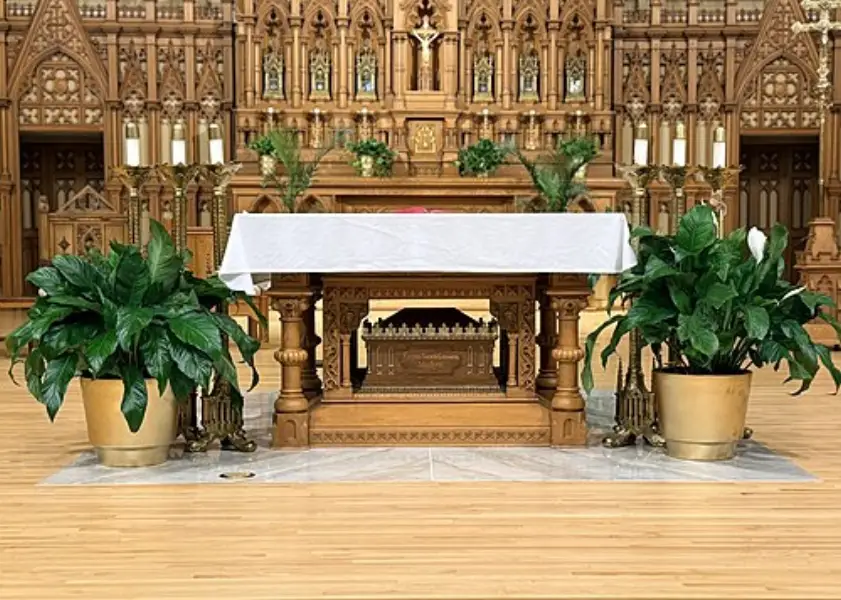
Cessianus is remembered as one of the youngest martyrs of the persecution launched by the Roman emperor Diocletian. According to the tradition that preserves his memory, he was only eight years old when he was put to death in the year 303, a date that fixes his birth around 295. In him the Church honors a child who bore witness to Christ in an age when the empire turned against the faith. His bones, removed from the Roman catacombs, were given a remarkable second history in the modern era. In 1838 Pope Gregory XVI presented the relics to Bishop Mathias Loras, who carried them across the Atlantic as he traveled to take charge of the church in the young American territory of Iowa. They were sealed within a side altar of St. Raphael's Cathedral in Dubuque, and after renovations in the twentieth century they were transferred to a place of honor beneath the freestanding main altar, where they rest today, making a modest church in the American Midwest the shrine of a child martyr of ancient Rome.
The Complete Life
A Child's Martyrdom
The persecution decreed by Diocletian in the early fourth century fell upon Christians of every age and station, and the traditional record of Cessianus places him among its youngest victims. He is said to have been eight years old at the time of his death, which the same tradition assigns to the year 303. This means that his entire life unfolded within the final and fiercest attempt of the Roman state to suppress the Christian name. Nothing in the surviving account explains why a boy so young was seized, whether his parents died with him, or what form his execution took. The silence is characteristic of the catacomb martyrs: names and bones were preserved when stories were not. Yet the very bareness of the record carries its own testimony. The communities that venerated these relics believed that a child had confessed Christ at the cost of his life, and that this confession, made without the understanding of age, was nonetheless complete. The church of the fourth century drew such figures into its calendar and honored them beside bishops and soldiers, holding up the innocence of a child as a full share in the victory of the martyrs. Cessianus stands in that company, an eight-year-old whose death in 303 is the one fixed point of his biography.
§ History
From the Catacombs to Iowa
The afterlife of Cessianus is inseparable from the nineteenth-century practice of distributing relics from the Roman catacombs to mission territories. In 1838 Pope Gregory XVI entrusted his remains to Bishop Mathias Loras, the first bishop of the new see centered on Dubuque, Iowa. Loras carried the bones with him on his journey to the United States, a physical link between the church of the martyrs and the church then being planted on the American frontier. Once in Dubuque the remains were enclosed within a side altar of the newly built St. Raphael's Cathedral, where they rested for well over a century. When the cathedral underwent renovations in the middle of the 1980s, the decision was taken to give the relics a more prominent station. A freestanding main altar was erected, and on November 23, 1986, during Mass, the wooden box containing the martyr's remains was installed beneath it. That box remains there today. Pilgrims who approach the altar of the cathedral therefore stand, quite literally, over the bones of a boy killed for the faith in 303, an unbroken line drawn from Diocletian's Rome to the Catholic community of the American Midwest.
§ History
Timeline
- 295
Born around this year, his age at death being recorded as eight.
§ Introduction
- 303
Put to death at eight years old in the persecution of the emperor Diocletian.
§ Introduction
- 1838
Pope Gregory XVI presented his remains to Bishop Mathias Loras, who carried them with him to the United States.
§ History
- 1838
The relics were enclosed within a side altar of the new St. Raphael's Cathedral at Dubuque, Iowa.
§ History
- 23 Nov 1986
After cathedral renovations, the wooden box holding his remains was installed beneath the new freestanding main altar during Mass.
§ History
The Record
- Symbols
- Relics in a wooden box sealed beneath the main altar of St. Raphael's Cathedral, Dubuque
- Canonization
- Pre-congregation; venerated from antiquity as an early Christian martyr
Prayer
Bibliography
Show 3 sources
- Thomas Craughwell. "St. Cecilia and the History of the Roman Catacombs". National Catholic Register. Retrieved 2019-09-02.
- Joseph Frazier (25 January 2010). The WPA Guide to 1930s Iowa. Federal Writers' Project. ISBN 9781587296635. Retrieved 2015-05-25.
- Craughwell, Thomas J., "Cessianus", Saints Preserved, Crown Publishing Group, 2011. ISBN 9780307590749.
Profile text adapted from the Wikipedia article, licensed CC BY-SA 4.0.
Pray with this saint every day
Save St. Cessianus to your favorites, read the full profile, and get feast-day reminders in the Saints app.
Get the Saints AppFree on the App Store for iPhone and iPad