
died 597·Feast June 13
St. Cetteus
Bishop of Amiternum, Martyr and Patron of Pescara
Overview
Cetteus, also spelled Ceteus and known in tradition as Peregrinus or Pellegrino, was a bishop of sixth-century Italy who died a martyr's death in 597 and is honored today as the patron saint of Pescara. He was chosen in 590 for the ancient see of Amiternum in Sabina, the site now occupied by San Vittorino, during the pontificate of Gregory the Great. His episcopate fell in the years of the Lombard invasion, and the Passio that recounts his end, though largely legendary in its detail, is thought by scholars to be right in tying his death to that turbulent period. The story tells of two Lombard captains, Alai and Umbolus, who held the city; of the bishop's refusal to back them and flight to Rome; of Gregory persuading him to return under promises of humane treatment. When a quarrel between the captains ended in a night occupation and a near lynching that Cetteus himself prevented, Umbolus condemned the bishop as a collaborator and had him executed. A stone was fastened around his neck and he was cast from a bridge into the Aterno-Pescara. Fishermen found the body downstream at Pescara, and, not knowing his name, buried the stranger as Peregrinus, the pilgrim.
The Complete Life
A See in Troubled Times
Almost nothing is recorded of Cetteus before his elevation to the episcopate. The one secure fact is his election in 590 to the see of Amiternum in Sabina, an ancient Roman town whose site is now marked by the village of San Vittorino; the election took place while Gregory the Great sat on the chair of Peter. The see he inherited lay in a Italy convulsed by the Lombard invasion that had begun in 568 and that had shattered the Byzantine administration of the peninsula. Bishops in such circumstances were often the only remaining figures of authority: they negotiated with occupying soldiers, fed the displaced, and kept the civic fabric from dissolving entirely. It was this role, rather than any scholarly or pastoral achievement recorded for posterity, that carried Cetteus into the events of his final years. The Latin and Italian traditions preserve his name in several forms, Ceteus and Ceteo among them, while the cult at Pescara long knew him simply as Peregrinus, the pilgrim, the name the fishermen gave the unknown body they drew from the river. Nicholas Everett's study of the Passio places the text within the wider body of Lombard-era hagiography, which regularly cast bishops as defenders of their cities against military violence.
§ References
Between Two Captains
The Passio of Cetteus, a text modern scholarship regards as largely legendary though rooted in real conditions, describes his see as occupied by two Lombard commanders, Alai and Umbolus. Unwilling to lend the occupation his support, the bishop withdrew to Rome. There Gregory the Great prevailed upon him to go back, armed only with a promise from the Lombards that the townspeople would be treated humanely. The undertaking soon collapsed. A quarrel broke out between the two captains, and Alai threw in his lot with Count Verilianus of Orte, whose men seized Amiternum under cover of darkness. At dawn the inhabitants, discovering soldiers in their streets, turned on Alai and would have killed him had the bishop not stepped between them; Alai was imprisoned instead. Umbolus, however, concluded that the bishop had been acting for his rival all along, and ordered his immediate execution. The episode, whatever its historical reliability, preserves the memory of a bishop who tried to hold a broken city together: he had refused the occupiers, obeyed the pope, returned to his people, and in the end risked and lost his life shielding a prisoner from a mob. It is a small drama of the Lombard wars in which the churchman stands as the sole defender of order and mercy.
§ References
The River and the Pilgrim
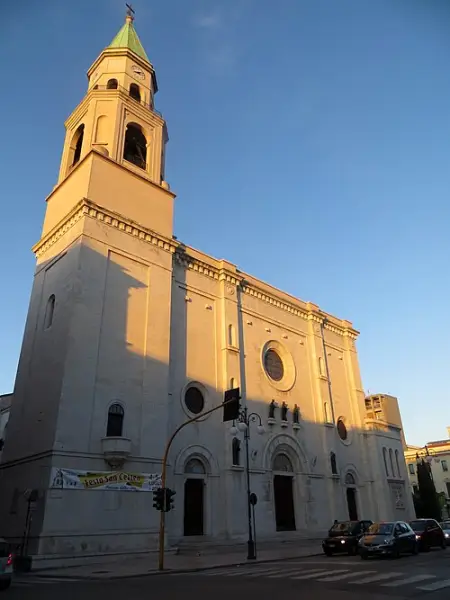
The manner of Cetteus's death was that of a common criminal. A heavy stone was fastened around his neck and he was thrown from a bridge into the Aterno-Pescara, the river that runs from the Apennine interior down to the Adriatic. The same fate is recorded of Saints Florian and Quirinus of Sescia, a detail that suggests the hagiographic tradition drew on known forms of execution. The body, carried downstream, came ashore at Pescara, where fishermen drew it from the water. Recognizing the vestments as those of a bishop but having no idea of his name, they buried the stranger with respect and called him Peregrinus, the traveler or pilgrim. In time his identity was established, and the body was translated to the church at Pescara that came to bear his name, San Cetteo, the building that now serves as the cathedral of the city. Scholars have noted that although the Passio cannot be trusted in its particulars, its placement of the bishop's death in the period of the Lombard invasion is probably sound. His feast is kept on June 13, the traditional date of his drowning, and on October 10 in Pescara itself, where he remains the principal patron of both the city and its diocese.
§ References
Patron of Pescara
The cult of Cetteus has been inseparable from the identity of Pescara for well over a thousand years. The church raised over his relics grew into the present cathedral of San Cetteo, which stands as the mother church of the diocese and the center of his feast, kept on June 13 and celebrated again on October 10 in the city itself. His patronage extends over both the municipality and the diocese that bears its name. Modern scholarship has given the cult fresh attention: Nicholas Everett, in his study of the patron saints of early medieval Italy, examined the Passio in detail, and a diplomatic edition of the text, based on the manuscript in Venice's Biblioteca Marciana, was published in Hagiographica in 2015, making the legend of the bishop of Amiternum available for critical study. The story the city tells of itself begins with fishermen and an unnamed body in the river: the pilgrim who turned out to be a shepherd. That memory, of a bishop who died for refusing to make peace with violence, continues to shape the religious imagination of the Abruzzo coast, where the saint's name is spoken daily in the cathedral built over his resting place.
§ References
Timeline
- 590
Elected bishop of Amiternum in the Sabina, during the pontificate of Gregory the Great.
§ Introduction
- 597
Refusing to back the Lombard occupation by the captains Alai and Umbolus, he withdrew to Rome, but Gregory the Great persuaded him to go back.
§ Introduction
- 597
After Count Verilianus of Orte seized Amiternum by night, he saved Alai from the townsfolk, and Umbolus, suspecting collusion, ordered the bishop killed.
§ Introduction
- 13 Jun 597
Executed by drowning, a heavy stone fastened about his neck, thrown from a bridge into the Aterno-Pescara; his body drifted to Pescara, where fishermen buried him as Peregrinus.
§ Introduction
The Record
- Patron of
- Patron of the city of Pescara·Patron of the diocese of Pescara
- Symbols
- Bishop's vestments·Stone bound about the neck
- Canonization
- Pre-congregation; venerated as bishop and martyr since late antiquity
Prayer
Bibliography
Show 3 sources
- "San Ceteo (Peregrinus) di Amiterno".
- Nicholas Everett, Patron Saints of Early Medieval Italy AD c. 350-800 (PIMS / Durham University Press, 2016), pp. 104-123.
- Nicholas Everett, 'The Passion of Cetheus of Pescara and the Lombard Invasion of Italy. With a diplomatic edition of Passio Cethei based on Venice, Biblioteca Marciana lat. Z 356', Hagiographica 22 (2015), 79-132.
Profile text adapted from the Wikipedia article, licensed CC BY-SA 4.0.
Pray with this saint every day
Save St. Cetteus to your favorites, read the full profile, and get feast-day reminders in the Saints app.
Get the Saints AppFree on the App Store for iPhone and iPad