
6th century·Feast July 1
St. Cewydd
Welsh Rain Saint of the Early Middle Ages
Overview
Cewydd was a pre-congregational Welsh saint of the sixth century, a figure of the Early Middle Ages whose life is known almost entirely through the churches that carry his name. He is remembered as the Welsh rain saint, occupying in the devotion of Wales the same place held by Medard in France, Gildas in Brittany and Swithin in England: the holy man to whom the weather of midsummer was attributed. A folk belief, probably older than Christianity itself, attached a date in July to the rain, holding that a shower on that day foretold forty more days of wet weather. The documentary record of Cewydd himself is nearly empty, a consequence of the scarcity of written sources from early medieval Wales. What can be traced is a scatter of dedications across the Welsh landscape and the English border: on Anglesey, at Lancaut near Chepstow, Cusop, Kewstoke in Somerset, Steynton in Pembrokeshire, Aberedw and Disserth in Radnorshire, Llangewydd and Laleston near Bridgend, and Capel Cewydd at Mynachlogddu. The Book of Llandaff records a religious foundation at Lancaut, likely in existence by 625 and documented by 703.
The Complete Life
A Saint Known by His Churches
Almost nothing can be said of Cewydd as a man. The records of early medieval Wales, already sparse, grow thinner still for the sixth century, and the usual apparatus of hagiography, a birth story, a lineage, a voyage, a miracle, is entirely absent from his file. He is known to history mainly through a chain of church dedications that stretches across Wales and its borders with England. On Anglesey his name survives in a local foundation; at Lancaut, on a cliff above the Wye near Chepstow, stands the church of St Cewydd; Cusop in Herefordshire, Kewstoke on the Somerset coast, Steynton in Rhos in Pembrokeshire, Aberedw and Disserth yn Elfael in Radnorshire, Llangewydd and Laleston near Bridgend, and the Capel Cewy at Mynachlogddu in Pembrokeshire all bear witness to a cult that must once have been widespread. The dedication pattern itself is the saint's biography: wherever a community prayed under his patronage, his memory was kept. The Book of Llandaff, the great episcopal chartulary of south-east Wales, contains notice of a religious house of lann ceuid that is most plausibly identified with Lancaut, a house likely founded before 625 and entered in the charters by 703, dates that bring the cult within a century or so of the saint's traditional lifetime.
§ References
The Rain Saint
What gave Cewydd his distinct identity in the devotion of Wales was his association with rain. He stands in a family of weather saints that includes Medard in France, Gildas in Brittany and Swithin in England, each of them a Christian successor to older beliefs about the rains of early summer. A traditional weather rule, noted in the record of the saint, tied a July date to the fortunes of the season: should it rain on that day, the belief ran, rain would continue for forty days thereafter. Such observances belong to a layer of agricultural piety in which the saints were asked to govern the skies on which the harvest depended. The custom is likely the Christian transformation of a pre-Christian rain festival fixed to the same point of the year. The liturgical commemoration of Cewydd is July 1, though the tradition of south Wales kept a separate festival, the Dygwyl Cewydd or Feast of St Cewydd, on July 15, a date that had originally fallen on July 2 before the shift from the Julian to the Gregorian calendar. The doubling of feasts, one fixed and one popular, mirrors the saint's double character as a calendar entry and a folk presence in the farming year of the Welsh countryside.
§ References
Dedications Across the Borderlands
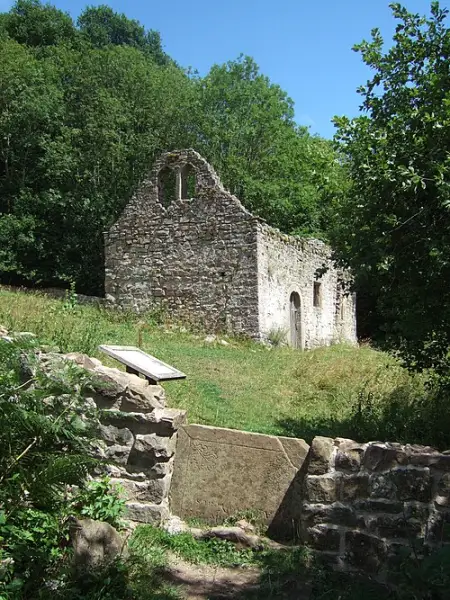
The map of Cewydd's dedications tells its own story. The churches that carry his name run from Anglesey in the north-west, through Radnorshire and the Wye valley at Lancaut, to Pembrokeshire and Bridgend in the south, and even across the border into England at Cusop and Kewstoke in Somerset. Such a spread suggests a cult of real standing in the early Welsh church, sustained by local communities over many centuries rather than by any single monastic house. The Lancaut dedication, set above the Wye near Chepstow, has drawn particular attention: the church of St James at Lancaut has been surveyed and described by archaeologists, and the site is now within a nature reserve managed for its woodlands and cliffs. Modern reference works, from the Welsh Academy Encyclopaedia of Wales to the older English Cyclopaedia of the nineteenth century, continue to register his name. The rain saint of Wales thus survives in three registers at once: in stone, in the landscape of dedications scattered across the country; in ink, in the charters of the Book of Llandaff; and in the seasonal folklore of July, in which his name was long linked to the weather on which all farming life depended.
§ References
Timeline
- 625
A religious house of lann ceuid, most plausibly the one at Lancaut, was likely already founded by this year, per the Book of Llandaff.
§ Introduction
- 703
The Lancaut religious house of lann ceuid is entered in the ecclesiastical records of the Book of Llandaff.
§ Introduction
The Record
- Patron of
- Invoked for rain and weather
- Symbols
- Rain and showers as his emblem
- Canonization
- Pre-congregation; venerated in Wales since the early medieval period
Prayer
Bibliography
Show 6 sources
- Charles Knight, The English Cyclopaedia: Division. Geography. 4v. (Bradbury, Evans, 1867), page 132.
- Church of St Cewydd, Aberedw (British Listed Buildings).
- John Davies & Nigel Jenkins, Menna, Baines et al., eds., The Welsh Academy Encyclopaedia of Wales (Cardiff: University of Wales Press, 2008), p. 444.
- Gloucestershire Wildlife Trust, Lancaut and Ban-y-Gor Nature Reserves, local leaflet.
- Charles Parry, A Survey of St James's Church, Transactions of the Bristol and Gloucestershire Archaeological Society, 1990, volume 108, pages 53-103.
- T. B&G AS Walters, A Survey of St James's Church (1992), 125-126.
Profile text adapted from the Wikipedia article, licensed CC BY-SA 4.0.
Pray with this saint every day
Save St. Cewydd to your favorites, read the full profile, and get feast-day reminders in the Saints app.
Get the Saints AppFree on the App Store for iPhone and iPad