
d. 672 (born probably in the 620s)·Feast March 2
St. Chad of Mercia
Apostle of Mercia and Humble Bishop of Lichfield
Overview
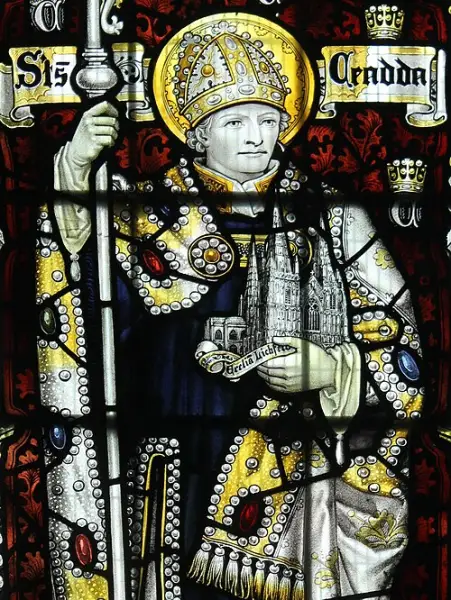
Chad, in Old English Ceadda, was a seventh-century Anglo-Saxon monk, abbot and bishop who died on 2 March 672. A younger brother of Saint Cedd, he trained under Aidan at Lindisfarne, completed his studies as a monk in Ireland, and in 664 succeeded his brother as abbot of Lastingham in Yorkshire. The same year, after the Synod of Whitby and a plague that had emptied the episcopal bench, King Oswiu made him bishop of the Northumbrians; ordained in Wessex by Wini with two Welsh bishops, he toured his vast see on foot in the manner of Aidan. When Theodore of Tarsus arrived as archbishop in 669 he asked Chad to stand down in favor of Wilfrid, and was so struck by the bishop's humility that he confirmed his consecration. Within months Chad was recalled and consecrated bishop of the Mercians and Lindsey People, with his see at Lichfield. There he continued his missionary labors, walking until Theodore himself lifted him into the saddle. Bede judged that in two and a half years Chad, with Cedd, effectively Christianized Mercia. A man of intense eschatological prayer, he died of plague, forewarned by the sound of angels, and was buried near the church of St Mary at Lichfield, around which the cathedral grew.
The Complete Life
Four Brothers of Northumbria
Chad was one of four brothers, Cedd, Cynibil and Caelin, all of whom served the Anglo-Saxon church, and he seems to have been the youngest, appearing on the scene about a decade after Cedd. The family was very likely drawn from the Northumbrian nobility and certainly enjoyed close ties to the ruling house; Caelin served as chaplain at the court of Œthelwald, the king's nephew who administered Deira. The name Chad itself, however, is British Celtic rather than Anglo-Saxon in origin, an element common in the names of Welsh princes of the period and carrying the sense of battle. The one solid fact Bede records of his youth is that Aidan taught him at the Celtic foundation on Lindisfarne. Aidan, a disciple of Columba, had been summoned by King Oswald from Iona in 635 and died in 651, so Chad's schooling fell within those years. Bede regarded the whole pattern of Chad's later ministry as an imitation of Aidan and of Cedd, who had trained under the same master. Sources for the life are strong by the standards of the age: Bede's Ecclesiastical History, written within living memory, supplemented by Stephen of Ripon's Life of Wilfrid, and Bede says the brothers' story reached him through the Lastingham community, in whose house both had served as superiors, and through Trumbert, his own teacher and once Chad's pupil.
§ Sources
A Monk in Two Traditions
Chad is thought to have finished his education in Ireland before ordination to the priesthood, though Bede does not say so outright. He went with other English scholars to Rath Melsigi, a house for Anglo-Saxon students in County Carlow which kept the Roman reckoning of Easter; among his companions there was Egbert of Ripon, later famous as the apostle of Iona. The party had probably left for Ireland after 651, in the years when Finan and Colmán presided at Lindisfarne. In 664 a plague swept the island, killing all of Egbert's companions, but Chad had already gone home to help Cedd build the monastery of Lastingham in the North York Moors, on land given by Œthelwald at the urging of the brothers' chaplain Caelin, close by a usable Roman road. Cedd consecrated the site with a strict forty-day fast, interrupted on its thirtieth day and completed by Cynibil for the last ten. The monastic culture that formed Chad was thus not the Benedictine rule then spreading over the West but an older, peripatetic tradition that looked to Martin of Tours, prized asceticism and the close reading of Scripture, and carried a vivid awareness of the last things. Egbert later remembered that he and Chad had kept the monastic life with great strictness, in prayer, continence and meditation on the Scriptures, and Bede notes that the Irish monks taught their English guests freely, feeding them and lending them precious books without charge.
§ Travels in Ireland and dating of Chad's life
Bishop of the Northumbrians and the Mercians
Chad's elevation came out of catastrophe. The Synod of Whitby in 663/4 had settled the Easter dispute in favor of Roman practice, with his brother Cedd serving as interpreter; plague then carried off most of the bishops in the English kingdoms, Cedd among them, and Wilfrid, the first choice as bishop of the Northumbrians, had gone to Neustria for ordination and stayed away. King Oswiu therefore invited Chad himself. Seeking consecration, Chad traveled first to Canterbury, where he found Archbishop Deusdedit long dead, then on to Wessex, where Wini, installed irregularly by the West Saxon king, ordained him with two British bishops, none of the three recognized at Rome. Bede's verdict on the man at this moment is telling: he describes Chad as diligent in carrying out in deed what he had learned from Scripture. His ministry was ceaseless travel through towns, villages, cottages and houses, preaching the Gospel in the pattern of Aidan and Cedd, baptizing and confirming wherever he went. Around 666 Wilfrid returned and found Chad in possession; in 669 Theodore of Tarsus, the new archbishop, instructed Chad to yield the see to Wilfrid, but was so moved by Chad's humility that he confirmed his orders. Later that same year Wulfhere of Mercia asked for a bishop, and Theodore sent Chad, consecrated for the Mercians and the people of Lindsey, with a new see at Lichfield, where he worked with such effect that Bede could write that Mercia came to the faith through the two brothers.
§ Ministry among the Mercians
Storms, Prayer and the Last Things
The most intimate portrait of Chad comes from Trumbert, one of his students at Lastingham, and it turns on weather. Whenever a gale rose, Chad would break off his reading and call on God to pity mankind; if the storm grew worse he would shut his book and prostrate himself; in prolonged storms or thunder he would go into the church itself and pray and sing psalms until the weather calmed. His monks thought this an extreme reaction even by English standards and asked him to explain. Chad answered that storms are sent by God to recall to human beings the day of judgment and to humble their pride. The episode reveals what modern historians describe as a typically Celtic Christian involvement with the natural world: not a modern love of landscape but the resolve to discern God's purpose within it, above all as it bore on the world's ending. The same awareness shaped his ascetic habits. At Lichfield he built himself a small house a short distance from the church, large enough for the seven or eight brothers who formed his core community, who gathered there with him for prayer and study whenever he was not on the road. He refused a horse and walked everywhere, out of what Bede presents as humility and austerity, until Theodore, insisting that his office required it, personally lifted him into the saddle. Even this legend of the archbishop's hands on the bishop's body has been read as evidence that Chad was remembered as small of stature, for no portrait or physical description from his own century survives.
§ Abbot of Lastingham
Seven Days with the Angels
Only two and a half years were given to Chad's work among the Mercians and the people of Lindsey before plague took him too. Bede's account of his end occupies more space than everything else he records of Chad's work in Northumbria and Mercia combined, and it is told as the death of a man already regarded as a saint. Owin, the former East Anglian court official who had come to Lastingham in ragged clothes with an axe and become one of Chad's closest companions, was working outside the oratory at Lichfield. Alone inside, because the other monks were at worship, Chad suddenly heard what Owin also heard: the sound of joyful singing from heaven, approaching from the south-east until it filled the roof, then silence for half an hour, then the singing withdrawing as it had come. About an hour later Chad called Owin in, summoned the seven brothers from the church, and gave them a final address on keeping the monastic discipline they had learned. Only then did he tell them his death was near, speaking of it as the visit of a familiar guest. He asked their prayers, blessed and dismissed them. To Owin privately he explained that angels had come to summon him to his reward and would return in seven days to fetch him. His strength failing, he died on 2 March 672, and his grave lay beside St Mary's church, a building the growing cathedral was later to absorb. Bede wrote that his mind had always been fixed on the Day of the Lord; and long afterwards Egbert related to a visitor how a man in Ireland had watched the angelic host arrive to take Chad's spirit away, with Cedd among its number.
§ Death
Cult, Shrine and Relics
No formal canonization was needed or attempted for Chad. Bede reports that he was honored as a saint directly after his death, when his remains were translated to a new shrine, and through the Middle Ages his cult, centered on healing, drew pilgrims to two foci at Lichfield: his tomb in the nave and his skull in a special Head Chapel beside the south choir aisle. At the Reformation, Bishop Rowland Lee, who had secretly married Henry VIII to Anne Boleyn, pleaded successfully for the shrine of the cathedral's first bishop, its greatest ornament in his words; the reprieve was brief and the shrine was robbed and torn down. In 1538 Prebendary Arthur Dudley rescued the relics and passed them to his nieces at Russells Hall near Dudley. They surfaced again in 1651 at the deathbed of the farmer Henry Hodgetts, who told his confessor that he prayed to Chad because the bones were in the head of his bed; from him some relics traveled to the seminary at St Omer, and in the nineteenth century others were found at Aston Hall, examined, and presented in 1837 to Bishop Thomas Walsh. In 1841 they were enshrined in the new Catholic cathedral of St Chad in Birmingham in an ark designed by Pugin, and in 1985 radiocarbon dating assigned all but one of the six bones to the seventh century, the Vatican confirming them as authentic. An annual Mass and procession at Birmingham, begun in 1919, continues on the Saturday nearest his feast; in 2022 one relic came home to a new shrine at Lichfield.
§ Cult and relics
The Saint of the Midlands
Chad is commemorated on 2 March in the Roman Catholic Church, the Church of England, the US Episcopal Church, the Celtic Orthodox Church and a new edition of the Eastern Orthodox Synaxarion. Birmingham's Catholic cathedral holds his relics on its high altar, the only cathedral in England able to make that claim of its patron, and the grave and shrine tower were found under the east end of the Lichfield Cathedral nave in 2003, the year the Lichfield Angel, a late eighth-century carving of Gabriel thought to be the end piece of Chad's shrine, came to light there. His name saturates the West Midlands: two Anglican churches and an academy in Wolverhampton, church and school at Pattingham, the great classical church at Shrewsbury that replaced one which collapsed in 1788, an Orthodox church in Rugby, and dedications from Leeds and Rochdale to Haggerston in London and Chelsea in Australia. St Chad's College in Durham was founded in 1904, Denstone College began as St Chad's, and the heraldic cross bearing his name — cross potent and quadrate — graces the arms of three dioceses and a university. His well at Lichfield, where tradition says he baptized converts, still stands. Folk memory credits him jocularly as patron of botched elections on account of the hanging chads of 2000, names 2 March the best day for sowing broad beans, and the Spa Research Fellowship claims him for medicinal springs. His personal name endures as one of the few seventh-century Anglo-Saxon names still in common use.
§ Notable dedications
Timeline
- 635
Aidan arrives in Northumbria from Iona; Chad later studies under him at Lindisfarne, at some point before Aidan's death in 651.
§ Education
- 651
After Aidan's death, Chad leaves for Ireland and studies at the Anglo-Saxon monastery of Rath Melsigi in County Carlow, with Egbert among his companions.
§ Travels in Ireland and dating of Chad's life
- 664
His brother Cedd dies of plague at Lastingham; Chad succeeds him as abbot.
§ Abbot of Lastingham
- 664
After the Synod of Whitby, King Oswiu selects Chad as bishop of the Northumbrians; he is ordained in Wessex by Wini with two Welsh bishops.
§ Elevation
- 666
Wilfrid returns from Neustria and finds Chad occupying the see he had expected.
§ Removal
- 669
Archbishop Theodore of Tarsus deposes Chad in Wilfrid's favor yet confirms his consecration, moved by his humility; Chad retires to Lastingham.
§ Removal
- 669
Recalled at the request of King Wulfhere, Chad is consecrated bishop of the Mercians and Lindsey People, with the new see centered on Lichfield.
§ Recall
- 669
Receives land at Ad Barwae in Lindsey, probably Barrow upon Humber, for a monastery, while remaining abbot of Lastingham.
§ Monastic foundations
- 2 Mar 672
Dies of plague at Lichfield after foreknowledge of his death, and is buried near the church of St Mary, later absorbed into the cathedral.
§ Death
- 1538
On Henry VIII's orders the Lichfield shrine is dissolved; Prebendary Arthur Dudley passes the relics to his nieces at Russells Hall.
§ Cult and relics
- 1651
The relics reappear when the dying Henry Hodgetts of Sedgley explains that he prays to Chad because his bones lie in the head of his bed.
§ Cult and relics
- 1837
Relics recovered from Aston Hall are examined and presented to Bishop Thomas Walsh, Vicar Apostolic of the Midland District.
§ Cult and relics
- 1841
The relics are enshrined in the new St Chad's Cathedral, Birmingham, in an ark designed by Augustus Pugin.
§ Cult and relics
- 1919
An annual Mass and solemn outdoor procession of the relics begins at Birmingham, kept on the Saturday nearest 2 March.
§ Cult and relics
- 1985
Radiocarbon dating by the Oxford Archaeological Laboratory assigns all but one of the bones to the seventh century; the Vatican authenticates them.
§ Cult and relics
- 2003
The Lichfield Angel, end piece of Chad's Anglo-Saxon shrine, is discovered at Lichfield Cathedral.
§ Cult and relics
- Nov 2022
One bone relic comes home to Lichfield, placed in a new shrine within the cathedral's retrochoir.
§ Cult and relics
In Their Own Words
at that time there was no other bishop in all Britain canonically ordained except Wini
he had always looked forward to this day, or rather his mind had always been on the Day of the Lord
because his bones are in the head of my bed
The Record
- Major works
- Lastingham Abbey (succeeded Cedd as abbot, 664)·Lichfield minster, seat of the new Mercian diocese·Monastery at Ad Barwae, probably Barrow upon Humber
- Patron of
- Mercia·Lichfield·Medicinal springs (per the Spa Research Fellowship)
- Symbols
- Bishop holding the triple-spired cathedral of Lichfield
- Canonization
- Pre-congregation; venerated as a saint immediately after his death, according to Bede
Prayer
Bibliography
Show 10 sources
- Leo Sherley-Price (1990). Ecclesiastical History of the English People by Bede. Penguin Classics. ISBN 0-14-044565-X.
- Bede. Ecclesiastical History of the English People, Book 3, chapters 23, 25, 27, 28; Book 4, chapters 2, 3.
- Higham, N. J., ed. (2013). Wilfrid, abbot, bishop, saint: papers from the 1300th anniversary conferences [2009]. Donington: Shaun Tyas. ISBN 978-1-907730-29-0.
- Richard Fletcher (1997). The Conversion of Europe. HarperCollins. ISBN 0-00-255203-5.
- Koch, J.T. (2006). Celtic Culture: A Historical Encyclopedia. ABC-CLIO. ISBN 1-85109-440-7.
- Mayr-Harting, Henry (1991). The Coming of Christianity to Anglo-Saxon England. Pennsylvania State University Press. ISBN 978-0-271-00769-4.
- Burton, Edwin. "St. Ceadda." The Catholic Encyclopedia, Vol. 3. New York: Robert Appleton Company, 1908.
- Farmer, David Hugh (2004). Oxford Dictionary of Saints (Fifth ed.). Oxford University Press. pp. 101-102. ISBN 978-0-19-860949-0.
- "Chad 1". Prosopography of Anglo-Saxon England.
- Lepine, David (2021). 'Glorious Confessor. The cult of St Chad at Lichfield Cathedral during the Middle Ages'. SAHS transactions. 52, 29-52.
Profile text adapted from the Wikipedia article, licensed CC BY-SA 4.0.
Pray with this saint every day
Save St. Chad of Mercia to your favorites, read the full profile, and get feast-day reminders in the Saints app.
Get the Saints AppFree on the App Store for iPhone and iPad