
c. 89 – 202·Feast February 10
St. Charalambos
Aged Hieromartyr and Bishop of Magnesia
Overview
Charalambos, in Greek Charalampus, a name meaning glowing with joy, was an early Christian priest and bishop of Magnesia on the Maeander in Asia Minor, the region of modern Tekin in Aydın Province, Turkey. He lived under the reign of Septimius Severus, when Lucian served as proconsul of the province, and by the traditional chronology he was 113 years old at his martyrdom in 202, which places his birth around 89. As bishop he labored for many years spreading the Gospel through the diocese. When word of his preaching reached the provincial authorities, the proconsul Lucian and the military commander Lucius, he was arrested and tried; he confessed Christ and declined to sacrifice to the idols. Despite his great age he was tortured with iron hooks and the skin was scraped from his body, to which he answered with thanks for the renewal of his soul. The account tells of soldiers and women who confessed the faith and died beside him, of tormentors miraculously maimed and healed, and of his own death by the sword that never fell: he prayed that no famine or disease might ever visit the place housing his relics, gave up his spirit, and was buried by the emperor's converted daughter. His skull is treasured at the Monastery of Saint Stephen, Meteora.
The Complete Life
A Long Life in Asia Minor
Charalambos belonged to Magnesia on the Maeander, a city of Asia Minor whose diocese he would later serve as bishop, and whose site today lies within modern Turkey, near Tekin in Aydın Province. His Greek name carries the sense of glowing with joy, a strange yet fitting name for a man whose memory is joined to suffering borne with thanksgiving. The chronology the tradition hands down is extraordinary: one source states that at his martyrdom in the year 202 he was 113 years old, which would set his birth around 89, early in the reign of Domitian. If the figure is accepted, his lifetime would have spanned the whole of the age of the Twelve Caesars' successors and the Antonines, from a church still living in the shadow of the apostles to the eve of the great persecutions. He would have been a very old man through the reign of Septimius Severus, under whom his death is set, with Lucian holding office as proconsul of Magnesia. The mere survival of such a tradition matters: the Greek church honors him as the most aged of all the martyrs, and the people of Greece have found in that extreme old age a special source of devotion. Modern scholarship, however, warns against pressing the details, noting that Septimius Severus had no children, so that the chronology of the received telling of his life is, in the words of one commentator, somewhat suspect.
§ Life and martyrdom
Preacher, Trial and Confession
As bishop of Magnesia, the tradition records, Charalambos labored for many years to spread the Gospel through the region. The success of that preaching eventually reached the ears of the authorities, and the proconsul Lucian and the military commander Lucius had him arrested and brought to trial. The charge was the standing one against Christians, and the demanded act the usual one: sacrifice to the idols. Charalambos confessed his faith in Christ and refused the offering. It is a spare formula, but the setting gives it weight. The trial took place, on the traditional account, before the two men who embodied in that province the civil and military power of Rome; against them stood a priest of extreme age whose only offense was the worship he would not disguise. The hagiography then unfolds in the pattern familiar from the acts of the martyrs: an escalating sequence of torments designed to break a body that age had already weakened, each answered by a constancy that confounds the torturers and wins converts among the onlookers. The value of such accounts for the historian lies less in their detail than in what they disclose about the church that cherished them: a community that understood witness as the heart of Christian life and expected the confessors of the past to model it for every generation. In that church's memory Charalambos holds the office of hieromartyr, the priest or bishop who dies for the faith he served at the altar.
§ Life and martyrdom
Torture, Wonder and Death
The tortures inflicted on the aged bishop were severe. His body was lacerated with iron combs or hooks, and the skin was scraped away, yet he had a word of thanks for his tormentors, saying that they were scraping away the old body and renewing his soul for new and eternal life. Two soldiers watching, Porphyrius and Baptus, openly confessed Christ and were at once beheaded; three women who had gathered to watch his sufferings likewise gave glory to Christ and were killed with them. The legend then turns to the tormentors themselves: Lucius, enraged, seized the instruments to torture the saint with his own hands, and his forearms were severed as though by a sword; Lucian spat in the martyr's face and his head was turned to face backwards; both, the story continues, prayed for mercy, were healed through the saint, and became Christians. Brought at last before Septimius Severus and condemned, Charalambos prayed along the way that the place where his relics would rest might never know famine or disease. Then, before the executioner could lay the sword to his neck, he gave up his spirit. The emperor's daughter Gallina, the legend says, was moved by his death, converted, and buried the martyr with her own hands, a detail whose historical difficulty, given Severus's lack of children, has been noted by scholars.
§ Life and martyrdom
Feast and Veneration
Charalambos stands among the pre-congregation saints, honored in both the Catholic Church and the Eastern Orthodox Church without any modern process of canonization, as bishop and hieromartyr of the early centuries. His feast is kept on February 10, with those following the Old Calendar observing it on February 23; when the date falls on the Saturday of Souls before Lent or on Clean Monday, the celebration shifts to February 9. His skull is preserved at the Monastery of Saint Stephen at Meteora in Greece, and fragments of his relics are found in many places across the Greek world and beyond, with numerous miracles traditionally attributed to them. His popularity in Greece is exceptional, bound up with his reputation as the oldest of the martyrs and with the belief that his dying prayer shields from famine and plague the places that hold his bones. The most striking survival of his cult is the ritual sacrifice of bulls on certain Greek islands on his feast day. At Agia Paraskevi on Lesvos this festival, described as the village's most important popular event, combines a variety of happenings around the rite of the bull's sacrifice; an agricultural group revived the ancient custom in 1774, and it was established in the saint's honor as the protector of the group that organizes the festival, a rare case of a pre-Christian rite continuing under a martyr's name.
§ Veneration
Priest or Bishop, East and West
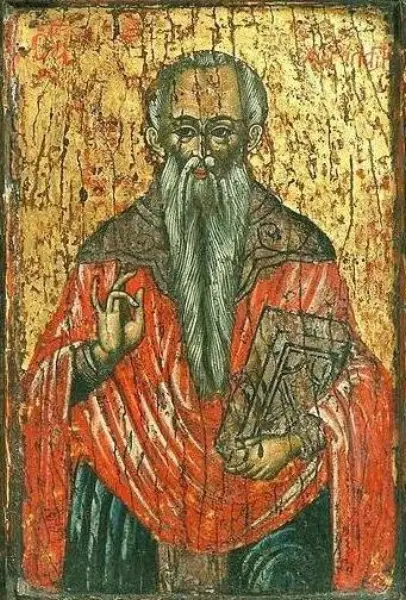
An interesting divergence runs through the iconography of Charalambos. Greek hagiography and iconography regard him as a priest, while Russian sources appear to regard him as a bishop of Magnesia in Thessaly, the title given him in the Orthodox Church in America's calendar. The usual image presents him in priestly or episcopal vestments, Gospel Book in hand, blessing the viewer with a raised right hand, and a Greek icon of the early seventeenth century preserves his features according to the conventions of the tradition. He is listed among the martyrs who are saints of the Catholic Church and commemorated equally in the Orthodox east, and his cult stretches from the monasteries of Meteora, where his skull rests, to the villages of Lesvos and the Greek communities of the diaspora, where his feast is kept with processions and, in Luton in England among other places, with celebrations recorded in the local Greek press. The English-language lives by Nikolai Velimirovic in The Prologue from Ochrid and the synaxarion notices of the Orthodox Church in America have carried his story to new audiences, and the folk practices around his name, from the blessing of fields to the bulls of Agia Paraskevi, show how a martyr of the year 202 continues to shape the religious calendar of communities more than eighteen centuries later.
§ Iconography
Timeline
- 89
Born, by tradition, at Magnesia on the Maeander in Asia Minor, in present-day Turkey.
§ Introduction
- 202
As bishop of Magnesia he spreads the Gospel for many years until the proconsul Lucian has him arrested.
§ Life and martyrdom
- 202
Brought to trial, he confesses Christ before Lucian and the commander Lucius and refuses idol sacrifice.
§ Life and martyrdom
- 202
Tortured with iron hooks and flayed alive; soldiers Porphyrius and Baptus and three women die for confessing Christ.
§ Life and martyrdom
- 202
Taken before Emperor Septimius Severus, condemned, and dies in prayer before the executioner can strike, supposedly aged 113.
§ Life and martyrdom
- 202
Gallina, said in the legend to be the emperor's daughter, is moved by his death, converts, and buries him herself.
§ Life and martyrdom
- 1774
An agricultural group at Agia Paraskevi revives the ancient custom of sacrificing bulls in the saint's honour.
§ Veneration
In Their Own Words
Thank you, my brethren, for scraping off the old body and renewing my soul for new and eternal life.
The Record
- Patron of
- Protector of the agricultural group at Agia Paraskevi, Lesvos
- Symbols
- Vested as a priest or bishop, holding a Gospel Book, right hand raised in blessing
- Canonization
- Pre-congregation; venerated in the Catholic and Eastern Orthodox churches as a hieromartyr
Prayer
Bibliography
Show 6 sources
- Velimirovic, Nikolai. "The Hieromartyr Charalampus". The Prologue from Ochrid. Serbian Orthodox Church. Retrieved 2007-03-11.
- "Hieromartyr Charalampus the Bishop of Magnesia in Thessaly". Feasts and Saints. The Orthodox Church in America. Retrieved 2007-03-11.
- "Three Women Martyrs with St. Charalampus in Thessaly", Antiochian Orthodox Christian Archdiocese of North America.
- "Haralambos, Charalambos, Prochoros". The Mission of St. Clare. Retrieved 2007-03-11.
- "February 10: Feast of the Holy and Glorious Hieromartyr Haralambos". Greek Orthodox Archdiocese of America. Retrieved 2013-01-10.
- "St. Charalambos Saints Day Celebrations in Luton, UK", Parikiaki, 20 February 2019.
Profile text adapted from the Wikipedia article, licensed CC BY-SA 4.0.
Pray with this saint every day
Save St. Charalambos to your favorites, read the full profile, and get feast-day reminders in the Saints app.
Get the Saints AppFree on the App Store for iPhone and iPad