
c. 287 – 304·Feast October 5
St. Charitina of Amisus
Virgin Martyr of Pontus under Diocletian
Overview
Saint Charitina of Amisus, sometimes called Charitina of Rome, was a virgin martyr of Asia Minor who died in the year 304 during the persecution of Diocletian. Born around 287 in Amisus, a port on the Black Sea in Pontus, she was orphaned young and taken into the household of an eminent Christian named Claudius the Pious, who raised her as though she were his own daughter. Although she had not yet been baptized, she was a Christian in heart and conduct: meek, humble, obedient, and silent, devoted to fasting, prayer, and the study of the law of God, and pledged to perpetual virginity as a bride of Christ. Her way of life drew many others to the faith. Denounced to Dometius, the governor sent by Diocletian, she was brought to trial at Amisus, where she confessed Christ boldly before her judge. Her hair was cut off and live coals set upon her head, yet she was preserved; cast into the sea, she emerged calling the waters her baptism; bound to a wheel, she was freed when an angel stopped its turning. When the judge finally sent dissolute youths to violate her, she knelt in prayer and God received her soul before they could touch her. Her body was thrown into the sea, and her memory is kept on 5 October.
The Complete Life
An Orphan of Amisus
Charitina was born around the year 287 at Amisus, the modern Samsun, a city on the southern shore of the Black Sea in the region of Pontus. She lost her parents early, and her childhood was reshaped by an act of Christian charity: an eminent believer of the city, remembered as Claudius the Pious, received her into his household and brought her up as though she were his own child. The chroniclers of her life describe the girl who grew there as lovely in face and still lovelier in character — sensible, kind, and gentle. She was meek and humble, obedient and sparing of speech, and her whole bent was toward God. Curiously, she lived as a Christian before she was baptized; her faith was of the heart and of practice rather than of the font, a catechumen in the full sense. In that household she studied the law of God, and the love of Christ that filled her she communicated to others, so that by her example alone many were drawn into the Church. Hers was thus a quiet apostolate of conduct, carried out in the years when Diocletian's persecution was gathering over the Christian world.
§ Life
A Bride of Christ
The center of Charitina's vocation was a vow. Still unbaptized, she committed herself to perpetual virginity, understanding herself as a bride of Christ in the language of the early Church, and she ordered her days around that promise with fasting, prayer, and the reading of Scripture. The ascetic discipline she embraced was not an escape from the world but a form of witness within it: those who watched her live began to ask what sustained such a life, and many were converted by the answer. Her story belongs to the great company of virgin martyrs of the Diocletian generation — Agnes, Agatha, Lucy, and their sisters — in whom the Church saw innocence made invincible. When the storm of persecution finally reached Amisus, it was precisely this consecrated life that the state's officers set out to break: her judge attacked her faith with interrogation, her body with fire and the wheel, and her virginity with the threat of rape. Each assault failed, and the last was defeated not by force but by her prayer, as God received her soul while she knelt.
§ Life
Trial and Martyrdom
Word of Charitina reached Dometius, whom Diocletian had set over the province; his soldiers came and took her out of her foster father's house to be tried. Asked whether she was a Christian seducing others into a dishonorable faith, she answered that she was a Christian indeed and that far from deceiving anyone she guided the erring toward truth and toward her Christ. The judge then ordered her hair shorn and live coals heaped on her head, but she was preserved by God's power. Thrown into the sea, she climbed out unharmed, calling the water her baptism. Bound to a wheel that began to turn, she was freed when an angel of God stopped it. At last, failing to break her by torture, the judge sent dissolute youths to rape her; fearing that dishonor above all, Charitina knelt and prayed that God would receive her soul before they could lay hands on her, and while she knelt her soul left her body. She died a martyr's death in 304, and her body was cast into the sea. The Martyrologium Romanum, notably, places her passion at Corycus in Cilicia Trachaea, a divergence the churches have allowed to stand.
§ Life
Veneration
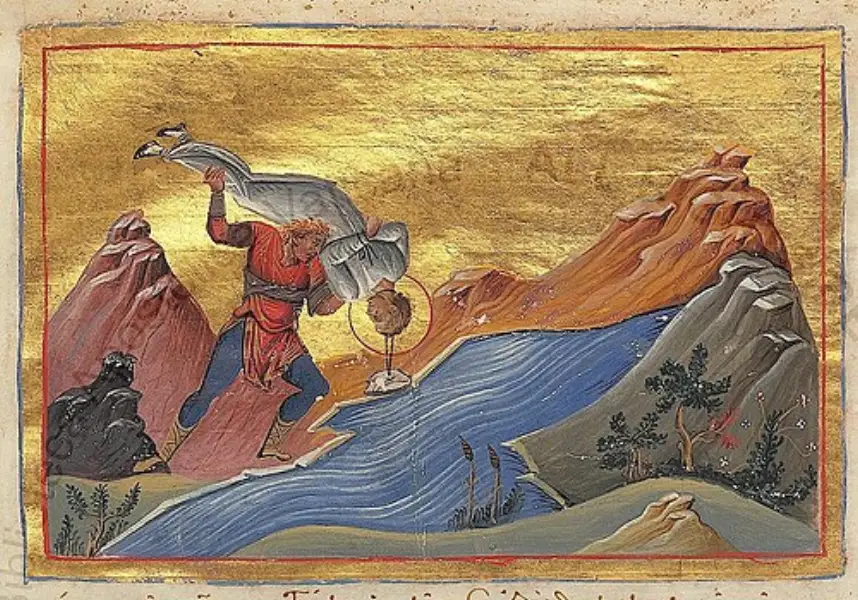
Charitina is honored as a saint both in the Orthodox churches and in the Roman Catholic Church, belonging to the era before formal canonization processes existed. Her feast is kept on 5 October, and a miniature preserved in the Menologion of Basil II, the great illustrated Byzantine calendar of saints, depicts her among the virgin martyrs of the year. The Byzantine liturgy sings a kontakion in her honor that catches the meaning of her death: she armed her soul with faith and knowledge, put the enemy to open shame, stood before Christ in a robe dyed with her blood, and now rejoices with the angels, interceding for those who ask her prayers. That hymn, still sung in Orthodox churches on her day, has carried her memory from the Black Sea coast across the whole Orthodox world, and her name appears in the western martyrologies as well.
§ Kontakion of St Charitina
The Maiden in the Menologion
Charitina's legacy rests on two images. The first is the miniature from the Menologion of Basil II, in which she appears as a young Byzantine noblewoman, her rank and her youth setting off the violence of the story told of her. The second is her iconography, which shows an angel snuffing out a burning pyre — a compressed image of the whole passion, in which heavenly power again and again nullified the instruments of her torture — the coals, the sea, the wheel — until only her free confession of faith remained. Her alternate designation, Charitina of Rome, shows how her cult traveled and was adopted in the western calendars, while the Martyrologium Romanum's notice of Corycus in Cilicia preserves a competing tradition about the place of her death. For the churches that keep her feast she remains the pattern of the virgin martyr whose purity was a choice, whose death was a prayer, and whose witness converted more by example than by argument.
§ Iconography
Timeline
- 287
Born in Amisus on the Black Sea around this year
§ Life
- 304
Seized at Amisus by order of Dometius, Diocletian's governor, and brought to trial for her faith
§ Life
- 304
Endures hair shorn, coals, the sea, and the wheel unharmed, then dies in prayer before an assault
§ Life
- 304
After her martyrdom her body is thrown into the sea
§ Introduction
In Their Own Words
It is true that I am a Christian, and a lie that I delude others. I lead those in error to the way of truth, bringing them to my Christ.
This is my baptism.
The Record
- Symbols
- Represented with an angel extinguishing a funeral pyre·Virgin martyr
- Canonization
- Pre-congregation; venerated in the Orthodox churches and the Roman Catholic Church
Prayer
Bibliography
Show 5 sources
- "Martyr Charitina of Amisus". Orthodox Church in America.
- Antiochian Orthodox Christian Archdiocese of North America.
- Baring-Gould, Sabine, Rev. The Lives of the Saints, vol. eleven, p. 117. John C. Nimmo, London, 1898.
- Odden, Per Einar. "Den hellige Charitina av Amisus (~287-~304)". Den katolske kirke, December 12, 2015.
- Dunbar, Agnes B. C., A Dictionary of Saintly Women, vol. I, p. 173. George Bell & Sons, London, 1904.
Profile text adapted from the Wikipedia article, licensed CC BY-SA 4.0.
Pray with this saint every day
Save St. Charitina of Amisus to your favorites, read the full profile, and get feast-day reminders in the Saints app.
Get the Saints AppFree on the App Store for iPhone and iPad