
died 1281·Feast October 5
St. Charitina of Lithuania
Lithuanian Noblewoman and Novgorod Abbess
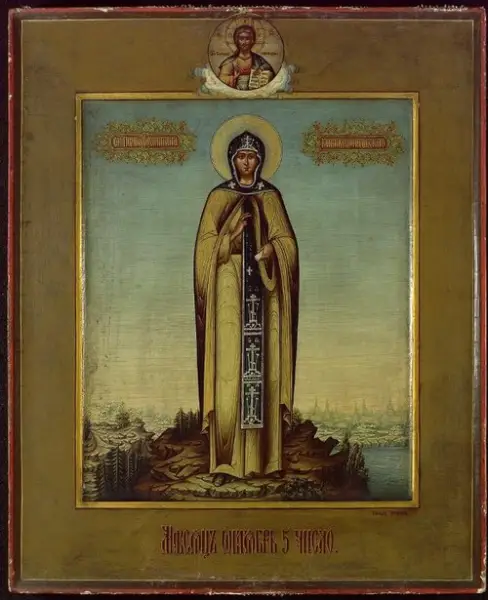
Overview
Saint Charitina of Lithuania, who died in 1281, is a nun and abbess of the Eastern Orthodox Church whose life is known only in outline, because her hagiography has not survived. She was a noblewoman of the still-pagan Grand Duchy of Lithuania who left her homeland and received the monastic habit in Novgorod, the great commercial and spiritual city of the Russian north. Entering the Monastery of Saints Peter and Paul there as an unmarried woman, she won a reputation for piety and in time became the abbess of that community. A tradition holds that she may have been intended as a bride for a prince of Novgorod, though scholars caution that this could be a confusion with Euphrosyne of Suzdal, who was betrothed to Fyodor, the eldest son of Yaroslav II of Vladimir. In 2009 the Lithuanian literary historian Algimantas Bučys proposed a further hypothesis: that Charitina was a daughter of Tautvilas, the Lithuanian prince murdered by Treniota, who escaped to Novgorod after her father's death. Her feast is kept on 5 October, and she remains one of the few saints of the Orthodox calendar who came from the Lithuanian nation in its pre-Christian era.
The Complete Life
A Noblewoman of Pagan Lithuania
Charitina was born into the nobility of the Grand Duchy of Lithuania at a time when that state, though powerful, had not yet accepted Christianity; the Lithuanian rulers and their people still worshipped the old gods, and the duchy stood surrounded by Orthodox Rus to the east and Catholic Poland and the Livonian orders to the west. Of her family and childhood nothing certain is recorded, because the written life that once told her story has perished. Modern scholarship has attempted to fill the silence. Algimantas Bučys, a Lithuanian literary historian, proposed in 2009 that she may have been a daughter of Tautvilas, one of the rival princes of the duchy, who fled to Novgorod after Treniota murdered her father; if so, her monastic vocation would have begun in exile from a dynastic tragedy. Another tradition gives her a different path to Novgorod, suggesting she traveled there as the intended bride of one of its princes. Both suggestions remain hypotheses, and little more can be known of her.
§ Charitina of Lithuania
Nun and Abbess of Novgorod
Whatever road brought her to the city, Charitina's settled vocation was lived at Novgorod, in the Monastery of Saints Peter and Paul. She arrived unmarried, and instead of a wedding she received the monastic habit, becoming one of the many noblewomen of the Baltic and Russian worlds who ended their days in convents. Within the community she earned a reputation for piousness, and that reputation ripened into office: she became the abbess of the monastery. That a Lithuanian, born into a pagan duchy outside the Orthodox fold, could rise to such a trust says something about both her character and the church that received her. She died in 1281, and the Orthodox Church came to number her among the saints, keeping her feast on 5 October.
§ Charitina of Lithuania
A Saint Without a Story
Charitina's afterlife in the Church is unusual: she is a saint whose hagiography did not survive, so that her veneration rests on the bare facts of her profession, her office, and her death rather than on any written Life with miracles and visions. The one detailed narrative that circulates about her — a betrothal to a prince of Novgorod that ended in the convent instead — is itself suspect, since scholars note it may simply be borrowed from the better-documented case of Euphrosyne of Suzdal, who was contracted to marry Fyodor, son of Yaroslav II of Vladimir. The modern attempts to identify her, including Bučys's Tautvilas hypothesis of 2009, testify to the continuing interest of Lithuanian scholarship in reclaiming a national saint from the Orthodox east. For believers, her quiet case carries its own lesson: sanctity does not depend on documentation, and the Church's memory holds places for those of whom almost nothing is written.
§ Charitina of Lithuania
Timeline
- 1281
Dies; the Eastern Orthodox Church venerates her as a saint, keeping her feast on 5 October.
§ Charitina of Lithuania
- 2009
Lithuanian literary historian Algimantas Bučys hypothesizes that she was a daughter of Tautvilas who fled to Novgorod.
§ Charitina of Lithuania
The Record
- Symbols
- Nun and abbess of Novgorod·Lithuanian noblewoman
- Canonization
- Pre-congregation; venerated as a saint in the Eastern Orthodox Church
Prayer
Bibliography
Show 3 sources
- Kutkaitytė, Monika (2009-10-11). "Istoriniai tyrinėjimai leido atrasti naują pradžią" (in Lithuanian). Lrt.lt via Technologijos.lt.
- Girdzijauskas, Vytautas (2010-01-29). "Vis dar vienišas" (in Lithuanian). Šiaurės Atėnai.
- Walsh, Michael (2007). A New Dictionary of Saints: East and West. Liturgical Press. p. 118. ISBN 978-0-8146-3186-7.
Profile text adapted from the Wikipedia article, licensed CC BY-SA 4.0.
Pray with this saint every day
Save St. Charitina of Lithuania to your favorites, read the full profile, and get feast-day reminders in the Saints app.
Get the Saints AppFree on the App Store for iPhone and iPad