
mid-3rd century – c. 350·Feast September 28
St. Chariton the Confessor
Founder of Monasticism in the Judaean Desert
Overview
Saint Chariton the Confessor, born in the mid-third century at Iconium in Asia Minor, was an early Christian monk who became the founding father of monastic life in the Judaean desert. Under the emperor Aurelian, between 270 and 275, he was imprisoned and tortured in a persecution of Christians; when Aurelian died and the prisons opened, Chariton was released alive — a fate he received with regret, having hoped to die a martyr. Setting out on pilgrimage to Jerusalem, he was captured by bandits and held in a cave in the Pharan Valley, the upper reach of Wadi Qelt; when his captors were killed by wine poisoned, as the account says, by a snake, Chariton stayed in the cave as a hermit, built a church there, and established the first monastery of the lavra type. Crowds of disciples gathering around him drove him onward: to the Mount of Temptation overlooking Jericho, where upon the wreck of the Hasmonean and Herodian stronghold of Dok he raised the lavra of Douka, and about 345 to the Valley of Tekoa, where he established Souka, later known as the Old Lavra. In these houses his personal example fixed the traits of desert monastic rule — silence, restricted food taken after sundown, manual work, night psalmody, prayer at fixed hours, and custody of thought. He died around 350, and tradition credits him with compiling the Office of the Monastic Tonsure. His feast is 28 September.
The Complete Life
A Confessor of Iconium
Chariton was a native of Iconium, the modern Konya, which the sources place in Phrygia and the Byzantine province of Lycaonia in central Asia Minor. He reached adulthood in the decades when the Roman state was making systematic attempts to suppress Christianity, and under the emperor Aurelian, who ruled from 270 to 275, he was arrested in a persecution of Christians, tortured, and held in prison. When Aurelian died and the persecution lost its driver, Chariton walked out of prison alive. The experience left him with a wound of a spiritual kind: he regretted that he had not been granted to die as a martyr, and that desire for a complete confession of faith shaped the rest of his life. He is called a confessor in the strict ancient sense — one who suffered for the faith without being killed — and the title distinguishes him in the calendars from the martyrs while binding him to them. The main narrative of his life comes from a sixth-century Life of Chariton, written by an anonymous monk, elements of which are borne out by modern archaeological excavation of the sites it names. He died around the year 350 in the Judaean desert.
§ Early life
The Cave at Pharan
Released in 275, Chariton went on pilgrimage to Jerusalem and the other holy places. On the way he was seized by bandits, who carried him to a cave in the Pharan Valley, the upper course of Wadi Qelt west of Jerusalem. The traditional account then turns his captivity into his vocation: his abductors drank wine that a snake had poisoned, and all of them died. Reading in their deaths the finger of God, Chariton chose to remain in the cave as a hermit. There he built a church, and around that church grew a monastery — the first of the lavra type, the Palestinian form of monastic life in which hermits dwell in separate cells and gather for common worship. So the accident of a kidnapping became the foundation of an institution. The lavra of Pharan stood at the head of a movement; it was followed in Chariton's own lifetime by two more foundations, and the desert between Jerusalem and the Dead Sea, which he entered as a fugitive, became under his influence a monastic landscape that it would remain for centuries.
§ Pharan near Jerusalem
Three Lavras in the Wilderness
Chariton's career as a founder was driven by an ambivalence he never resolved: his fame attracted Christians who wished to learn from him, while he himself preferred solitude, and so he repeatedly moved on. From Pharan he moved to the Mount of Temptation that overlooks Jericho, raising the lavra of Douka upon the wreck of the Hasmonean and Herodian stronghold of Dok. In about 345 he moved again, this time to the Valley of Tekoa, and there founded his third monastery, at first called Souka and later known simply as the Old Lavra — the name it still bears in Arabic form as Wadi Khureitun, the valley of Chariton. At Souka he finally settled in a cliffside cave near the center of the lavra, remembered as the Hanging Cave of Chariton, where his remains were found in modern times by the Israeli archaeologist Yizhar Hirschfeld. When the Muslims took the country his relics were carried from Pharan to the Old Lavra, the house known today as the Monastery of Chariton, which became the principal shrine of his cult. His major shrine today is at Sille near Konya, and he is invoked as patron of that city.
§ Souka (Old Lavra at Tekoa)
The Rule Written in a Life
Chariton's importance lies less in any written legislation than in the example that became law for others. By his own practice he established the norms of monastic life in the Judaean desert, within the lavra form he had brought into being, and later monastic rules everywhere took their chief traits from them. The ancient summary of his discipline reads like a manual of the ascetic life: he lived in silence; he ate only certain kinds of food, and only after sundown; he performed manual work; he spent the night alternating sleep with psalmody; he prayed at fixed hours; he stayed in his cell; and he controlled his thoughts. Behind each of these practices stands the single aim of unbroken attention to God. Tradition also assigns to Chariton the compilation of the Office of the Monastic Tonsure, the rite by which a novice is admitted to the monastic habit — an attribution that, whether or not literal, marks him as one of the architects of monastic liturgy. His remembrance day is 28 September in both the eastern and western calendars.
§ Legacy
Father of the Judaean Desert
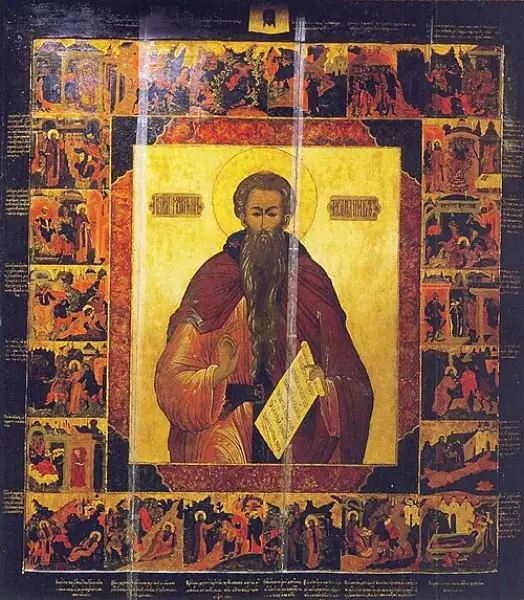
Historians of monasticism set Chariton at the head of the Judaean branch of the movement. Count him the founder of desert monasticism in Judaea, and his near-contemporary Hilarion stands beside him — the anchorite of the Gaza coast who imitated his Egyptian master Anthony the Great and whom Jerome, his biographer, names the founder of Palestinian monasticism altogether. Around and after them gather the other great names of the desert: Paul of Thebes, the first hermit, who preceded them both; Pachomius, the founder of cenobitic life in Egypt; and in Palestine itself Theoctistus and Euthymius, who established the first coenobium in the Judaean desert, Theodosius the Cenobiarch, and Sabbas the Sanctified. Within that constellation Chariton's distinctive gift was the lavra and the ascetic pattern he embodied in it. The Hebrew University's digital corpus of early Christian churches and monasteries records his houses at Pharan, Douka, and Khirbet Khureitun, and excavation continues to confirm elements of the sixth-century Life. A Russian Orthodox icon preserves his image, as does a miniature in the Menologion of Basil II.
§ Legacy
Timeline
- 273
Tortured and imprisoned during the persecution of Christians under Emperor Aurelian
§ Early life
- 275
Released after Aurelian's death, he is abducted by bandits while pilgriaging to Jerusalem
§ Pharan near Jerusalem
- 275
He remains a hermit in the Pharan cave and establishes the first lavra-type monastery
§ Pharan near Jerusalem
- 345
He founds a third monastery in the Valley of Tekoa, later called the Old Lavra
§ Souka (Old Lavra at Tekoa)
- 350
Dies in the Judaean desert c. 350, having set the rule for Judaean monastic life
§ Legacy
The Record
- Major works
- Office of the Monastic Tonsure (traditional attribution)·Founder of the lavras of Pharan, Douka, and Souka (Old Lavra) in Palestine
- Patron of
- Patron of Konya (Iconium)
- Symbols
- Monk's habit·Confessor who survived torture under Aurelian·Founder of lavra-type monasteries
- Canonization
- Pre-congregation; venerated by both the Eastern Orthodox and Roman Catholic churches
Prayer
Bibliography
Show 8 sources
- Ryrie, Alexander "Sandy" (2011). The Desert Movement: Fresh Perspectives on the Spirituality of the Desert (1st ed.). Hymns Ancient & Modern Ltd. pp. 78-81. ISBN 9781848250949.
- "Venerable Chariton the Confessor, Abbot of Palestine". Orthodox Church in America (OCA).
- "Saint Chariton the Confessor". Greek Orthodox Archdiocese of Australia, official website.
- Tzamalikos, Panayiotis (2012). The Real Cassian Revisited: Monastic Life, Greek Paideia, and Origenism in the Sixth Century. Vigiliae Christianae, Supplements 112. Brill. pp. 82-83. ISBN 9789004224407.
- "Khirbet Khureitun - Chariton; Souka; Old Laura". A Digital Corpus of Early Christian Churches and Monasteries in the Holy Land. The Hebrew University of Jerusalem.
- Bar, Doron (January 2005). "Rural Monasticism as a Key Element in the Christianization of Byzantine Palestine". Harvard Theological Review 98 (01): 49-65.
- Leah Di Segni: The Life of Chariton, in: Ascetic Behavior in Greco-Roman Antiquity: A Sourcebook, Vincent L. Wimbush, Minneapolis 1990, p. 393-421.
- Shehadeh, Raja: Palestinian Walks, pp. 136-7. Profile Books (2008). ISBN 978-1-86197-899-8.
Profile text adapted from the Wikipedia article, licensed CC BY-SA 4.0.
Pray with this saint every day
Save St. Chariton the Confessor to your favorites, read the full profile, and get feast-day reminders in the Saints app.
Get the Saints AppFree on the App Store for iPhone and iPad