
1606-1649·Feast October 19
St. Charles Garnier
Priest, Missionary and Martyr (Jesuit)
Overview
Charles Garnier, born in Paris in May 1606, his father served the French crown as secretary to King Henri III. Educated at the Collège de Clermont, he entered the Jesuit seminary there in September 1624, later served the college as prefect, taught for two years at the college of Eu, and was ordained a priest in 1635. His father at first refused to let him sail for Canada, where missionaries faced almost certain death; permission finally came, and on 25 March 1636 he embarked, writing his father a letter that describes giving Viaticum to a sailor injured in a fall from the mizzenmast, and giving the man his own cabin and mattress so he could sleep. Reaching New France that June, he went straight to the Huron mission with Pierre Chastellain, and by early August was working among the Nipissings. He never saw France again. The Wendat called him Ouracha, 'rain-giver', because rain ended a drought soon after his arrival; he was the 'lamb' to Jean de Brébeuf's 'lion'. He wintered among the Petun in 1639 and 1640 and served the Saint-Joseph mission from 1641 to 1646. Word reached him in March 1649 that Brébeuf and Lalemant were dead; he understood his own end was near, that December, Haudenosaunee musket fire killed him during an attack on the Petun village where he lived.
The Complete Life
Early Life
Charles Garnier was born in Paris on 25 May 1606, the son of a father who had served the French crown as secretary to King Henri III. He was educated at the Jesuit Collège de Clermont and entered the Jesuit seminary there in September 1624. After his novitiate he returned to Clermont as prefect, taught for two years at the college of Eu, and completed his studies in language, culture and theology, being ordained a priest in 1635. He asked at once to be sent to the missions of New France. His father at first refused permission — Canada was known to mean hardship and, for a missionary among the Huron, almost certain death — but eventually relented. On 25 March 1636 Garnier sailed, and the first letter he sent home about the crossing already reveals the man: when a sailor plunged from the mizzenmast and the crew administered Viaticum to him, Garnier handed over his own cabin and mattress so the injured man could rest.
§ Biography
Mission Among the Wendat and Petun
Reaching New France in June 1636, Garnier went straight to the Huron mission with Pierre Chastellain, and by early August was working among the Nipissings. He never saw France again. The Wendat called him Ouracha, rain-giver, because rain ended a drought soon after his arrival; missionaries and historians alike have paired his gentleness with Jean de Brébeuf's strength, the lamb to Brébeuf's lion. He learned the languages of the nations he served, wintered among the Petun (Tionontati) in 1639-1640, and from 1641 to 1646 served the Saint-Joseph mission among the Wendat, teaching, baptizing, and sharing famine, epidemic and war with the villages entrusted to him.
§ Biography
Martyrdom
Word reached Garnier in March 1649 that Brébeuf and Gabriel Lalemant had been killed and the Huron country overrun by the Haudenosaunee and their allies. Rather than withdraw to the French settlements, he went to the Petun villages he had wintered among, to be with his Christians as the war came to them. On 7 December 1649 a war party attacked the Petun village of Etharita where he was ministering. Garnier was shot through the shoulder and chest by musket fire while helping the wounded; as he lay dying he raised himself to baptize a dying man beside him and was killed with a hatchet. He was forty-three, and had been thirteen years in the mission without once returning to France.
§ Biography
Canonization
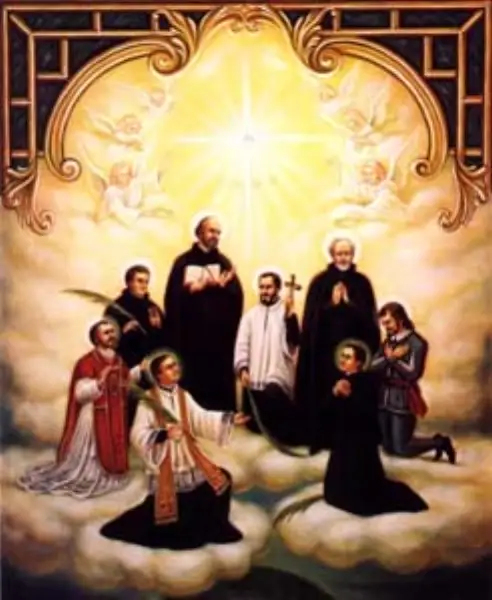
Garnier was beatified with the other Jesuit martyrs of the mission by Pope Benedict XV in 1925, and canonized by Pope Pius XI in 1930 together with the seven other Canadian — the North American — Martyrs: Brébeuf, Lalemant, Daniel, Jogues and his companion René Goupil, Antoine Daniel, Noël Chabanel and Garnier himself. Their feast is kept on 19 October in Canada and 26 September in the United States. The shrine of the martyrs at Midland, Ontario, and the mission of Sainte-Marie among the Hurons keep their memory at the sites of their work.
§ Bibliography
Legacy
Garnier's memory is that of the gentle missionary. Where Brébeuf's endurance has become proverbial, Garnier is remembered for the tenderness of his thirteen years among the Wendat and Petun — the rain-giver whose name marked him as a blessing from his arrival, the priest who gave his cabin to a dying sailor and his life to the villages of a collapsing nation. The destruction of the Huron confederacy in 1649-1650, of which his death was part, remains one of the great tragedies of the colonial encounter; his cult has had to be carried forward in awareness of that history. He is honored as a patron of missionary work, and his letters remain a primary source for the Huron and Petun missions.
§ Biography
Timeline
- 25 May 1606
Born in Paris, son of a secretary to King Henri III of France
§ Introduction
- Sep 1624
Entered the Jesuit seminary at Clermont, after studying at the Collège de Clermont
§ Biography
- 1635
Ordained a priest after completing studies in language, culture and theology
§ Biography
- 25 Mar 1636
Embarked for Canada, describing the Atlantic crossing in a letter to his father
§ Biography
- Jun 1636
Reached New France and travelled at once to the Huron mission with Pierre Chastellain
§ Biography
- 1639
Wintered in the land of the Petun, as he did again the following year
§ Biography
- 1641
Took up service at the Saint-Joseph mission, where he remained until 1646
§ Biography
- Mar 1649
Learned that Jean de Brébeuf and Gabriel Lalemant had been killed in a Haudenosaunee raid
§ Biography
- 7 Dec 1649
Killed by Haudenosaunee musket fire during an attack on the Petun village where he lived
§ Introduction
- 1930
Canonized by Pope Pius XI together with the seven other Canadian Martyrs
§ Introduction
In Their Own Words
We gave Viaticum to a sailor who had fallen from the top of the mizzenmast to the deck. He was well-disposed to die.
The Record
- Symbols
- Martyr's palm
- Canonization
- Canonized with the seven other Canadian (North American) Martyrs by Pope Pius XI in 1930
Prayer
Bibliography
Show 6 sources
- ↑ Gray, Charlotte; Angel, Sara (2004). The Museum Called Canada: 25 Rooms of Wonder . Random House Canada. ISBN 978-0-679-31220-8 .
- ↑ Larivière, Florian (1957). La Vie ardente de Saint Charles Garnier . Montreal: Bellarmin.
- 1 2 Lindsay, Lionel (1909). "Charles Garnier" . In Herbermann, Charles (ed.). Catholic Encyclopedia . Vol. 6. New York: Robert Appleton Company. p. 388.
- ↑ Campbell, Thomas Joseph (1910). Pioneer Priests of North America, 1642-1710: Among the Hurons . Vol. II. Fordham University Press. p. 331.
- 1 2 3 English, Darren. "Garnier" . Wyandot.org . Retrieved August 22, 2018 .
- 1 2 3 Larivière, Florian (1979) [1966]. "Garnier, Charles (Ouracha)" . In Brown, George Williams (ed.). Dictionary of Canadian Biography . Vol. I (1000–1700) (online ed.). University of Toronto Press .
Profile text adapted from the Wikipedia article, licensed CC BY-SA 4.0.
Pray with this saint every day
Save St. Charles Garnier to your favorites, read the full profile, and get feast-day reminders in the Saints app.
Get the Saints AppFree on the App Store for iPhone and iPad