
1613 – 1670·Feast January 6
St. Charles of Sezze
Franciscan Lay Brother and Mystic of Rome
Overview
Charles of Sezze, whose baptismal name was Giancarlo Marchioni, entered the world at Sezze on 19 October 1613, the child of two poor farmers, Ruggero Marchioni and Antonia Maccione, and grew up to be a professed lay religious of the Order of Friars Minor.
The Complete Life
A Shepherd Boy of the Pontine Hills
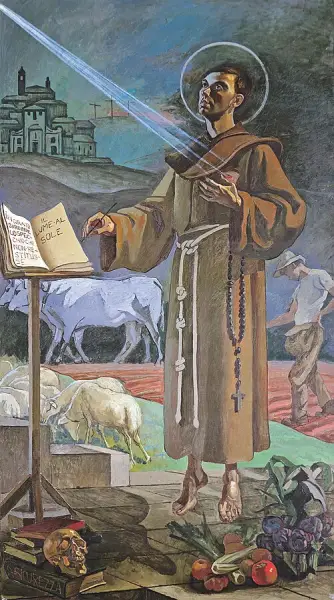
Giancarlo Marchioni, who would enter religion as Charles of Sezze, was born in the town of Sezze on 19 October 1613, in the Papal States, and was baptized three days later, on 22 October. His parents, Ruggero Marchioni and Antonia Maccione, were poor farmers, and the boy grew up in the sweat and austerity of a smallholding household. Religion entered his life early and through the women of his family. While he was little more than a toddler his mother took pleasure in clothing him in a dark tunic, corded and hooded, after the manner of Francis of Assisi and Anthony of Padua, and she preserved that small habit long after he had outgrown it, a domestic prophecy of the garment he would one day put on in earnest. From his grandmother on the maternal side, Valenza Pilorci, he received in childhood the devout practices and religious values that furnished his mind permanently with prayer, sacrament, and the lives of the saints. As soon as his strength allowed he shepherded on the farm, lightening his parents' exhausting burden, and he loved to plough in the fields because, as he later admitted with disarming simplicity, he liked the oxen. The virtues of his age were patience, obedience, and endurance, learned not from books but from animals, seasons, and poverty. That a child of the Campagna, half-literate and wholly unremarkable in the world's eyes, should end his life blessing a dying pope is the paradox his whole biography exists to explain.
§ Life
Against His Parents' Wishes, a Friar
The vocation of Giancarlo Marchioni ran against the grain of his family's hopes. A priestly career, which his parents urged on him as real advancement for a poor farming family, lay beyond his reach: a poor student and largely illiterate, he gave little promise of excelling in advanced studies. Two experiences fixed his direction instead. Still a teenager, he bound himself in 1630 with a private vow of chastity, giving himself to God before any rule required it. Two years later sickness brought him near to death, and from that extremity he promised the Order of Friars Minor his life if health were restored. He recovered, and the pledge stood. His models were not the hierarchy his parents admired but two professed religious of humble rank, Pascal Baylon and Salvador of Horta, whose lives kindled him, and India's missions drew him too. Nazzano's San Francesco convent admitted him to the order in 1635, clothing him with the habit on 18 May of that year. He would say afterwards that what drew him was the wish to live poorly and to go begging alms out of love for Christ. He set his heart once more on the missions, but poor health halted that dream as well. Father Angelo Maria received his solemn profession on 19 May 1636. The name first given him in religion was Cosmas; his mother pressed for Carlo, and Carlo it became. Though his parents protested, he never asked for ordination to the priesthood.
§ Life
Porter, Beggar, Mystic
The sanctity of Charles of Sezze was forged in the scullery and at the gate. The friaries employed him in a whole range of humble offices: the kitchen, the gate, the sacristy, the garden, and the streets, where he begged. Not every office suited his gifts, and one house still remembered how he set its kitchen ablaze, a failure he neither concealed nor excused. His practical wisdom was nonetheless real. While he kept the gate, a convent guardian directed him to feed the traveling friars who presented themselves; he obeyed, and the alms given to the friars fell away. He convinced the guardian that cause and effect were at work, and when the friars went back to aiding everyone who knocked, the alms rose again. October 1648 found him at Mass in the church of San Giuseppe a Capo le Case, where light streamed from an elevated Host, entered his side, and opened in it a visible wound, the mark he would carry to his death. Though no priest, he was instructed by his confessor to write the account of his life, and the result, The Grandeurs of the Mercies of God, was well read; several other books followed. A spiritual director guided him throughout, yet others, sensing where grace actually dwelt, came to him for spiritual counsel, and Pope Victor I and Teresa of Avila appeared to him in a vision dated 28 July 1665. The pattern is consistent: extraordinary graces resting upon a man of deliberately ordinary obedience.
§ Life
The Deathbed of a Pope and the Epiphany
The last years of Charles were marked by illness, prophecy, and a strange intimacy with the papacy. In 1656 he had tended to victims of cholera at Carpineto, exposing himself to contagion for the sake of the dying. Malarial fever struck him at San Pietro in Montorio on 22 August 1664, and he was moved to San Francesco a Ripa to convalesce under an order of bed rest, recovering by 30 August. Deathbeds brought the friar and the pope together at the last. Clement IX, not long before his own end, called for Charles to comfort and bless him; the summons was repeated in the first December week of 1669, when the friar, himself sick, had to be borne on a chair into the papal chamber. His greeting was characteristically simple, asking the Holy Father how he was; the pope answered that he was as well as God wanted him to be. Giacomo Rospigliosi, the cardinal present in the room, was asked by Charles to lay a special relic upon the pope; but the dying man preferred a blessing from the frail friar's own hands, and received it. When Clement asked at what meeting they would next greet one another, Charles answered, on the feast of the Epiphany, and the bystanders supposed the pope would be well enough within the month for such a meeting. Clement died on 9 December, and the friar's word seemed to have failed, until Charles himself died on the Epiphany, 6 January 1670, and the meaning became plain: the two friends were to greet one another in Heaven. Pleurisy had pinned him to his bed on 31 December 1669, and his death came in the Roman convent beside San Francesco a Ripa, the church of his burial.
§ Life
From Venerable to Saint Across Three Centuries
The cause of Charles of Sezze unfolded with the deliberate slowness of the older Roman process. On 14 June 1772, a full century after the friar's death, Clement XIV conferred on him the title of Venerable. Two miracles ascribed to his intercession were ratified on 1 October 1881, clearing the path for Leo XIII to beatify him at Saint Peter's Basilica on 22 January 1882. The formal cause for his sainthood was then opened on 4 August 1946, resuming the work at a modern pace. Two additional miracles were confirmed by Pope Pius XII on 7 January 1958, which should have carried the friar promptly to canonization; but Pius died before he could perform the ceremony, and the honour passed to his successor. Pope John XXIII canonized Charles on 12 April 1959 in Saint Peter's Square, giving the Catholic Church a Franciscan lay brother among its canonized confessors. His major shrine is at San Francesco a Ripa in Rome, the church of his burial, where a chapel dedicated to his name still houses his relics. The essentials of his cult had, in truth, never waited for official confirmation: the people of Rome and of his native Lazio had venerated the porter of San Francesco a Ripa from the moment of his death, and the long judicial process served to ratify a judgment already formed. His feast is kept on 6 January, the Epiphany on which he died, in keeping with the promise he had made to a dying pope.
§ Sainthood
Counsellor of Princes, Model of Humility
The most striking legacy of Charles of Sezze is the range of the people who sought him out. Throughout Lazio his name was held in honour: the great noble houses of Colonna and Orsini spoke well of him and consulted him, and so, in their turn, did the popes Innocent X and Clement IX. The Roman houses thought highly of him and sought him out at every opportunity, the Salviati and Orsini among them, the Colonna, the Cibo, the Caetani, the Borghese, the Boncompagni and the Ludovisi; the cardinals followed their lead, from Francesco Barberini and Gianstefano Donghi to Michelangelo Ricci, Celio Piccolomini, Cesare Facchinetti, Carlo Barberini, and Benedetto Odescalchi, who would reign as Innocent XI. His gift of prophecy was remembered above all in papal elections: the elevations of Innocent X, of Alexander VII and of Clement IX were all foretold by him, as was the election of Cardinal Emilio Altieri, which fell out not long after the friar's own death. His writings, beginning with the autobiography his confessor had required of him, kept his memory alive in print. In more recent times his devotion has spread beyond Italy: the Croatian Capuchin Venerable Ante Antić, who died in 1965, was his devotee and kept a picture of Charles above his bed. He remains a standing lesson in the economy of grace: the Church that honoured him with canonization was the same Church whose princes had once queued, figuratively, at the door of the friary where an illiterate cook and porter answered the bell.
§ Legacy
Timeline
- 19 Oct 1613
Born Giancarlo Marchioni at Sezze to the poor farmers Ruggero Marchioni and Antonia Maccione
§ Life
- 22 Oct 1613
Baptized at Sezze, three days after his birth
§ Life
- 1630
Made a private vow to remain chaste
§ Life
- 1633
Fell so gravely ill that he pledged to enter the Order of Friars Minor if he recovered
§ Life
- 18 May 1635
Admitted to the order at the San Francesco convent, Nazzano, and clothed with its habit
§ Life
- 19 May 1636
Made solemn profession into the hands of Father Angelo Maria; his religious name Cosmas was changed to Carlo at his mother's insistence
§ Life
- 1640
Stationed for the next two years at the convent of Saint John the Baptist at Piglio and at San Francesco, Castel Gandolfo
§ Life
- Oct 1648
At Mass at San Giuseppe a Capo le Case, a beam of light from the elevated Host pierced his side and left an open wound
§ Life
- 1656
Tended to victims of cholera at Carpineto
§ Life
- 22 Aug 1664
Fell ill with malarial fever at San Pietro in Montorio and was taken to San Francesco a Ripa, recovering after bed rest on 30 August
§ Life
- 28 Jul 1665
Had a vision of Pope Victor I and Teresa of Avila
§ Life
- Dec 1669
Summoned in the first week of December to the deathbed of Pope Clement IX, whom he blessed
§ Life
- 31 Dec 1669
Forced to bed by pleurisy
§ Life
- 6 Jan 1670
Died on the Epiphany in the convent attached to San Francesco a Ripa in Rome and was buried in that church
§ Life
- 14 Jun 1772
Pope Clement XIV granted him the title of Venerable
§ Sainthood
- 1 Oct 1881
Two miracles attributed to his intercession were ratified
§ Sainthood
- 22 Jan 1882
Beatified by Pope Leo XIII in Saint Peter's Basilica
§ Sainthood
- 4 Aug 1946
The cause for his canonization was opened
§ Sainthood
- 7 Jan 1958
Pope Pius XII ratified two further miracles, yet passed away before he could perform the canonization
§ Sainthood
- 12 Apr 1959
Canonized by Pope John XXIII in Saint Peter's Square
§ Sainthood
In Their Own Words
Holy Father, how are you?
As well as God wants me to be.
The Record
- Major works
- The Grandeurs of the Mercies of God (autobiography)·Birth of Holy Mary's Novena·Christmas Novena·Holy Settenario·Invalid Path of the Soul·Jesus Christ's Talk about Life·The Three Ways
- Patron of
- Patron of Sezze·Patron of the Diocese of Latina-Terracina-Sezze-Priverno
- Symbols
- Franciscan habit·wound in the side
- Canonization
- Declared Venerable by Pope Clement XIV in 1772; beatified by Pope Leo XIII on 22 January 1882; canonized by Pope John XXIII on 12 April 1959
Prayer
Bibliography
Show 9 sources
- "Saint Charles of Sezze". Saints SQPN. 6 January 2017.
- "Saint Charles of Sezze". Roman Catholic Saints.
- "St. Charles of Sezze" (PDF).
- "San Carlo da Sezze". Santi e Beati.
- "Cappella di San Carlo da Sezze". sanfrancescoaripa.it (in Italian). Retrieved 11 May 2019.
- Index ac status causarum beatificationis servorum dei et canonizationis beatorum (in Latin). Typis polyglottis vaticanis, January 1953, p. 45.
- Donald Attwater; Catherine Rachel John (1995). The Penguin Dictionary of Saints, 3rd Edition. New York: Penguin Books. ISBN 0-14-051312-4.
- Raphael Brown (1960). The Wounded Heart: St. Charles of Sezze. Chicago: Franciscan Herald Press. OCLC 3247159.
- St. Charles of Sezze (1963). St. Charles of Sezze: an autobiography. Translated by Leonard Perotti. London: Burns & Oates. OCLC 221056796.
Profile text adapted from the Wikipedia article, licensed CC BY-SA 4.0.
Pray with this saint every day
Save St. Charles of Sezze to your favorites, read the full profile, and get feast-day reminders in the Saints app.
Get the Saints AppFree on the App Store for iPhone and iPad