
died c. 286·Feast September 7
St. Chiaffredo
Theban Legionary Martyr and Patron of Saluzzo
Overview
Chiaffredo, also known as Chiaffredus, Theofredus, Ciafre, Chaffre, Teofredo, Jafredo, Eufredus, and Sinfredus, is venerated as the patron saint of Saluzzo in Piedmont, Italy. Tradition counts him a member of the Theban Legion, the fabled Egyptian corps martyred with St. Maurice at Agaunum in present-day Switzerland; instead of dying with the legion, he is said to have escaped to Piedmont, where, refusing sacrifice to the pagan idols, he won the martyr's crown at Crissolo beneath Monte Viso in about 270, or in 286. The cult grew out of a find in the fields. A fourteenth-century account tells how, towards 522, a man tumbled from a cliff near Crissolo yet walked away unhurt; the people of the district credited his survival to a skeleton turned up by a plowing peasant, which received the name San Ciafre and was lodged in a sanctuary at Crissolo that became celebrated. The indulgences granted in 1387 by Clement VII of the Avignon obedience, to visitors contributing to repairs at the Crissolo church, form the cult's earliest documentary trace. A late sixteenth-century legend written down by Guglielmo Baldesano fixed the Theban story, though scholars such as Fabio Arduino judge it without historical foundation, noting that a third-century Roman legionary would not have borne so Germanic a name. In 1593 his relics were carried to Revello, and in 1642 into Saluzzo Cathedral. His supposed Egyptian origin has won him the veneration of the Coptic Church, even though the Roman Martyrology nowhere mentions him by name.
The Complete Life
A Soldier of the Theban Legion
The traditional life of Chiaffredo begins in Egypt. He is venerated as a martyr who belonged to the Theban Legion, the celebrated band of Christian soldiers from Thebes in Egypt who, under their leader Maurice, refused to sacrifice to the pagan gods and were put to death at Agaunum in present-day Switzerland. The tradition concerning Chiaffredo departs from the common story of that legion at the moment of the massacre: instead of being martyred with his comrades at Agaunum, he is said to have escaped to Piedmont, and there, in the alpine valley beneath Monte Viso, to have suffered martyrdom on his own account, around the year 270 according to the late legend, or in 286 as the calendar traditions record. His name has come down in a remarkable variety of forms, including Chiaffredus, Theofredus, Ciafre, Chaffre, Teofredo, Jafredo, Jafredus, Eufredus, Jofredus, Sinfredus, and Zaffredus, a richness that itself testifies to the wide and old diffusion of his cult. Etymologically the name goes back to Theudofridus, a compound of the Germanic theuda, people, with frithu, peace. That Germanic name is exactly what makes the tradition doubtful in the eyes of Fabio Arduino and other scholars, who note how improbable it is that a third-century soldier of Rome should have carried a name of so plainly Germanic a character. The warrior of the tradition may thus be less a record than a pious construction of a later age.
§ References
Flight to Piedmont and Martyrdom at Crissolo
The heart of the Chiaffredo legend is the flight eastward from the slaughter at Agaunum. Guglielmo Baldesano set the story down at the end of the sixteenth century: Chiaffredo, or Teofredo, belonging to the Theban Legion, fled into Piedmont rather than take part in a sacrifice to idols, and at Crissolo, high in the Cottian Alps under Monte Viso, he was put to death in about 270. In this telling he is a double witness: he refused the idolatrous sacrifice that destroyed his legion, and then, having fled, he refused again and paid for the refusal with his blood on Italian soil. The choice of Crissolo as the scene of martyrdom gave the mountain village a hero of universal significance, a soldier of the greatest of the legendary martyr-legions, and it set the cult of Chiaffredo within the vast family of Theban derivations that spread through the Alps in the early Middle Ages. Whether history stands behind the legend is doubtful, and modern scholarship has been firm in saying so; but the legend itself did real historical work. It gave the people of the Po headwaters a saint of their own, a patron who had died among them rather than in a distant Swiss valley, and whose intercession could be sought at a specific tomb in a specific place. The mission of Chiaffredo, in the piety of Piedmont, was thus accomplished after his death, in the centuries during which his shrine drew the valleys to prayer under the standard of the red Mauritian cross.
§ References
The Growth of a Cult
The cult of Chiaffredo grew from a discovery in the fields. A fourteenth-century narrative records that towards 522 a man fell from a cliff near Crissolo without suffering harm, an escape which the local people ascribed to certain relics lately turned up in the neighbourhood by a plowing peasant, the unearthing itself being judged an act of providence. To the mysterious bones the name San Ciafre was attached, and round the tomb there grew up at Crissolo a sanctuary of wide renown. The sepulcher in question may well have been a grave of pagan date, and the devotion that formed around it belongs with the cults of Constantius at Crissolo, Bessus in the Val Soana, Tegulus at Ivrea, Magnus at Castelmagno and Dalmatius at Borgo San Dalmazzo, every one of them tied to the Theban Legion so as to give an air of antiquity to some local figure of whom nothing certain could be said. Documentary confirmation came late. For Chiaffredo by name, the cult's first documentary trace belongs to 1387, the year in which Clement VII, pope in the Avignon obedience, bestowed indulgences upon all who came to the Crissolo church and lent a hand in repairing it. The Baldesano legend followed at the end of the sixteenth century, and gave the martyr his written life. The ecclesiastical seal was set by the synod of 1516, in which Tornabuoni, the bishop of Saluzzo, named Chiaffredo, joined with Constantius as co-patron, guardian of his diocese, thereby giving the martyr of the mountain official standing over the whole see.
§ References
Relics, Doubts, and Enduring Devotion
The afterlife of Chiaffredo has been a story of translation, art, and recurring historical question. The relics went to Revello in 1593, and from Revello to Saluzzo's cathedral in 1642, where the altar shows the diocese's two patrons together, Constantius and Chiaffredo arm in arm in paint. His shrines remain at Crissolo and Saluzzo, and his feast is kept on 7 September. Devotion to him has never been confined to the Roman rite: the Coptic Church honours him on account of his claimed Egyptian origin, listing him with her martyrs, and the Eastern and Oriental Orthodox Churches likewise know his name. Within Catholicism, his position is deliberately restrained; the Roman Martyrology passes over him in silence, recording Maurice and the Theban Legion collectively while leaving Chiaffredo himself unmentioned. Modern scholarship has continued to probe the tradition. In 1902 one scholar proposed that the saint is really Theofredus, an abbot of the eighth century who governed Le Monastier by Puy-en-Velay, died at the hands of Muslim raiders, and was likewise honoured in Piedmont, a reading that puts an altogether different martyr at the cult's core. A nineteenth-century English man of letters made the cultural point sharply, observing that, under Monte Viso, the runaway apostle of the Theban legion has taken over the old worship once rendered to the river-god Eridanus, implying that the saint of the valley occupies the seat of an older divinity. Devotion in Piedmont has not been troubled by the debate.
§ References
Timeline
- 286
Martyred at Crissolo in Piedmont, by the tradition that makes him a Theban Legionary who escaped the massacre at Agaunum; a late legend sets the death nearer 270
§ Introduction
- 522
A fourteenth-century account tells how, about this year, a man who fell from a precipice near Crissolo was unharmed, a survival credited to relics a plowing peasant had unearthed and named San Ciafre
§ Introduction
- 1387
Avignon Pope Clement VII granted indulgences to visitors of the Crissolo church who helped repair it, the earliest documentary evidence of the cult
§ Introduction
- 1460
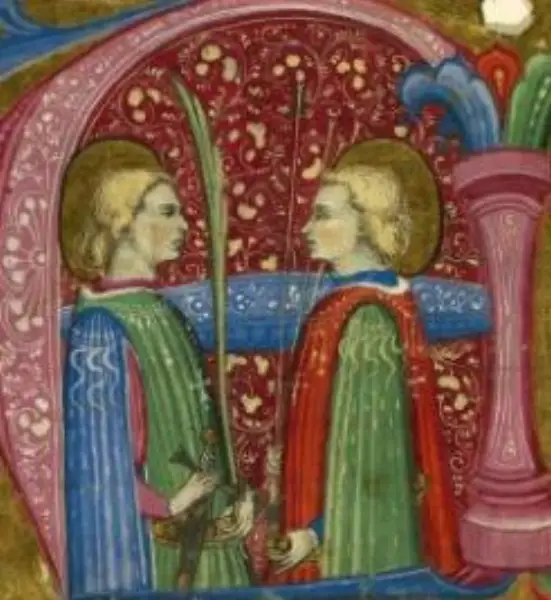
Miniature of Saints Maurice and Theofredus attributed to Frate Nebridio da Cremona, painted between about 1460 and 1480
§ Introduction
- 1516
Bishop Tornabuoni of Saluzzo declared Chiaffredo patron of his diocese at a synod, with Constantius as co-patron
§ Introduction
- 1593
His relics were translated to Revello
§ Introduction
- 1642
The relics were carried on to the cathedral of Saluzzo, where the altar depicts the two patrons together
§ Introduction
- 1902
A scholar identified Chiaffredo with the eighth-century Theofredus, abbot of Le Monastier near Puy-en-Velay, killed by Muslim raiders
§ Introduction
The Record
- Patron of
- Patron of Saluzzo, Italy·Patron of the Diocese of Saluzzo, with St. Constantius
- Symbols
- military attire·sword·standard of red Mauritian cross on white field·elm tree·horse
- Canonization
- Pre-congregation; Bishop Tornabuoni of Saluzzo declared him patron of the diocese at the synod of 1516, with St. Constantius as co-patron
Prayer
Bibliography
Show 6 sources
- "Mauritius van Agaunum". www.heiligen-3s.nl. Retrieved 2018-03-17.
- "San Chiaffredo di Saluzzo su santiebeati.it". Santiebeati.it. Retrieved 2018-03-17.
- "La Legione Tebea". www.cartantica.it. Retrieved 2018-03-17.
- Pomi, Damiano (July 16, 2004). "San Magno". Santi e Beati. Retrieved December 28, 2008.
- "La cappella di San Biagio - Comune di Revello". Archived from the original on 2008-07-02. Retrieved 2008-07-07.
- The Academy: A Weekly Review of Literature, Science, and Art. January-June 1882. Volume XXI (London, 1882), 39.
Profile text adapted from the Wikipedia article, licensed CC BY-SA 4.0.
Pray with this saint every day
Save St. Chiaffredo to your favorites, read the full profile, and get feast-day reminders in the Saints app.
Get the Saints AppFree on the App Store for iPhone and iPad