
605 – 696 or 697·Feast June 8
St. Chlodulf of Metz
Carolingian Bishop of Metz and Cathedral Builder
Overview
Chlodulf, also called Clodulphe or Clodould, and known in devotion as Saint Cloud or Saint Clou, was born in 605 into the family that would produce the Carolingian dynasty. His father was Saint Arnulf, bishop of Metz, and his brother Ansegisel served as mayor of the palace of Austrasia; through that brother's marriage to Begga, Chlodulf stood close to Saint Gertrude of Nivelles, his sister-in-law's sister, with whom he kept warm contact. Before ordination he had married an otherwise unknown woman and fathered a son, Aunulf, and the record candidly allows that his early manhood was not thought pious. Elevated in 657, he was the third pastor of Metz to follow his own father, and he ruled the see for forty years. His lasting monument was the rich decoration he gave the cathedral of St. Stephen. Butler's Lives adds that he passed through the greatest employments at the courts of Dagobert I and Sigebert II before accepting, reluctantly and under royal pressure, an election the clergy and people had made unanimous. He died in Metz on 8 June 696 or 697, at roughly ninety years of age, and was laid to rest in St. Arnulf's church; in 959 his remains were translated to the Benedictine priory of Lay near Nancy.
The Complete Life
Son of Saint Arnulf
Chlodulf was born in 605 into the aristocracy of Austrasia, at the center of the family from which the Carolingian dynasty would grow. His father was Arnulf, the Frankish nobleman who renounced the world to become bishop of Metz and is venerated as Saint Arnold; his brother was Ansegisel, who served as mayor of the palace of Austrasia and who married Begga, the daughter of Pepin of Landen. Through that marriage Chlodulf became uncle by alliance to Pepin of Herstal and great-uncle to Charles Martel, standing at the head of the Arnulfing line that would rule the Franks. Butler, writing from the older hagiographical tradition, says that Arnulf cultivated his two sons' inclinations to virtue by an excellent education, and that Chlodulf showed from the cradle that he had inherited his father's qualities in a high degree. Under the best masters, the same account relates, the boy progressed in the divine and human sciences to the astonishment of his teachers and the emulation of his classmates. Soberer modern accounts note only that his youth had carried a name for impiety that he outgrew on the way to the episcopate. Both portraits agree on the essentials: a son of privilege, formed amid the court and cloister of seventh-century Metz.
§ Butler's account
From Court to Cathedra
Chlodulf's path to the episcopacy ran first through marriage and the court. Before his ordination he had married a woman whose name the record has not kept, and by her he had a son called Aunulf; his was therefore a vocation ratified only after ordinary family life had begun. Butler's fuller narrative sets him in the courts of the kings of Austrasia, where he held the highest posts in the service of Dagobert I and Sigebert II, winning honor for himself and profit for the realm. In time, Butler says, he left his brother Ansegisel to push his fortune among earthly kings while he himself chose a state that removes a man from flattering objects of the passions. His father had meanwhile laid down the bishopric of Metz to live out his days in quiet, and two pastors had succeeded him in the see. When it fell vacant a third time, choir and city spoke with one voice for Chlodulf; the holy man tried every means to turn the choice upon another, but the whole country pressed him the harder, and at length the king compelled him to bow to an election heaven itself had made. Thus in 657, third pastor of Metz after his father, he was consecrated bishop and set himself cheerfully to the charge.
§ Butler's account
Forty Years in the See
Chlodulf's long reign over the church of Metz, from 657 until his death, left one visible monument and one pastoral program. The monument was the cathedral of St. Stephen, which he richly decorated during his tenure, adorning the mother church of his see as a sign of the liturgy's dignity. The program, as Butler transmits it, began with a visitation of the diocese, in which he corrected abuses and established regularity wherever he found disorder. His compassion for the poor shaped the manner of his own life: for their sake, Butler writes, he lived destitute of the most common conveniences, so that the bishop of one of Francia's richest sees kept a household poorer than his people's. Attentive to all their wants, he busied himself above all in instructing, comforting, and relieving the poor of Metz. Alongside this diocesan labor he cultivated a friendship that reached beyond his city: he stood in close contact with Saint Gertrude of Nivelles, the sister of his brother's wife Begga, a bond of two aristocratic households turned toward monastic reform. His governance, Butler calculates, lasted forty years and fifteen days, a span that carried the see of Metz from the age of the early Merovingian mission fields to the eve of Carolingian power.
§ Life
At the Foot of the Cross
What the tradition remembers of Chlodulf's inner life comes chiefly through Butler, whose portrait turns on two practices: poverty embraced for the sake of others, and prayer before the crucified Christ. Daily, with unwearying constancy, he knelt at the cross to feed his soul on the bread of life, and from that same school came an eloquence from above, by which he set before his hearers, most movingly, the insight and illumination the God of all science had poured into him. The image is of a bishop whose preaching drew straight from prayer, the pulpit supplied by the crucifix. Zealous for God's glory and tender toward his flock, he wearied himself in working for their holiness, above all among the poor. His renunciation had a courtly beginning: Butler notes that he embraced the clerical state precisely because it bears a man away from ambition's enticements and the press of distraction amid which even good men struggle to keep God before their eyes. The lesson his biographer draws is that holiness, for a man of Chlodulf's rank, meant subtraction: the deliberate stripping away of comfort and advantage until nothing impeded the work of shepherding.
§ Butler's account
Death in Metz
Chlodulf died in Metz on 8 June 696, or in 697 by another reckoning, with some sources giving 8 May of that later year; he was about ninety years old at his death, having governed the church of Metz for forty years and fifteen days. His burial place was the church of St. Arnulf, the house that held his father's memory, so that father and son rested in the same sanctuary of the city they had both served as bishops. Nothing survives of a final illness or of deathbed words, and Butler's account closes with equal brevity, moving directly from the tally of his years to the fate of his relics. What the record does guard is the length and continuity of his tenure: across four decades the see of Metz knew one shepherd, the son of its former shepherd, decorating its cathedral, visiting its parishes, and keeping its poor. His death closed the Arnulfing generation in Metz and left the see to successors who would serve a family increasingly dominant in Frankish politics. The city that received his body remembered him under a shortened and affectionate name, Saint Clou, a title that would attach to him most strongly not in Metz but at Nivelles.
§ Life
Saint Clou of Nivelles
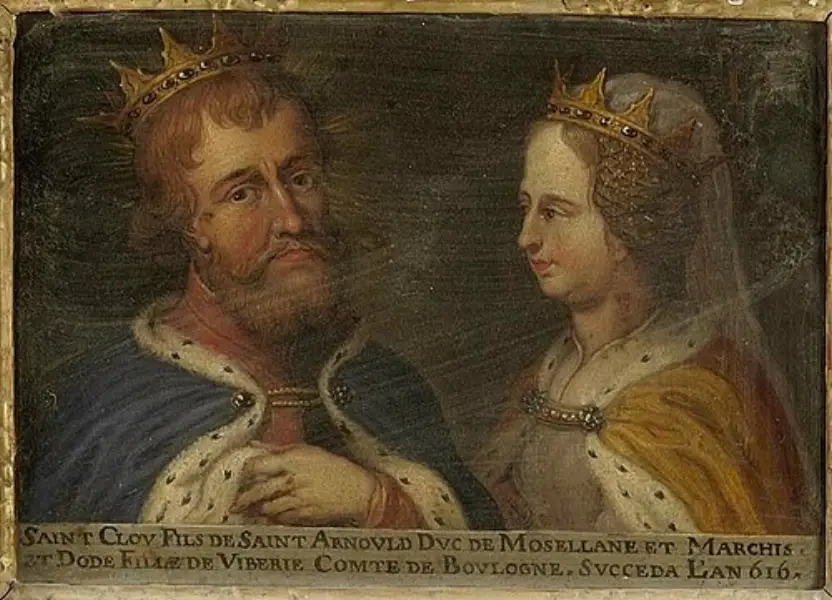
Chlodulf belongs to the vast company of saints raised to the altar before the modern process of canonization existed. He is commemorated in the Roman Martyrology on 8 June, the day of his death; Butler records that his name stands in that roll and in others beside it, with a life preserved among the annotated Acta Sanctorum of Henschenius. His cult, however, was always local rather than universal, and its center lay not in his own city but at Nivelles in Brabant. There he was venerated as Saint Clou, chiefly on account of his bond with Saint Gertrude of Nivelles, the abbess and foundress whose sister Begga had married his brother Ansegisel. The friendship between the bishop and the abbess, kept up across the distance between Metz and Nivelles, made him a familiar figure in the monastery's memory, and devotion followed the family tie. The name Saint Cloud, more famous in France through other bearers, attaches to Chlodulf as well: one illustration even captions him and a wife Marie as Saint Cloud and his wife. His formal standing in the Church today is that of a pre-congregation saint, honored by long tradition rather than by process, his feast kept on 8 June.
§ Life
Relics and Dynasty
Chlodulf's afterlife has two strands, one liturgical and one dynastic. Liturgically, his relics travelled: Butler records that his body was translated on 11 December 959 to the Benedictine priory of Lay, not far from Nancy, where the monastic community received the bishop of Metz as its own saint; a portion, Butler notes, stayed behind in the Metz church that carries his name, so that the city kept part of what Lorraine received. The double resting place fixed his memory in both the Moselle and the Meuse country. Dynastically, his significance is genealogical: as the son of Saint Arnulf of Metz and brother of Ansegisel, he stood at the junction of the Arnulfing line, and his kin through Begga and Pepin of Herstal would within two generations dominate the Frankish kingdom and, in Charlemagne, the whole West. He stands squarely in the Pippinid and Arnulfing succession tables, a reminder that the Carolingian reformation had saints among its grandfathers. For the modern reader his legacy is quieter: a cathedral decorated, a diocese visited, a long episcopate honestly accounted, and the candid admission that the man who did these things had not always been thought pious. That admission, rare in hagiography, is itself his monument.
§ Butler's account
Timeline
- 605
Born a son of the bishop Arnulf; his brother Ansegisel served as mayor of the palace in Austrasia.
§ Introduction
- 657
Raised to the see of Metz as the third pastor to follow his father; chroniclers note his early years had seemed wanting in piety. He led the diocese for forty years.
§ Life
- 8 Jun 696
Died in his ninetieth year and was laid to rest in the church of St. Arnulf; some sources instead give 8 May 697.
§ Introduction
- 11 Dec 959
His body was translated to the Benedictine priory of Lay near Nancy, though a portion remains in the Metz church bearing his name.
§ Butler's account
In Their Own Words
despite a reputation for impiety in his youth
Such was his compassion for the poor, that for their sake he lived himself destitute of the most common conveniences of life.
The Record
- Major works
- Rich decoration of the cathedral of St. Stephen at Metz
- Symbols
- Bishop's vestments·Model of a church, for his adornment of Metz cathedral
- Canonization
- Pre-congregation; commemorated in the Roman Martyrology and locally venerated as Saint Clou at Nivelles.
Prayer
Bibliography
Show 2 sources
- Halsall, Guy. Settlement and Social Organization: The Merovingian Region of Metz. Cambridge University Press, 2002. ISBN 9780521521895.
- Butler, Rev. Alban (1711–73) (1866). The Lives of the Saints, vol. VI: June. Via Bartleby.com.
Profile text adapted from the Wikipedia article, licensed CC BY-SA 4.0.
Pray with this saint every day
Save St. Chlodulf of Metz to your favorites, read the full profile, and get feast-day reminders in the Saints app.
Get the Saints AppFree on the App Store for iPhone and iPad