
3rd century·Feast July 24
St. Christina of Bolsena
Virgin Martyr of Bolsena and Tyre
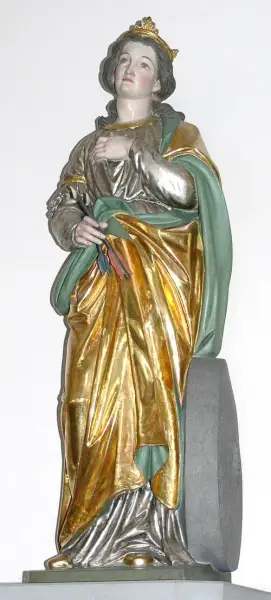
Overview
Christina of Bolsena, also called Christina of Tyre and known in the Eastern Orthodox Church as Christina the Great Martyr, is honored as a third-century virgin martyr, though the evidence for her existence is thin. The traditions divide her birthplace between Tyre in Phoenicia, the Eastern reading, and Persia, the Western one. Her legend, first written down in the ninth century and then branching into many variants, makes her the daughter of a rich man who governed Tyre. Destined by him for the pagan priesthood, she was lodged in a special dwelling filled with gold and silver idols before which she was to burn incense, attended by two servants. Instructed in the Christian faith by an angel who named her a bride of Christ, she smashed the idols and scattered the fragments to the poor, and her father Urbanus answered with torture that failed to kill her; after his death his successor Dion renewed the torments until she was beheaded. Archaeology gives firmer ground than legend: catacombs at Bolsena in central Italy, over an Etruscan settlement called Volsinium, hold the tomb of a female martyr whose inscriptions bear a name like Christina, showing local veneration by the end of the fourth century, and a sixth-century mosaic at Ravenna shows a crowned virgin of that name. She was dropped from the General Roman Calendar in 1969 yet remains in the Martyrology, and her basilica at Bolsena was the scene of the Eucharistic miracle of 1263.
The Complete Life
A Governor's Daughter
The traditions about Christina's origins disagree, and honesty about that disagreement is the beginning of her story. Eastern stories place her birth at Tyre in Phoenicia, Western stories in Persia, and the dates offered range across the third to the fifth century; the most widely received account settles on a virgin martyr of the third century, with Tyre as the favored birthplace. What the legend agrees upon is her rank: wealth was her birthright, and her father ruled Tyre as governor, so that the girl grew up amid the wealth and the expectations of a provincial aristocracy in the Roman world. By the age of eleven she was exceptionally beautiful, and many men sought to marry her. Her father, however, had a different plan for her altogether, one that had nothing to do with marriage: he envisioned his daughter as a pagan priestess. To prepare her for that office he placed her in a special dwelling of her own, where he had set up many idols of gold and silver, and he commanded her to burn incense before them. Two servants attended her in this gilded seclusion. The setting is the classic stage of the virgin-martyr legend, a wealthy house, an enclosure, and a father's religious ambition for his child, and on that stage the ninth-century passion unfolds.
§ Traditional accounts
The Bride of Christ
Christina's conversion, in the legend, arrived by angelic instruction. A messenger from heaven visited her in her enclosure and taught her the Christian religion; he then named her Christ's bride and told her of the sufferings in store for her, so that her vocation came with its cost announced in advance. Her answer was immediate and practical. She broke the idols of her chamber one by one and cast the fragments through the window, and the artistic tradition of later centuries fixed the meaning of the act by showing her giving her father's gold to the poor, a scene painted in the seventeenth century and now in the National Museum in Warsaw. When her father, named Urbanus in the accounts, came to visit his daughter and found the idols gone, he asked where they had disappeared; Christina kept silent, but the two servants, when summoned, told him the truth. From that moment the priestess he had intended became, in his eyes, a destroyer of the household gods and an enemy of the religion that secured his office. The vocation she had received in private was thus made public against her will, by servants' testimony and a father's interrogation, and the remainder of her life in the legend is the working out of that disclosure through tortures endured and survived.
§ Traditional accounts
Tortures and the Sword
The passion narratives make Christina's father her first persecutor. Urbanus subjected his daughter to torture because of her faith, and God, the accounts insist, thwarted his efforts: she survived what should have killed her. The catalog of her torments varies with each source, and the repertoire is long: iron hooks, grilling by fire, a furnace, the wheel, snakes, arrows, and other methods besides, all of which she outlives in the telling. The Roman Martyrology, summarizing the tradition, adds the lake: she was thrown into the water with a great weight of stone and rescued by an angel, and under a second judge she endured harsher tortures still, passing five days unscathed behind a blazing furnace once Christ's power had vanquished the serpents. That second judge is Dion, her father's successor, who took up the persecution when Urbanus died. Her end, at last, came by the sword: Christina is eventually beheaded, and with her death the legend closes, having shown a body that could not be broken by anything but the executioner's final stroke. What is historical in all this cannot be separated out; what is devotional is the whole of it, a virgin who outlasted every engine of coercion.
§ Traditional accounts
In the Martyrology, Off the Calendar
Christina belongs to the saints of the pre-congregation era, and the modern Church has treated her cult with a candor unusual for a martyr. Her feast once appeared in the General Roman Calendar: the Tridentine calendar of the older rite commemorated her in the Mass of the Vigil of Saint James the Great, and once Pius XII abolished that vigil in the 1955 reforms, her rank fell to a simple and, by 1960, to a commemoration. The revision of 1969 then dropped her from the calendar altogether, for a reason stated without ornament in the official commentary: beyond her name and her grave at Bolsena, nothing about her can be established. The omission was not a damnatio: she remained, and remains, in the Roman Martyrology, the Church's official list of recognized saints, where the 2004 edition carries the full traditional entry for her feast. Under the rubrics now governing the Roman Missal, indeed, a memorial of Saint Christina may be kept everywhere on her day, except where a locality marks some other obligatory celebration on that date. The arrangement is instructive: the calendar asks for evidence the record cannot give, while the martyrology keeps the name.
§ Veneration
Shrines and the Bleeding Host
Christina's bodily legacy is scattered and contested, as catacomb saints' legacies usually are. Her major shrine is the Basilica of Santa Cristina at Bolsena, the town near the old Etruscan settlement of Volsinium whose catacombs hold the tomb that anchors her cult. At Toffia in Rieti's province her relics are shown in a see-through urn. Palermo, which counts her among its four heavenly patrons, claims relics of her at Santa Cristina Gela, an Arbëresh village lying twenty kilometers to the city's south. Venice's church of San Francesco della Vigna claims her body, incorrupt, and a relic of her is honored at the Maronite Cathedral of Our Lady of the Seas at Tyre, the city of the Eastern birth tradition. One popular attribution has been corrected in the record: the relics in the Cathedral of Saint John the Evangelist in Cleveland, Ohio, are not hers, contrary to local belief. Her name is also tied to the most famous event at Bolsena, the Eucharistic miracle of 1263, when a doubting priest from Prague, saying Mass at her basilica, saw the Host drip the Precious Blood over his hands and onto the corporal, a wonder often counted the catalyst for the Feast of Corpus Christi and depicted by Raphael.
§ Relics
Timeline
- 300
By tradition a virgin martyr of the third century, born at Tyre and put to death at Bolsena in Lazio.
§ Introduction
- 400
An underground cemetery raised over her tomb indicates a cult in her honour at Tyre already flourishing in the fourth century.
§ Introduction
- 400
Inscriptions at the Bolsena catacombs confirm a female martyr of a name like Christina, venerated there by the end of the fourth century.
§ Life
- 500
A sixth-century mosaic at Sant'Apollinare Nuovo in Ravenna depicts among its virgins a Christina crowned as a martyr.
§ Life
- 900
An account of her martyrdom, composed by the ninth century, develops many variants in later ages.
§ Traditional accounts
- 1263
At the Basilica of Santa Cristina in Bolsena, a doubting priest from Prague sees the Host bleed onto the corporal, later a catalyst for the Feast of Corpus Christi.
§ Miracle of Bolsena
- 1955
Pius XII's liturgical reforms suppress the Vigil of Saint James the Great, within whose Mass the Tridentine calendar had commemorated her.
§ Veneration
- 1960
Her celebration is reduced in rank to a mere commemoration in the General Roman Calendar.
§ Veneration
- 1969
The calendar revision omits her, since nothing is known of her beyond her name and burial at Bolsena, though she remains in the Martyrology.
§ Veneration
In Their Own Words
because nothing is known of this virgin and martyr apart from her name and her burial at Bolsena
This virgin, believing in Christ, when had broken the gold and silver idols of her father, and had distributed their fragments to the poor, she was torn to pieces by the order of the same father with lashes, and was tortured with other tortures, and thrown into the lake with a great weight of stone, but was saved by an angel.
The Record
- Patron of
- One of four patron saints of Palermo
- Symbols
- Pierced by three arrows
- Canonization
- Pre-congregation; retained in the Roman Martyrology, the official list of recognized saints, after her 1969 removal from the General Roman Calendar.
Prayer
Bibliography
Show 8 sources
- Husenbeth, Frederick Charles. Emblems of Saints: By which They are Distinguished in Works of Art. Longman, Green, Longman, and Roberts, 1860.
- Reames, Sherry L., ed. "Christina of Bolsena: Introduction", Middle English Legends of Women Saints. Kalamazoo, Michigan: Medieval Institute Publications, 2003.
- "Saint Christina of Tyre (July 24)". Official website of the Antiochian Orthodox Christian Archdiocese of Australia, New Zealand and the Philippines.
- "St. Christina of Tyre, Martyr". Orthodox Church in America.
- Calendarium Romanum. Libreria Editrice Vaticana, 1969.
- Sanidopoulus, John. "The Incorrupt Relics of Saint Christina the Great Martyr in Venice". Mystagogy Resource Center, 24 July 2015.
- "Poetry, painting and procession". Zenit, June 23, 2011.
- Herbermann, Charles, ed. "Orvieto". Catholic Encyclopedia. New York: Robert Appleton Company, 1913.
Profile text adapted from the Wikipedia article, licensed CC BY-SA 4.0.
Pray with this saint every day
Save St. Christina of Bolsena to your favorites, read the full profile, and get feast-day reminders in the Saints app.
Get the Saints AppFree on the App Store for iPhone and iPad