
3rd–4th century (legendary)·Feast July 25
St. Christopher
Christ-bearer and patron saint of travelers
Overview
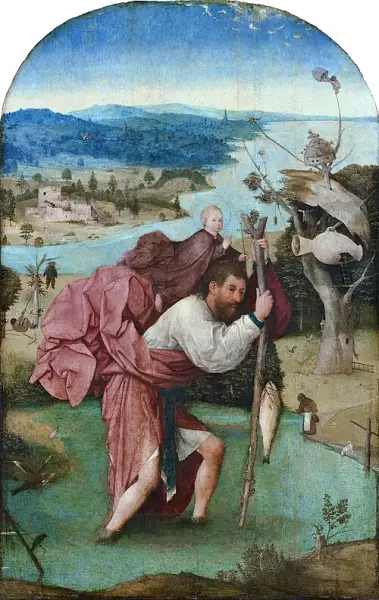
Christopher, whose Greek name means Christ-bearer, is a legendary martyr venerated across the Christian churches. The legends disagree on his time and place, setting his birth in Marmarica, the Middle East, or Barbaria and his death under the emperors Decius, Diocletian, or Maximinus Daza. Two great hagiographic traditions took shape: the older Eastern one describes him before conversion as a fierce, dog-headed being, while the younger Western one dwells instead on his giant size and uncultivated strength. Both agree that Christopher was not his birth name, Reprobus, but the name he took at baptism. He is said to have sought out the greatest prince in the world, passed from the service of a king to the devil, and finally to Christ, whose service he rendered by carrying travelers across a dangerous river. In the best-known tale, from the thirteenth-century Golden Legend, a child he carried grew heavy as the whole world and revealed himself as Jesus. His cult is first attested by a martyrium consecrated near Chalcedon in 452, and his veneration spread through both East and West. He became one of the Fourteen Holy Helpers and the beloved patron of travelers, drivers, sailors, and all who journey, his medal carried in countless pockets and vehicles for protection on the road.
The Complete Life
The Man Behind the Name
No evidence establishes the historicity of Christopher, and the legends about him do not agree on when or where he lived. His birthplace is set variously in Marmarica, west of Egypt, in the Middle East, or in the distant land called Barbaria, and his martyrdom is placed under Decius, Diocletian, or Maximinus Daza, emperors of the third and early fourth centuries. What the traditions share is the conviction that Christopher was not the name he bore at birth. Both the Eastern and Western accounts hold that he received it only after his conversion to Christianity. The Greek name Christóphoros joins Christós and phérein, to bear, and so proclaims what he became: the bearer of Christ. The older Eastern tradition paints his earlier self in startling colors, describing a man of ferocious nature marked with the head of a dog, while the Western writers soften the beast into a giant of uncouth strength and fearsome appearance. Modern scholarship has studied this strange double image, at once monster and man, as the key to the saint's meaning: the wild creature tamed and transfigured by grace, whose very otherness made him the fit bearer of a divine burden.
§ The legendary accounts
Serving the Greatest Prince
The Golden Legend tells of a giant of Canaanite lineage, called Reprobus, who resolved to serve only the greatest prince in the world. He entered the service of a king reputed supreme, until one day he saw the king make the sign of the cross at the mention of the devil and understood that his master feared someone stronger. He left at once to look for the devil, found him among a band of marauders, and took service with him, only to watch his new master detour around a wayside cross and learn that the devil too was afraid, and afraid of Christ. His search ended with a hermit who instructed him in the Christian faith. When the hermit counseled fasting and prayer, the giant confessed he could not serve in that way, and the hermit, judging wisely by his size and strength, set him another task: to carry travelers across a fearsome river, promising that such service would be pleasing to Christ. There by the water Christopher kept his station, until a little child asked to be borne across. The river swelled, the child grew heavy as lead, and the strongman scarcely reached the far bank, where the child revealed himself as Christ the king, and vanished.
§ The Golden Legend
Martyrdom Under Decius
In the oldest Greek account, the Martyrdom of Christophoros, the emperor Decius decreed that all must take part in pagan sacrifice. Reprebos, a dog-headed captive pressed into a Roman unit recruited from the Marmaritae, was granted the gift of speech after prayer and went to confront the persecutors of the Christians. Struck without retaliating, reported for his fearsome appearance, and hunted by two hundred soldiers, he knelt in prayer before a church while his staff burst into blossom. Refusing his captors' offer to delay his arrest, he fed them by a miracle worked through the angel Raphael when they complained of their rations, and at Antioch they were baptized with him by Bishop Babylas, receiving with the name Christophoros. At Perga he stood before the intimidated emperor, refused every plea to sacrifice, and endured torture. The courtesans Aquilina and Kallinike, sent to seduce him, were converted instead and chose death over apostasy. Two hundred converted soldiers were burned for their confession. Christopher himself, unharmed by fire, by the heated bronze cape, and by the stone and well, prayed before his beheading that his relics might drive away demons, hail, and drought, and that his persecutor might die in torment; a voice from heaven granted both requests, and Decius's body was afterward dissolved by disease.
§ Greek Martyrdom of Christophoros
The Athlete of God
Behind the strange forms of the legend stands a consistent spiritual figure: the wild man made gentle by bearing Christ. Walter of Speyer, the German bishop who versified the legend, portrayed Christopher as a giant of dog-headed race who ate human flesh, until he met the infant Jesus, repented, received baptism, and was rewarded with human appearance, spending his life after as an athlete of God among the soldier saints. The Irish Passion calls him plainly one of the Dog-heads. Yet other traditions moved in the opposite direction to defend his humanity: a thirteenth-century manuscript on Mount Athos makes him a handsome man from a rocky ridge called Cynoscephale, the dog-heads, near Scotussa in Thessaly, explaining that travelers mistook his home for his face. A folk tradition of Cyprus relates that his good looks drew the desire of local women, and that to escape temptation he prayed to be disfigured and received the dog's head as a mark of chosen humility. In the East the liturgy sings him as the Great Martyr, terrifying once in strength and countenance, who by his courage persuaded even the women sent to seduce him to follow the path of martyrdom, winning for all who honor him a great protector.
§ Other legendary accounts
The Confession in Lycia
The Golden Legend carries the giant to Lycia, where his prayers won him the gift of the local tongue. Comforting the Christians who faced death, struck in the face by the judges, he prayed that his walking staff might bear fruit and flowers; the prayer answered, eight thousand souls came to the faith. King Dagarus sent knights to seize him, and when they found him at prayer they offered him escape instead, and on his refusal became converts themselves and bound him at his own request. Hauled before the king, who scoffed at a name taken from a crucified man, Christopher answered that the king's gods were made by the hands of men. Cast into prison, he converted the women Bisena and Aquilina sent to tempt him, who then destroyed the idols and were put to death. Arrows were tried against him; one flew back and pierced the king's eye. Beheaded at last, the martyr saw his blood heal the very eye it blinded, and the king became a believer, commanding death to any who blasphemed the Christian God or his saint. Thus the Christ-bearer finished his course, his death itself a working of the power he had carried across the river.
§ The Golden Legend
The Oldest Witnesses
Christopher belongs to the ranks of the pre-congregation saints, honored from an age before formal processes of canonization existed. The earliest solid witness to his cult is a stone inscription unearthed among the remains of a church beside Chalcedon, the ancient city near where Istanbul stands today. It records how a martyrium honoring a blessed Christopher was raised there between May 450 and 22 September 452, the day of its consecration, in the days of Theodosius with Eulalios presiding over the church of Chalcedon, at the cost of Euphemia, a cubicularia of high dignity. The inscription names the imperial and church ministers involved but says nothing of the martyr himself beyond the honorific and his name, a silence that preserves the early date while leaving the man unseen. The cult was probably established in Asia Minor in the fifth century, and from there veneration spread through both the Eastern and Western churches. The legend took written root early: Greek versions survive from perhaps the fifth century, a Latin Passion from the eighth, and the stories ran ahead of the books, spreading through Egypt, Syria, and Palestine before reaching the West by the ninth century, so that by the Middle Ages Christopher stood among the most beloved saints of Christendom.
§ Earliest evidence of a cult of St. Christopher
Patron of All Who Travel
Because the legends made him the helper of travelers, the churches named Christopher patron of all who journey, and his protection widened to cover transportation workers, motorists, sailors, mariners, archers, bachelors, gardeners, surfers, and those who suffer epilepsy, toothache, storms, and lightning, together with a prayer for a holy death. The Roman Catholic Church counts him among the Fourteen Holy Helpers. A tradition held that to gaze on his image was to be preserved from sudden death, so his picture stood on city gates, bridges, and church walls. Devotional medals with his name are worn as pendants and his miniature statues fixed in automobiles; French and Spanish sayings promise safety to those who look on him or trust him. His relics are claimed at Rab in Croatia, where a bishop showed the skull from the walls to break a siege in 1075, and at Šibenik, which keeps an incorrupt leg brought from Constantinople in 1484. Places from Saint Kitts to Vilnius, Havana, and Riga claim his patronage, and his name marks islands, cities, and common place names across three languages. In art he carries the child on his shoulders, staff in hand, while Byzantine and Russian icons kept for centuries the memory of the dog-headed martyr of the East.
§ Veneration and patronage
Timeline
- May 450
Construction of a martyrium dedicated to a blessed Christopher began near Chalcedon in Asia Minor.
§ Earliest evidence of a cult of St. Christopher
- 22 Sep 452
The martyrium near Chalcedon was consecrated, the earliest evidence of a cult of Saint Christopher.
§ Earliest evidence of a cult of St. Christopher
- 986
Walter of Speyer completed his Vita Sancti Christophori in both verse and prose, beginning the Western development of the legend.
§ Sources of the earliest legendary accounts
- 1075
A bishop showed the saint's relics from the walls of Rab to end a siege by an Italo-Norman army.
§ Relics
- 1275
Jacobus de Voragine compiled the Golden Legend, which introduced the famous tale of Christopher carrying the Christ Child across a river.
§ The Golden Legend
- 1423
The image of St. Christopher appeared in the earliest dated woodcut in Europe, made at Buxheim.
§ Depictions in art
- 1484
A relic said to be the saint's leg, uncorrupted, arrived at Šibenik from Constantinople by way of Corfu.
§ Relics
- 1550
The Tridentine calendar began commemorating the saint on 25 July in private Masses.
§ Roman Catholic liturgy
- 1722
A Synod of the Russian Church banned the dog-head imagery of St. Christopher, permitting only human form.
§ Iconography
- 1954
His commemoration was extended to all Masses of the Roman rite.
§ Roman Catholic liturgy
- 1970
His feast left the general calendar in 1970, thenceforward limited to particular calendars within the Roman rite.
§ Roman Catholic liturgy
- 1971
The ban on Old Believer practices, including the dog-headed iconography, was lifted.
§ Iconography
In Their Own Words
You had on your shoulders not only the whole world but Him who made it. I am Christ your king, whom you are serving by this work.
You have put me in the greatest danger. I do not think the whole world could have been as heavy on my shoulders as you were.
This Christopher was one of the Dog-heads, a race that had the heads of dogs and ate human flesh.
The Record
- Patron of
- patron of travelers·patron of motorists and drivers·patron of sailors and mariners·patron of archers·patron of bachelors·patron of gardeners·patron of surfers·against storms and lightning·against epilepsy·against toothache·for a holy death
- Symbols
- carrying the infant Jesus·tree·branch·as a giant or ogre·spear·shield·as a dog-headed man
- Canonization
- Pre-Congregation martyr, venerated by Eastern Orthodox, Roman Catholic, Lutheran, Oriental Orthodox, and Anglican churches
Prayer
Bibliography
Show 8 sources
- Jacobus de Voragine, The Golden Legend or Lives of the Saints, compiled 1275, first printed 1470; Englished by William Caxton, first edition 1483; Temple Classics, edited by F. S. Ellis, 1900, reprinted 1922, 1931.
- David Woods, 'St. Christopher, Bishop Peter of Attalia, and the Cohors Marmaritarum: A Fresh Examination', Vigiliae Christianae, Vol. 48, No. 2 (June 1994), pp. 170-186.
- Stefanović, Danijela (2013). "The 'Christianisation' of Hermanubis". Historia: Zeitschrift für Alte Geschichte, 62 (4), pp. 506-514.
- Louis Duchesne (1878). "Inscription chrétienne de Bithynie". Bulletin de correspondence hellénique, 2, pp. 289-299.
- Mershman, Francis (1908). "St. Christopher". In The Catholic Encyclopedia. New York: Robert Appleton Company.
- Godden, Richard H.; Mittman, Asa Simon (2019). Monstrosity, Disability, and the Posthuman in the Medieval and Early Modern World. Springer Nature. ISBN 978-3-030-25458-2.
- Molteni, E.; Vergani, M.; Riva, M. A. (February 2019). "The gigantic tooth of St. Christopher". British Dental Journal, 226 (4), p. 240.
- Voragine, Jacobus de (1993). The Golden Legend: Readings on the Saints. Translated by William Ryan. Princeton University Press. ISBN 978-0-691-00865-3.
Profile text adapted from the Wikipedia article, licensed CC BY-SA 4.0.
Pray with this saint every day
Save St. Christopher to your favorites, read the full profile, and get feast-day reminders in the Saints app.
Get the Saints AppFree on the App Store for iPhone and iPad