
c. 712 – 766·Feast March 6
St. Chrodegang
Frankish Bishop of Metz and Father of the Canonical Rule
Overview
Chrodegang was a Frankish churchman of noble birth who rose from the court of Charles Martel to the bishopric of Metz, which he governed from 742 or 748 until his death. Born around 712 in the Hesbaye region of present-day Belgium, he was educated at the monastery of Saint-Trond and at the cathedral school of Metz before entering the service of his kinsman Charles Martel as referendary, chancellor, and by 737 prime minister. Even after his elevation to the episcopate he retained his civil office, embodying the close alliance between Carolingian power and the Frankish church. In 753 he received and escorted Pope Stephen II during the pope's journey to seek Frankish aid against the Lombards, and as apostolic delegate he took part in the coronation of Pepin in 754. The pope later conferred on him the pallium, the insignia of an archbishop. His enduring monument is the Regula Canonicorum of about 755, a rule of common life for the cathedral clergy of Metz in thirty-four chapters, adapted from the Rule of St. Benedict but shaped for priests serving the faithful rather than monks. He founded Gorze Abbey in 748, established St. Peter's Abbey on the Moselle, secured notable relics for Lorsch and Gorze, and introduced the Roman liturgy and chant into his diocese. During a grave illness in 762 he formed his priests into the League of Attigny, a confraternity of prayer. His death came at Metz on 6 March 766, and his body was laid at Gorze, which remained his principal shrine.
The Complete Life
A Noble Frankish Upbringing
Chrodegang was born in the early years of the eighth century in the Hesbaye, a fertile district of Austrasia lying within the old Roman civitas of Tongeren, in what is now Belgium. His family belonged to the high Frankish nobility: the evidence gathered by his biographers points to his father being Sigramnus, Count of Hesbaye, and his mother Landrada, daughter of Lambert II, who himself had held the same county. Through Landrada the family was connected to Rotrude of Hesbaye, the first wife of Charles Martel, so that the boy who would become a bishop grew up within the kinship network that dominated Frankish politics. Some later genealogists even claim him as a progenitor of the Robertian dynasty. His early schooling was received at the monastery of Saint-Trond, counted among the oldest and most powerful abbeys of the Low Countries, where a noble child could learn letters, psalmody, and discipline. He completed his formation at the cathedral school of Metz, the city whose clergy he would one day govern. This double formation, monastic and cathedral, proved decisive: he knew both the cloister's rhythm of prayer and the administrative world of a great episcopal see. From these beginnings he passed naturally into the court of his powerful kinsman, carrying with him the learning of the church and the confidence of his class, a combination the Frankish kingdom would put to hard use in the decades of Carolingian consolidation that followed.
§ Biography
From Chancellor to Bishop
At the court of Charles Martel, Chrodegang first served as referendary, the officer who prepared petitions and replies for the royal signature, and then as chancellor. By 737 he had risen to prime minister, standing at the centre of the Frankish government. His vocation, in the sense the medievals understood it, took a decisive turn sometime after 742, when the choice to succeed Sigibald on the throne of Metz fell upon him. Remarkably, he did not lay down his civil office on receiving the mitre, but continued to exercise both, a fusion of spiritual and temporal authority characteristic of the age and useful to both prince and church. His courtly gifts were soon needed on the widest stage. In 753 Pope Stephen II crossed the Alps to seek Frankish help against Lombard incursions, and Chrodegang met and escorted the pontiff through France. Acting for the pope as delegate to the Frankish kingdom, he took a direct hand in the coronation of Pepin during 754 and in the campaign that followed that broke the power of the Lombard king Aistulf, and he accompanied the pope as far as Ponthieu. After the death of Saint Boniface, Pope Stephen conferred on him the pallium in 754 or 755, the sign of archiepiscopal rank, though the See of Metz itself was not elevated. Thus the courtier of Martel ended his public career as one of the most trusted agents of the alliance between the papacy and the new Carolingian dynasty.
§ Biography
Foundations and Reform of the Diocese
Chrodegang's work as a bishop was above all a work of reform and foundation. In 748 he established Gorze Abbey near Metz, which became the great house of his diocese and eventually his own resting place. He also founded St. Peter's Abbey on the Moselle and laboured for the benefit of the abbeys of Gengenbach and Lorsch. His care for these houses extended to their most precious possessions: he is credited with securing the bones of Saint Nazarius for Lorsch and of Saint Gorgonius for Gorze, giving each community a patron whose intercession would draw pilgrims and endowments. Within his own diocese he undertook a liturgical reorientation of real consequence, introducing the Roman Liturgy and its musical chant in place of older Gallican uses, thus aligning the worship of Metz with the practice of the apostolic see he had served as delegate. He also enriched the common life of the canons of his cathedral, the secular priests who served the bishop and the city. The historian M.A. Claussen has judged that the achievement of Chrodegang lay beneath the whole Carolingian spiritual revival of the later eighth and ninth centuries. Taken together, his monastic foundations, his relic diplomacy, and his liturgical reform formed a single programme: to rebuild the Frankish church on Roman norms, communal discipline, and princely patronage, preparing the ground for the wider renewal that Charlemagne would attempt in the following generation.
§ Reform
The Regula Canonicorum
Around 755 Chrodegang drew up a special rule for his cathedral clergy, the Regula Canonicorum, afterward known as the Rule of Chrodegang. In thirty-four chapters it took the Rule of St. Benedict as its model, but its purpose was chiefly pastoral rather than monastic. Chrodegang wanted his priests to enjoy the mutual support and structured common life of a monastery while continuing to carry the very different responsibilities of canons who must serve the spiritual needs of the lay faithful in a city. He therefore adapted the Benedictine inheritance where cathedral reality demanded it: the welcome given by monasteries to guests and their nursing of the sick had to be rethought, since cathedrals possessed neither guest houses nor hospices. The rule circulated widely and did much to extend common life among the secular clergy far beyond Metz. Its influence seems to have reached even Ireland, where monks returning from the monasteries of north-eastern Gaul may have carried it home; the Rule of the Céli Dé preserved in the Leabhar Breac, though attributed to Máel Ruain, is reckoned more canonical than monastic, standing close to the work of Chrodegang. Communities of Culdees, established at nine Irish places in the course of the ninth century as annexes to regular monasteries, seem to have had particular charge of the poor and the sick and a strong bent toward the musical side of worship, echoes of the concerns the Frankish bishop had written into his rule.
§ Rule of Chrodegang
Illness, the League of Attigny, and Death
The closing years of Chrodegang's life combined the burdens of government with the piety of a man preparing his account. In 762, during a dangerous illness, he turned the fear of death into an instrument of pastoral bonding: among his priests he formed a confraternity of prayer bearing the name of the League of Attigny, binding the clergy of his diocese to remember one another before God. The gesture reveals the same instinct that produced his rule for the canons, the conviction that no Christian, least of all a priest, should stand alone before illness and death. He was a man of considerable learning for his century, well versed in Latin and in the native early Old High German, a bilingual competence that served both his administration and his teaching. He continued to govern the church of Metz until the end, dying in that city on 6 March 766. His body was carried to Gorze Abbey, the house he had founded eighteen years earlier, and buried there. Gorze remained his principal shrine through the Middle Ages, the place where the memory of the bishop-chancellor was kept alive by the monks who owed their existence to him. His death removed one of the last personal links between the generation of Charles Martel and Boniface and the church of Charlemagne, but the institutions he had planted were only beginning their work.
§ Biography
A Rule that Shaped the Secular Clergy
The most durable part of Chrodegang's legacy is the written rule that bears his name. In 816, half a century after his death, the Rule of Chrodegang was taken up in part into the Institutio canonicorum Aquisgranensis issued by the Council of Aachen, the great legislative effort of the Carolingian church to order the life of the secular clergy; in this way a rule written for one cathedral became a norm for an empire. Its authority was eventually displaced: by the eleventh and twelfth centuries newer and better-loved rules drawn from Augustine had slowly displaced it, rules whose shorter and more flexible teaching on common life proved better suited to the canonical reform movements of that later age. Yet the displacement itself testifies to the rule's success, for those Augustinian presuppositions, clerical community, shared property, common prayer, were precisely the things Chrodegang had laboured to establish. In Ireland, the Rule of the Céli Dé preserved in the Leabhar Breac and possibly written in the ninth century by a member of Máel Ruain's community at Tallaght, stands as a distant analogue, a canonical rather than strictly monastic rule whose scholars have compared it to the Regula Canonicorum of Metz; Irish anchorites originally free of cloister rules may have bound themselves by it after the Frankish fashion. Modern scholarship, above all M.A. Claussen's study of the Frankish reform, has restored Chrodegang to his place at the head of the movement. The image of his shrine at Gorze, his feast kept on 6 March, and his veneration in both the Catholic and Orthodox churches complete the picture of a reformer whose quiet legislation outlived the dynasty he served.
§ Rule of Chrodegang
Timeline
- 712
Born in the Hesbaye region of Austrasia into a noble Frankish family, possibly the son of Count Sigramnus.
§ Biography
- 737
Becomes prime minister at the court of Charles Martel, having earlier served as referendary and chancellor.
§ Biography
- 748
Founds Gorze Abbey near Metz and is appointed to succeed Sigibald as Bishop of Metz.
§ Reform
- 753
Meets and escorts Pope Stephen II on the pope's visit to France seeking help against the Lombards.
§ Biography
- 754
As apostolic delegate he is directly involved in the coronation of Pepin and the defeat of King Aistulf.
§ Biography
- 754
Pope Stephen confers the pallium on Chrodegang after the death of Saint Boniface, making him an archbishop.
§ Biography
- 755
Writes the Regula Canonicorum, a thirty-four chapter rule of common life for his cathedral clergy.
§ Rule of Chrodegang
- 762
During a dangerous illness he introduces among his priests the League of Attigny, a confraternity of prayer.
§ Biography
- 6 Mar 766
Dies at Metz on 6 March and is buried at Gorze Abbey, the site of his principal shrine.
§ Biography
- 816
His rule is incorporated in part into the Institutio canonicorum established by the Council of Aachen.
§ Rule of Chrodegang
In Their Own Words
Chrodegang's work lay at the foundation of the Carolingian spiritual revival of later eighth and ninth centuries.
The Record
- Major works
- Regula Canonicorum (Rule of Chrodegang), c. 755·Foundation of Gorze Abbey, 748·Foundation of St. Peter's Abbey on the Moselle
- Symbols
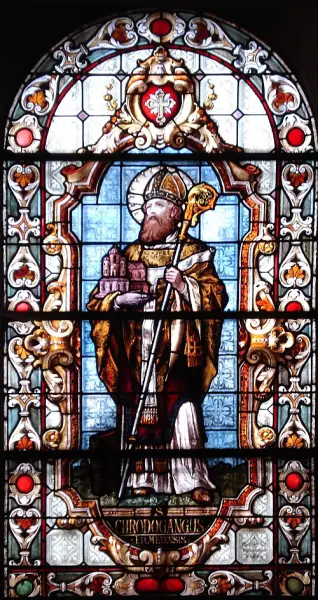
- Pallium of an archbishop·Bishop's crozier·Model of Gorze Abbey
- Canonization
- Pre-congregation; recognized as a saint in the Catholic Church and the Orthodox Church.
Prayer
Bibliography
Show 8 sources
- Arduino, Fabio. "San Crodegando di Metz", Santi e Beati, March 8, 2007
- Mershman, Francis. "St. Chrodegang." The Catholic Encyclopedia Vol. 3. New York: Robert Appleton Company, 1908.
- Butler, Alban. The Lives of the Saints. vol. III, 1866
- Monks of Ramsgate. "Chrodegang". Book of Saints, 1921. CatholicSaints.Info.
- Claussen, M.A., The Reform of the Frankish Church: Chrodegang of Metz and the Regula Canonicorum in the Eighth Century, Cambridge University Press, 2004, ISBN 9780521839310
- "Saint Chrodegang". New Catholic Dictionary. CatholicSaints.Info.
- Drout, Michael D. C. "Re-Dating the Old English Translation of the Enlarged Rule of Chrodegang: The Evidence of the Prose Style." The Journal of English and Germanic Philology, vol. 103, no. 3, 2004, pp. 341-368. JSTOR
- Langefeld, Brigitte. "The Rule of Chrodegang and Archbishop Wulfred's reforms at Canterbury", Anglo-Saxon England, vol. 25, Cambridge University Press, 1997
Profile text adapted from the Wikipedia article, licensed CC BY-SA 4.0.
Pray with this saint every day
Save St. Chrodegang to your favorites, read the full profile, and get feast-day reminders in the Saints app.
Get the Saints AppFree on the App Store for iPhone and iPad