
c. 560 – before 634
St. Chrodoara
Merovingian Noblewoman and Benefactress of Amay
Overview
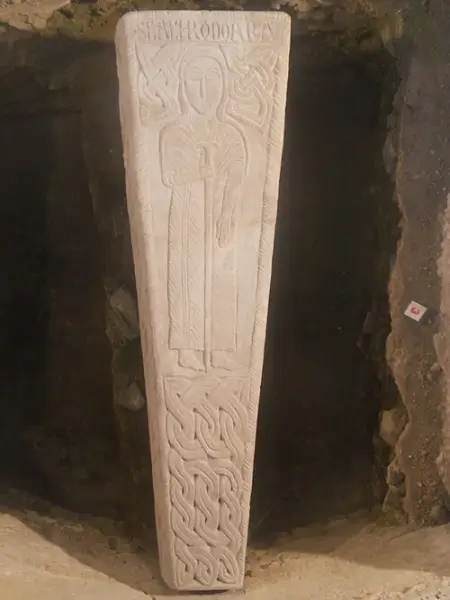
Chrodoara was a Merovingian noblewoman of the late sixth and early seventh centuries, thought to have been born around 560 in Swabia. She was probably married to Bodegisel-Bobo, a son of Mummolin of Soissons, and if so was widowed around 589. On her husband's death she left the world of Frankish aristocratic marriage and moved to Amay, on the Meuse in present-day Wallonia, where she gave her money and her days to the service of the church and to almsgiving. She is traditionally regarded as the foundress of an abbey at Amay, the house that survives today as the Collegiate Church of Saint George and Saint Ode. Later genealogies make her the mother of Bishop Arnulf of Metz and, two generations on, an ancestor of Plectrude, who married Pepin of Herstal, though the evidence for these connections is too late to be relied upon. She died sometime before 634 and was buried in the Church of Saint George at Amay. Her cult re-emerged in 1977, when restoration work in the church choir brought her stone sarcophagus back to light; carved on its lid as an abbess holding a staff, although she appears to have been a patron and benefactor of the abbey rather than its abbess. From the eleventh century the name Ode or Oda, attached to the church, has been identified with Chrodoara herself.
The Complete Life
A Swabian Noblewoman in the Frankish World
Chrodoara entered history through the fragmentary records of the Merovingian aristocracy, and nearly everything about her early life must be read through probabilities rather than certainties. Her birth is placed around 560 in Swabia, the region of the upper Danube from which several Frankish noble families traced their descent. Her marriage, likewise probable rather than certain, joined her to Bodegisel-Bobo, a son of Mummolin of Soissons, a union that would have placed her within the network of families that served the Frankish kings in both war and administration. If this reconstruction holds, she was widowed around 589, still a young woman by the standards of the age. Later medieval writers pressed her further into genealogy, declaring her the mother of Bishop Arnulf of Metz, one of the most influential bishops of the early seventh century, through whom she would be grandmother either to Hugobert or to his consort Irmina of Oeren, and thus great-grandmother to Plectrude, the powerful wife of Pepin of Herstal. Modern historians caution that the evidence for these connections is too late to be relied upon, yet the very existence of such traditions shows how dearly the Carolingian era wished to root its saints in the older Merovingian nobility, and Chrodoara's name stood at the head of that desired lineage.
§ Chrodoara
Widowhood and the Founding of Amay
The death of Bodegisel-Bobo around 589 became the hinge of Chrodoara's life. Widowed and wealthy, she did what a number of Merovingian noblewomen did before and after her: she left the orbit of aristocratic marriage and turned her fortune toward religion. She moved to Amay, a town on the Meuse in what is now Wallonia, and in that town she gave her fortune and her days to the church and to almsgiving. Tradition names her the foundress of an abbey at Amay, the community whose church stands today as the Collegiate Church of Saint George and Saint Ode. Her role, so far as the evidence allows us to judge, was that of patron and benefactor rather than ruler: the sarcophagus carved for her shows a woman in the habit and with the staff of an abbess, yet scholars conclude that she apparently never held that office. The distinction matters. In her world, founding and endowing a religious house was itself a form of vocation open to women of rank, a way of converting an inheritance into an institution. Chrodoara's gift created a centre of prayer and charity on the Meuse that would serve the region for centuries, and it earned her a burial within the church she had endowed, in the place of honour reserved for founders.
§ Chrodoara
The Sarcophagus and the Name of Ode
Her death fell sometime prior to 634, and her grave was made in the Church of Saint George at Amay. Her memory then passed through the peculiar transformations of medieval cult. From the eleventh century the church carried a second name, Ode or Oda, and that name has been identified with Chrodoara herself, so that the foundress came to be venerated under a title that belonged to a later age. The most dramatic chapter came in 1977, when restoration work in the choir of the Collegiate Church of Saint George and Saint Ode brought to light a stone sarcophagus recognised as hers. Its cover is one of the rare contemporary images of a Merovingian holy woman: she is shown in the dress of an abbess, a staff in her hand, a portrayal that both preserves her memory and complicates it, for the staff seems to claim an office she likely never held. The discovery, published and debated by scholars of Merovingian archaeology, returned Chrodoara from the obscurity of genealogical legend to the status of a documented person, a widow of the late sixth century whose generosity built a house of God at Amay. The church she endowed still stands in Wallonia, Belgium, and keeps her sarcophagus, so that the woman who gave her wealth to the church now rests at its centre, visible to all who come.
§ Chrodoara
Timeline
- 560
Born around this year in Swabia.
§ Introduction
- 589
Probably widowed about this year; her husband is thought to have been Bodegisel-Bobo, son of Mummolin of Soissons.
§ Introduction
- 634
Died sometime before this year and was buried in the Church of Saint George at Amay.
§ Introduction
- 1000
From about the eleventh century the church at Amay bore the name Ode or Oda, identified with Chrodoara.
§ Introduction
- 1977
Restoration work in the choir brought her sarcophagus to light; its cover shows her robed as an abbess with a staff.
§ Introduction
The Record
- Major works
- Traditional foundation of the abbey at Amay, now the Collegiate Church of Saint George and Saint Ode
- Symbols
- Depicted as an abbess holding a staff·Merovingian noblewoman's dress
- Canonization
- Pre-congregation; venerated traditionally as a saint and foundress at Amay.
Prayer
Bibliography
Show 4 sources
- Freddy Van Daele, "La Dame du Sarcophage", Alfred Van Daele, Hosdent-sur-Mehaigne, 2012
- Stiennon, Jacques (1979). "Le sarcophage de Sancta Chrodoara à Saint-Georges d'Amay: Essai d'interprétation d'une découverte exceptionnelle". Comptes rendus des séances de l'Académie des Inscriptions et Belles-Lettres. 123 (1): 10-31.
- Gutierrez, Ricardo (August 7, 1995). "CHRODOARA, LA MEROVINGIENNE D'AMAY". Le Soir.
- Brubaker, Leslie; Smith, Julia, eds. (2004). Gender in the Early Medieval World: East and West, 300-900. Cambridge University Press. ISBN 0-521-81347-6.
Profile text adapted from the Wikipedia article, licensed CC BY-SA 4.0.
Pray with this saint every day
Save St. Chrodoara to your favorites, read the full profile, and get feast-day reminders in the Saints app.
Get the Saints AppFree on the App Store for iPhone and iPad