
4th century – 406/407·Feast December 2
St. Chromatius
Bishop of Aquileia and Friend of the Church Fathers
Overview
Chromatius, who died around 406 or 407, was bishop of Aquileia, the great Roman port and ecclesiastical metropolis of northern Italy. Probably born at Aquileia, he lost his father in infancy and was raised by his mother together with a large group of older siblings. Ordained a priest of the church of Aquileia in 381, he took part that same year in the small Synod of Aquileia organized by Ambrose of Milan, and after the death of Valerianus in 388 he became bishop of the see. He grew to be numbered among the most celebrated prelates of his generation and kept an active correspondence with Ambrose, Jerome, and Tyrannius Rufinus. It was Chromatius who baptized Rufinus, and he served as something of a guide to the younger scholar. A scholarly theologian himself, he pressed his friends toward learned work: he encouraged Ambrose's exegetical writing, prompted Jerome's translations of Paralipomenon, Tobit, and the books of Solomon and commentaries on Habakkuk, and helped pay for Jerome's labours. In the fierce quarrel that divided Jerome from Rufinus over Origenism he rejected Origen's doctrines yet laboured to make peace, keeping communion with Rufinus and steering him toward the translation of Eusebius. He opposed Arianism with zeal and rooted it out of his diocese, supported John Chrysostom in his unjust oppression, and wrote to Emperor Honorius on Chrysostom's behalf, though the intervention proved fruitless. As an exegete he was long known for seventeen treatises on Matthew and a homily on the Eight Beatitudes; in 1969 Henri Lemarié brought to light and printed thirty-eight further sermons. His feast is kept on 2 December.
The Complete Life
An Orphan of Aquileia
Chromatius probably first saw the light at Aquileia itself, the great city at the head of the Adriatic whose ruins still stand near modern Grado and whose bishopric, in the fourth century, carried the weight of a metropolitan see for the whole of northern Italy. He grew up there, in a household marked early by loss: his father died while Chromatius was still an infant, and the boy was raised by his mother together with a large group of older siblings, a family circle in which an orphan's upbringing depended on the piety and solidarity of many hands. Of his mother the records say nothing more, but the shape of the household may be read in the man he became, a bishop remembered above all for his capacity to gather, encourage, and reconcile. Aquileia in his youth was a church of consequence. Its cathedral had been the seat of bishops who confronted emperors, and its position on the roads between Italy, Illyricum, and the East made it a crossroads of ideas, peoples, and controversies, above all the Arian dispute that filled the century. A boy of ability raised in such a city, in a family large enough and faithful enough to rear him in the scriptures, had before him the whole stage of the late antique church. When in due course he entered the clergy of his native city, he did so as one formed from within its life, not called in from outside, and Aquileia would remain the centre of his labours until his death around 406 or 407.
§ Career
Priest at the Synod, Bishop of the See
The year 381 was decisive for Chromatius's public vocation. He was ordained a priest of the church of Aquileia, and in the same year he took part in the small Synod of Aquileia that Ambrose of Milan convened, the gathering at which the western bishops, with Ambrose presiding, pronounced on the Arian leaders of the day and strengthened the Nicene cause in Italy. To be present at such an assembly so early in his priesthood marked Chromatius as a man trusted by his bishop and noted by his province. His own elevation followed within the decade: on the death of Valerianus in 388 the church of Aquileia received Chromatius as its bishop. The see he inherited was among the most important in the western church, and he filled it so well that his contemporaries counted him one of the most celebrated prelates of the age. His episcopate was above all relational. He kept an active correspondence with Ambrose of Milan, with Jerome, and with Tyrannius Rufinus, the three most formidable Latin writers of his generation, and he stood to each of them not as an admirer but as a friend and equal. It was he who baptized Rufinus, and he served as something of a guide to the learned monk; toward Jerome he acted as patron and instigator, helping to finance his work. In an age when bishops were becoming the principal patrons of Christian learning, Chromatius used his office and his means to set scholars to their tasks.
§ Career
Defender of the Faith and Peacemaker
Two causes framed Chromatius's public mission as bishop. The first was the struggle against Arianism, the doctrine that subordinated the Son to the Father and had for decades divided the church with the help of imperial favour. Chromatius opposed it with much zeal and, the record states, rooted it out in his diocese, so that the ancient metropolitan see stood firmly on the Nicene side under his government. The second cause was the defence of John Chrysostom, the archbishop of Constantinople whose brilliance as a preacher was matched by the enemies his reforms made at court. When Chrysostom was unjustly oppressed, Chrysostom, Chromatius stood by him with unwavering support and addressed a letter on his behalf to Honorius, the Western emperor, who passed it on to his brother Arcadius in the East. The intervention proved of no avail, and Chrysostom died in exile; but the attempt itself shows the reach of Aquileia's bishop, able to address the imperial college on behalf of a colleague he would never meet. Closer to home, Chromatius worked as a peacemaker in the fierce quarrel that divided Jerome from Rufinus over the legacy of Origen. He himself rejected the doctrines of Origen of Alexandria, yet he refused to let theological disagreement destroy friendship and communion: he kept Rufinus within the church's communion and persuaded him to leave Jerome's final attack unanswered, turning his pen instead to fresh literary work, above all the translation of the Ecclesiastical History of Eusebius that later ages would treasure.
§ Career
A Scholar of the Gospel
Chromatius was active as an exegete, and it is as an interpreter of Scripture that his own voice survives. Down to modern times scholarship recognized only seventeen treatises as his, on the Gospel according to Matthew, covering portions of chapters three and five and six, together with a fine homily on the Eight Beatitudes which editors have counted as an eighteenth treatise. These works reveal a bishop who preached through the Gospel verse by verse, feeding his people on the Sermon on the Mount, the Beatitudes, and the baptism of the Lord, the passages where the mercy of Christ is set out most plainly. The scale of his achievement became clear only in the twentieth century: in 1969 the researcher Henri Lemarié brought to light and printed thirty-eight sermons beyond the treatises long known, a recovery that transformed Chromatius from a minor name in patristic bibliographies into a substantial witness of late fourth-century northern Italian preaching. His spirituality, so far as these texts show it, was that of a pastor-scholar: learning in the service of the liturgy, correspondence in the service of friendship, and money in the service of books. He urged his celebrated friends toward learned work, encouraged Ambrose to write exegetical works, and prompted Jerome's translations and commentaries. For Chromatius, the intellectual labour of the church was itself a spiritual discipline, a way of honoring the Word made flesh by searching the words that witnessed to him.
§ Career
The Close of a Celebrated Episcopate
The last years of Chromatius's life were shadowed by the misfortunes of the church he loved best after his own. John Chrysostom, the archbishop of Constantinople whose cause he had taken up, was driven from his see and hounded to death in 407, and Chromatius lived to see his letter to Honorius fail of its purpose, the Western plea powerless before the factions of the Eastern court. Jerome and Rufinus, the two friends he had tried to hold together, remained unreconciled, though Rufinus, at his urging, had turned from polemic to the translation of Eusebius, a quiet victory of pastoral wisdom. At home the diocese of Aquileia was quieter than it had been when he received it: Arianism, which he had opposed with zeal, had been rooted out of his territory, and the see stood secure in the Nicene faith. He continued to rule his church among the most celebrated churchmen of his day, the correspondent of Ambrose until that father's death in 397, and thereafter the senior figure among the Latin churchmen of northern Italy. Chromatius died around 406 or 407, leaving the church of Aquileia at the height of its prestige. Within a few years the Gothic invasions would sweep over his city and drive his successors to the lagoons of Grado and Venice, but the work he had built in two decades of episcopate, in doctrine, in learning, and in the communion of the churches, endured the ruin that followed.
§ Career
A Church Father Restored to the Church
The memory of Chromatius has passed through two lives: a long obscurity and a modern restoration. To the generations between the middle ages and the twentieth century he was a name attached to seventeen treatises on Matthew and a homily on the Beatitudes, quoted in the Patrologia Latina and known chiefly to specialists. The critical editions of the twentieth century changed that. Étaix and Lemarié produced his Opera for the Corpus Christianorum, Lemarié and Tardif published his sermons in two volumes in the Sources Chrétiennes series in 1969 and 1976, and in 2018 Thomas P. Scheck made a substantial body of his preaching available in English as Sermons and Tractates on Matthew in the Ancient Christian Writers series. Pope Benedict XVI devoted a catechesis to him, and the calendars of both the Catholic and the Eastern Orthodox church keep his feast on 2 December. He is honoured as a Church Father, listed among the saints who shaped the doctrine and devotion of the early church. His distinctive gift to later ages is his example of learned peaceableness: a bishop who rejected Origen's errors yet would not break with the man who defended them; a champion of Nicene orthodoxy who financed the scholarship of his opponents' friends; a patron who set Ambrose and Jerome to work and turned Rufinus from quarrelling to translating. In an age of embittered controversy, Aquileia's bishop proved that firmness of faith and breadth of charity could govern one church together.
§ Career
Timeline
- 381
Ordained a priest of the church of Aquileia and takes part in the small Synod of Aquileia organized by Ambrose of Milan.
§ Career
- 388
Succeeds Valerianus as bishop of Aquileia on the latter's death, entering correspondence with Ambrose, Jerome, and Rufinus.
§ Career
- 407
Dies around this year, closing an episcopate that made him famous throughout the church of his day.
§ Introduction
- 1969
Researcher Henri Lemarié discovers and publishes thirty-eight of his sermons, beyond the seventeen Matthew treatises long known.
§ Career
The Record
- Major works
- Seventeen treatises on the Gospel according to Matthew·Homily on the Eight Beatitudes·Thirty-eight sermons discovered and published by Henri Lemarié in 1969
- Symbols
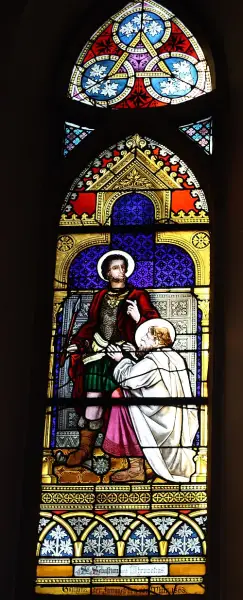
- Bishop's vestments·Gospel book·St. Sebastianus and St. Chromatius depicted together in art
- Canonization
- Pre-congregation; honoured as a Church Father and saint in the Catholic and Eastern Orthodox churches.
Prayer
Bibliography
Show 7 sources
- "St. Chromatius", Catholic Encyclopedia, www.newadvent.org
- "St. Chromatius", FaithND
- Chromace d'Aquilée, Sermons I-II, Paris 1969, 1971 (Sources Chrétiennes 154, 164)
- Raymond Étaix, Joseph Lemarié (edd.): Chromatius Aquileiensis Opera. 2 vols., Brepols, Turnhout 1974-1977 (CCSL IX A)
- Joseph Lemarié (ed.), Henri Tardif (transl.). Sermons, tome I: 1-17 (SC 154). Éditions du Cerf, 1969.
- Chromatius of Aquileia. Sermons and Tractates on Matthew, translated and introduced by Thomas P. Scheck, 2018 (ACW 75).
- Herbermann, Charles, ed. (1913). "St. Chromatius". Catholic Encyclopedia. New York: Robert Appleton Company.
Profile text adapted from the Wikipedia article, licensed CC BY-SA 4.0.
Pray with this saint every day
Save St. Chromatius to your favorites, read the full profile, and get feast-day reminders in the Saints app.
Get the Saints AppFree on the App Store for iPhone and iPad