
died c. 304·Feast November 24
St. Chrysogonus
Roman knight, martyr of Aquileia, teacher of Anastasia
Overview
Chrysogonus, honored in Italian as San Crisogono and in Croatian as Krševan, was an early Christian martyr of Aquileia. Holy tradition remembers that he served the Roman army as a knight, held office under the vicarius Urbis, and taught the Christian faith to Anastasia, whose father was the noble Roman Praetextatus. When the persecution of Diocletian broke over the Church, the emperor offered him the prefecture of a province in exchange for abandoning Christianity; he declined, was imprisoned in Rome, and from his cell cheered the afflicted Anastasia by his letters. Brought at the emperor's order to Aquileia, he was condemned to death and beheaded, his body cast into the sea and washed ashore, where the aged priest Zoilus buried it. His name appears in the Martyrologium Hieronymianum on 31 May and 24 November with the note in Aquileia, and his veneration passed very early from that city to Rome, where a titular church in Trastevere bears his name, first recorded at the Roman Synod of 499. A sixth-century legend made him a Roman and bound his story to that of Saint Anastasia. He is named in the Communicantes of the Roman Canon, is patron of Zadar, and is celebrated by Catholics on 24 November and by the Orthodox on 22 December with his spiritual daughter.
The Complete Life
A Knight of the Roman Army
The man whom the Church would honor under a name meaning a dear or precious birth, formed from the Greek words for gold and for birth, served first another master. Holy tradition remembers Chrysogonus as a knight serving in the Roman army, holding office under the vicarius Urbis, that officer of the city's administration, ranked among the armed servants of an empire that would one day kill him. Alongside his military and civil duties he carried another charge: instructing in the Christian faith young Anastasia, child of the noble Roman Praetextatus, and forming her in the belief for which both of them would afterward be venerated as martyrs. Some ancient testimony styles him a bishop of Aquileia before the persecution, and the earliest records tie him firmly to that Adriatic city. His life thus spanned the two worlds of late antiquity, the military machinery of Diocletian's empire and the quiet house-churches where the noble daughters of Rome were instructed in the Gospel, until the day came when the two worlds collided and he was made to choose between them.
§ Saint Chrysogonus
Refusal, Prison, and the Sword
When the persecution of Diocletian broke out, the emperor himself tested the Christian knight. In exchange for abandoning Christianity, Diocletian offered Chrysogonus the prefecture of a province, wealth and rank set against conscience. The offer was refused, and the refusal cost him his freedom. Thrown into prison, he turned his captivity into a ministry of consolation: from his cell he wrote letters to Anastasia, his severely afflicted spiritual daughter, strengthening her in the faith across the distance that separated them. By the emperor's order he was brought to Aquileia, condemned to death, and beheaded, the legend placing his death on 23 November during the persecution that raged from 303 to 311. His corpse was thrown into the sea, but the waves carried it back to land, where the aged priest Zoilus, himself venerated as patron of Zadar, buried it with honor. There at Aquileia the faithful of the region venerated the martyr publicly from the beginning, gathering in his honor from the first generation after his death. He remains one of the company of confessors whose blood, the Church believed, watered the faith rather than drowning it, and whose tombs became the seed of the churches raised above them.
§ Saint Chrysogonus
From Aquileia to the Roman Canon
Devotion to the Aquileian martyr crossed at a very early date to Rome, where a titular church in Trastevere carries his name. The Titulus Chrysogoni shows up first among the signatories of the Roman Synod of 499, though the building itself is probably older, reaching back to the fourth century. Whether it was founded by a certain Chrysogonus and only later devoted to the martyr of the same name, in the manner in which the cult of Saint Anastasia of Sirmium was transplanted to Rome, or whether it was consecrated to him from the beginning, no record now decides. About the sixth century a legend arose that made the martyr a Roman and joined his story to Anastasia's, explaining the Roman church that honored him. The Catholic Church keeps his feast on 24 November, recalling the day that church was consecrated; the Eastern Orthodox celebrate him on 22 December, joining him to his spiritual daughter. His name stands in the Martyrologium Hieronymianum on 31 May and 24 November with the note in Aquileia, and, dearer than any record, it is invoked at every Mass in the Communicantes of the Roman Canon, where the Church venerates his memory among the saints and asks to be defended by their merits and prayers. He is likewise the patron of Zadar, where he is honored as Krševan.
§ Saint Chrysogonus
Timeline
- 23 Nov 304
According to the legend, condemned by Diocletian at Aquileia and beheaded, the legend placing his death on 23 November.
§ Saint Chrysogonus
- 499
The Titulus Chrysogoni at Rome made its first appearance among the signatures of the Roman Synod of that year.
§ Saint Chrysogonus
In Their Own Words
In communion with the whole Church, they venerate above all others the memory of the glorious ever-virgin Mary, Mother of our God and Lord, Jesus Christ, then of blessed Joseph, husband of the Virgin, your blessed Apostles and Martyrs, Peter and Paul, Andrew, James, ... Chrysogonus, John and Paul, Cosmas and Damian and all your Saints: grant through their merits and prayers that in all things we may be defended by the help of your protection.
The Record
- Patron of
- patron of Zadar
- Symbols
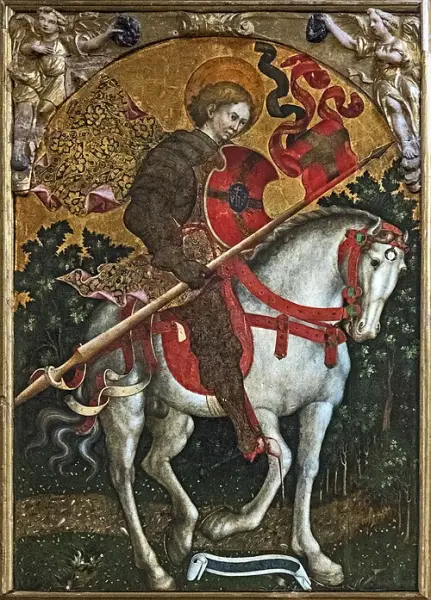
- bearded young man dressed as a Roman military officer
- Canonization
- Pre-congregation martyr, venerated since antiquity in East and West
Prayer
Bibliography
Show 6 sources
- Herbermann, Charles, ed. (1913). "Saint Chrysogonus". Catholic Encyclopedia. New York: Robert Appleton Company.
- Martyrologia Hieronymianum, ed. De Rossi; Duchesne in Acta SS., Nov. II.
- Duchesne, "Notes sur la topographie de Rome au moyen age", Mélanges d'archéologie et d'histoire, VII, 227.
- De Rossi, "Inscript. christ.", II, 152, N. 27, "Bulletino di archeol. crist.", 1887, 168.
- Martyrologium Romanum, Libreria Editrice Vaticana (2001). ISBN 88-209-7210-7.
- Foley, Leonard. "Sts. Cosmas and Damian", Saint of the Day (revised by Pat McCloskey OFM), Franciscan Media.
Profile text adapted from the Wikipedia article, licensed CC BY-SA 4.0.
Pray with this saint every day
Save St. Chrysogonus to your favorites, read the full profile, and get feast-day reminders in the Saints app.
Get the Saints AppFree on the App Store for iPhone and iPad